Anchor roller as a Gennaker mounting point?

VandKoala

Active Member
Joined
10 Jul 2023
Messages
60
Visit site
Would it be a good idea to attach a Gennaker on a sturdy anchor roller that has been welded onto the bow with a (welded) support tube from the bottom?
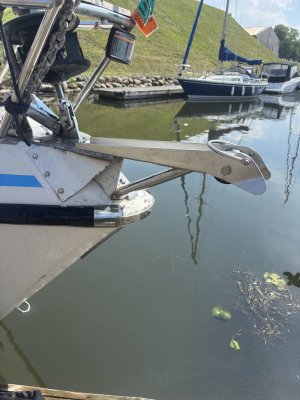
att.I8vzDY55nq5SdRDMOodl1dOMCtIUdfyNGYoqii4QvWQ.jpeg
 
My anchor roller is on a stainless assembly which has a hole drilled in the side of the “trough “ in which the chain runs out. I have a quick release sail coupling attached through this hole and use it to secure the foot of my cruising chute. The coupling is kept out of the way of the anchor and chain by the spinnaker halyard.
I use a 1m length of rope at the foot of the spinnaker to keep its foot above the pulpit.
I will be at the boat next week and can send a picture if you want
 
My anchor roller is on a stainless assembly which has a hole drilled in the side of the “trough “ in which the chain runs out. I have a quick release sail coupling attached through this hole and use it to secure the foot of my cruising chute. The coupling is kept out of the way of the anchor and chain by the spinnaker halyard.
I use a 1m length of rope at the foot of the spinnaker to keep its foot above the pulpit.
I will be at the boat next week and can send a picture if you want
I would appreciate the picture, thanks a lot!
 
That is easily strong enough. Ours is on the end of a 45mm carbon pole with a bobstay to the U bolt on the stem, and side stays to the ama tips. It’s 80sq m, I daresay your anchor fitting is stronger than that.
 
That is easily strong enough. Ours is on the end of a 45mm carbon pole with a bobstay to the U bolt on the stem, and side stays to the ama tips. It’s 80sq m, I daresay your anchor fitting is stronger than that.
Cheers. It looks really strong. I tried kicking/pushing and jumping on it in different ways and it is not moving at all. I will try it out on our next crossing.
 
It all looks over engineered to me,

Why not use the existing structure as the support for a dedicated prodder for a gennaker, but retaining the existing bow roller for, dedicated, anchoring.

If you want ideas how to make better use of what you have - establish a new thread (that's what PBO is for).

Jonathan
 
It all looks over engineered to me,

Why not use the existing structure as the support for a dedicated prodder for a gennaker, but retaining the existing bow roller for, dedicated, anchoring.

If you want ideas how to make better use of what you have - establish a new thread (that's what PBO is for).

Jonathan
But it is - an existing structure, the bow roller is retained like this to support a 25kg Rocna Vulcan without hitting the hull. And it is a new thread asking if this could also work as a gennaker attachment point :)
 
Last edited:
A Gennaker can exert a lot of vertical stress on a fitting and I like to see a vertical tang or internal brace to counter it.

I look at the photo and - yes its definitely grossly overengineered - BUT for anchoring. Any load UP will be using the lengthy of the fitting as a lever multiplier.

Therefore my question is : Apart from the external pipe and the welding to the stemhead plate. What vertical form is there to counter the load the Gennaker will put on it internally ?

To be honest - I would be looking to use the forestay point instead as that should have internal stiffening to counter vertical loads.
 
A Gennaker can exert a lot of vertical stress on a fitting and I like to see a vertical tang or internal brace to counter it.

I look at the photo and - yes its definitely grossly overengineered - BUT for anchoring. Any load UP will be using the lengthy of the fitting as a lever multiplier.

Therefore my question is : Apart from the external pipe and the welding to the stemhead plate. What vertical form is there to counter the load the Gennaker will put on it internally ?

To be honest - I would be looking to use the forestay point instead as that should have internal stiffening to counter vertical loads.
There are stainless steel backing plates for both the plates on the top and the angled-plate that the pipe is welded to.
Forestay point is definitely stronger as it has a vertical thick SS “chainplate” going through the deck and attached through the lower hull part as well. And the hull is at least 8cm thick fiberglass at that point. I will check for vertical “pull”, thanks.
 
My point about vertical ... is based on years of checking out boats in UK and other locations.

For years - boats had tangs down the stem to take the vertical loads while wide deck plates spread the transverse and longitudinal. Then it seemed like designers moved away from the tangs and relied on the wide deck plates and an overalapping turn edge round the deck to hull joint. It was not uncommon to find evidence of lift or compression of backing plates under deck.

I would then advise client to look at having a vertical tang added.
 
Top
