Anchor chain marker colour combinations.

My approach, and I'm not saying it is perfect, but it has worked for me, is to fit small bright yellow cable ties at 5m intervals. I know I won't be using only 5m of chain, but I like knowing how much is left to bring up when raising anchor. I have one tie at 5m, two ties at 10m, three ties at 15m etc. I find this system very easy as the amount of chain is the number of ties multiplied by 5. Occasionally one pops off, but it is super easy to spot, and super easy to add a replacement.
similar here but with short pieces of cord. 1 knot 5m, 5 knots 25m, start again at 1 knot but with another bit string at 30m . Been working fine for years & can tell by feel in the dark. This thread has been done many times for years as well ?
 
This thread has been done many times for years as well ?
Yep this one is originally from 2010, we should re-open all "chain markers" threads of the past 12 years to insert again one's own messages, so that each thread is complete with the full forum views and people do not need to jump from a chain marker thread to the other risking to skip vital pieces of information. :)
 
similar here but with short pieces of cord. 1 knot 5m, 5 knots 25m, start again at 1 knot but with another bit string at 30m . Been working fine for years & can tell by feel in the dark. This thread has been done many times for years as well ?
Why struggle in the dark. Turn the deck lights on?
 
I did wonder when reading the knowledgable comments above whether the first consideration for many might be where they carry out most anchoring. If you tend to want to anchor in say 3m even if you carry 60m of chain isn’t it the low levels needed. If you put out 4x depth say that’s not much of your chain supply used most of the time.
 
Why struggle in the dark. Turn the deck lights on?
good to have the option of not ruining night vision pulling the chain up. The post is what happens and works on one boat over many years , everyone else can do as they see fit. And tell everyone else they are doing it all wrong....... ??
and.. must be very very few times the system came in useful in the dark, but enough times over the years to be useful & not change anything.
 
Last edited:
Having never needed to re-galvanise chain ... I shall stay with my paint ....

If it ever got to re-galvanise chain .... then I'm sure I will find ways to clean up the chain .... but as I say - I have no intention so far.
Tie your chain to the tow ring on the back of your car and drag along a beach (or road) it will clean up your chain pronto. If you have 100m maybe dragging it as one length is not a good idea. Make one length into 4 shorter lengths and you only have 25m out on the road, or beach, behind you.

Jonathan
 
I've learned that paint wears off and that paint is so tenacious it makes re-galvanizing impossible. It can't be both.

a. Paint wears off some, but I can still see it at least as well as plastic bits, both or which get covered in mud. I suspect mud vs. sand is a factor in which works better.
b. The economics of re-galv chain are so poor around here (US east coast) it is never done anyway, so not a factor.
 
I am bemused and indeed amused by the idea of towing your anchor chain along a beach behind a vehicle. If this is such a good method of removing paint from the chain, how come a boat doesn't do exactly the same? At anchor, if the boat yaws around, any chain in contact with the ground will be subjected to the same treatment. Of course it does, but any paint on the inside protected parts of the links, is not worn off. Why would towing behind a vehicle be any different?
 
Don't fancy hanging onto the forestay, stretching to a foot switch and looking over the bow for a b***y (in our case 'approved sized') anchor. Seeing a prominent mark at 2m wins - even at night, or early morning (helps that the marks are yellow, the chain almost black and the use of a head torch).

These are the marks - they wear on the outside of the 6mm chain but are retained on the inside of the links. No problems with paint if you use Thermal Diffusion Galvanising - grit blasting is part of the process and our HT chain was supplied for TDG (galvanising) painted (as are all lifting chains), grit blasted and galvanised - without questions. Our chain has a minimum galvanising coating of 100 microns - at least 30% more than most HDG chains. The vertical portion of the chain is the 2m mark.

View attachment 143417

No chance of fingers in the windlass - its under the deck.

The door mats allow the chain to drain. The door mats have small pimples underneath. The locker slopes aft and has 2 x 1" drain holes

This is the feed to the windlass (through the hawse hole, bottom left) - You would need long legs to use the foot switch and stretch to look over the bow to even see a b***y big anchor, let alone one of a normal size, over the cross beam. Marks are easily seen on the 'U' shaped beam. Its just as difficult a stretch with your foot on the switch and access the windlass - simultaneously - no danger with fingers in windlass.

View attachment 143418
The 8kg aluminium anchor is retained on passage using the hook and the short, green, dyneema strop. All tension taken off the windlass when on passage. We use the strop as the back up for the rode when at anchor should the bridle fail. The clip for the bridle to the chain is to the right, the triangular device with the slot (for the chain) and the two halyard knots at the end of the climbing rope bridle. The shackle with the orange shackle pin is a 10t shackle with a 2t WLL from Campbell in the US

There is no right way to complete many tasks - its what suits you, is sensible and safe.

Take care, stay safe

Jonathan
That's one of the reasons that we don't use a foot switch. A hand held switch gives the operator much more freedom.
 
I've learned that paint wears off and that paint is so tenacious it makes re-galvanizing impossible. It can't be both.

a. Paint wears off some, but I can still see it at least as well as plastic bits, both or which get covered in mud. I suspect mud vs. sand is a factor in which works better.
b. The economics of re-galv chain are so poor around here (US east coast) it is never done anyway, so not a factor.
Yes, paint will be worn off the outer parts of the links, but will survive for much longer on the inner protected parts. Re-galvanising of chain in Scotland is readily available. If there is paint on the chain, it will have to be grit blasted off, leading to increased expense.
 
That's one of the reasons that we don't use a foot switch. A hand held switch gives the operator much more freedom.
I think it depends on the layout of your foredeck. We have had both remote wired, wireless and foot switches. For our deck layout the foot switches are the only ones we use now. They are perfectly positioned for ease of use. They have been fantastically reliable as well
 
I think it depends on the layout of your foredeck. We have had both remote wired, wireless and foot switches. For our deck layout the foot switches are the only ones we use now. They are perfectly positioned for ease of use. They have been fantastically reliable as well
We’ve got both foot switches and wireless remote but use the foot switches nearly all the time.
 
I am bemused and indeed amused by the idea of towing your anchor chain along a beach behind a vehicle. If this is such a good method of removing paint from the chain, how come a boat doesn't do exactly the same? At anchor, if the boat yaws around, any chain in contact with the ground will be subjected to the same treatment. Of course it does, but any paint on the inside protected parts of the links, is not worn off. Why would towing behind a vehicle be any different?

You should try it and then you will not be bemused.

I can hang chain off our transom from our cat on a swing swing mooring, hung so that the chain is constantly abraded and remove the gal in about 6 weeks - this is chain that would normally last 1,000 days at anchor. Its an accelerated test. Dragging chain along a beach is the same, except paint is softer than gal. Dragging the chain rams sand between and into the links - and it cleans. Instead of the grit being thrown at the chain, the chain is being thrown at the grit.

Most gal is about 70 microns and lasts on chain about 4 years, 1,000 -1200 days at anchor. Paint is less abrasion resistant and not particularly well adhered. Gal is alloyed to the underlying steel. Paint does not last long - which is why it is not used to protect anchor chain.

So though chain is dragged over the seabed and there is abrasion its not quite as aggressive as driving along a beach dragging the chain behind you. The technique also removes rust and leaves the chain, that has rusted, as bright steel.

I would not use the technique to drag the chain through water - it will do the underside of your car no good - and the seawater will act as a lubricant, reducing abrasion.

Jonathan
 
You should try it and then you will not be bemused.

I can hang chain off our transom from our cat on a swing swing mooring, hung so that the chain is constantly abraded and remove the gal in about 6 weeks - this is chain that would normally last 1,000 days at anchor. Its an accelerated test. Dragging chain along a beach is the same, except paint is softer than gal. Dragging the chain rams sand between and into the links - and it cleans. Instead of the grit being thrown at the chain, the chain is being thrown at the grit.

Most gal is about 70 microns and lasts on chain about 4 years, 1,000 -1200 days at anchor. Paint is less abrasion resistant and not particularly well adhered. Gal is alloyed to the underlying steel. Paint does not last long - which is why it is not used to protect anchor chain.

So though chain is dragged over the seabed and there is abrasion its not quite as aggressive as driving along a beach dragging the chain behind you. The technique also removes rust and leaves the chain, that has rusted, as bright steel.

I would not use the technique to drag the chain through water - it will do the underside of your car no good - and the seawater will act as a lubricant, reducing abrasion.

Jonathan
I have no need or desire to drag chain along a beach. I don't paint my chain. ?
 
I have no need or desire to drag chain along a beach. I don't paint my chain. ?

Norman,

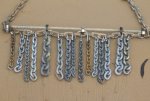
Here is my test rig to measure gal abrasion rates. The rig is allowed to hang between the 2 transoms such that it rubs on the seabed whatever the state of tide, tides are a max of 2m. The seabed is silica sand, quartz, quite abrasive. This is a test after one week and the gal is all still intact. I leave rubbing on the seabed for a week, retrieve, wash, weigh and then re-set - and repeat. I've conducted the test, different combinations - and get the same results. It seems a fair test but accelerated.

We paint our rode and renew.

IMG_7585.jpeg

I have included Thermal Diffusion Galvanising, Hot Dipped Galvanising, 'black' chain and chains of different sizes but galvanised with the same process. One chain, 5th from the left a 12mm I have spray painted with yellow paint. The chain on the far right has been zinc coated, sort of a pale, metallic yellow (its a Transport Chain)..

TDG is the most abrasion resistant (Viking Anchor will offer TDG coated anchors sometime in the future - some people read Practical Sailor and take note, they try, reconfirm and then believe). Size does not matter, a 6mm chain loses its gal as quickly, or as slowly, as a 10mm chain. The thicker the gal the longer it lasts, surprise, surprise. But paint and black chain, 6th from the left, simply does not last.

The life of the gal, its thickness and the process used (TDG or HDG) determines the life of your chain. In the chandler shiny gal lasts no longer than dull gal - its all about thickness and then looking after your chain.

Its interesting, at least to me, that the uncoated chains, far left and the black chain rust and the rust remains intact even though the chains are being abraded constantly. Eventually this is what happens when your gal is worn off.

You will also note that the yellow painted chain has lost the paint from within the links. The movement of the links one over the other in combination with the sand acts as a good scourer. Hence the beach pull process (I don't make these things up :) ).

Jonathan
 
Last edited:
Yes, paint will be worn off the outer parts of the links, but will survive for much longer on the inner protected parts. Re-galvanising of chain in Scotland is readily available. If there is paint on the chain, it will have to be grit blasted off, leading to increased expense.
When BE Wedge still ran their chain galvanising line their practice was to run painted chain through the molten zinc bath without first passing it through the acid bath. This burnt all paint off prior to going through the full process and added 50% to the cost.

It also created huge plumes of smoke and was surely highly environmentally-unfriendly.
 
Having never needed to re-galvanise chain ... I shall stay with my paint ....

If it ever got to re-galvanise chain .... then I'm sure I will find ways to clean up the chain .... but as I say - I have no intention so far.

With the price of galvanising these days its probably cheaper to buy new chain!
 
Norman,

Here is my test rig to measure gal abrasion rates. The rig is allowed to hang between the 2 transoms such that it rubs on the seabed whatever the state of tide, tides are a max of 2m. The seabed is silica sand, quartz, quite abrasive. This is a test after one week and the gal is all still intact. I leave rubbing on the seabed for a week, retrieve, wash, weigh and then re-set - and repeat. I've conducted the test, different combinations - and get the same results. It seems a fair test but accelerated.

We paint our rode and renew.

View attachment 143466

I have included Thermal Diffusion Galvanising, Hot Dipped Galvanising, 'black' chain and chains of different sizes but galvanised with the same process. One chain, 5th from the left a 12mm I have spray painted with yellow paint. The chain on the far right has been zinc coated, sort of a pale, metallic yellow (its a Transport Chain)..

TDG is the most abrasion resistant (Viking Anchor will offer TDG coated anchors sometime in the future - some people read Practical Sailor and take note, they try, reconfirm and then believe). Size does not matter, a 6mm chain loses its gal as quickly, or as slowly, as a 10mm chain. The thicker the gal the longer it lasts, surprise, surprise. But paint and black chain, 6th from the left, simply does not last.

The life of the gal, its thickness and the process used (TDG or HDG) determines the life of your chain. In the chandler shiny gal lasts no longer than dull gal - its all about thickness and then looking after your chain.

Its interesting, at least to me, that the uncoated chains, far left and the black chain rust and the rust remains intact even though the chains are being abraded constantly. Eventually this is what happens when your gal is worn off.

You will also note that the yellow painted chain has lost the paint from within the links. The movement of the links one over the other in combination with the sand acts as a good scourer. Hence the beach pull process (I don't make these things up :) ).

Jonathan
Having established with your experiments that paint disappears after one week of contact with the sandy bottom, I find it totally illogical that you still find that paint is your preferred method of marking your chain. However, it's your choice, so do whatever you like.
By the way, painting on newly galvanised steel in any situation is not recommended. It should always be allowed to weather for a period.
 
Having established with your experiments that paint disappears after one week of contact with the sandy bottom, I find it totally illogical that you still find that paint is your preferred method of marking your chain. However, it's your choice, so do whatever you like.
By the way, painting on newly galvanised steel in any situation is not recommended. It should always be allowed to weather for a period.

And you have tried this on TDG?

The crystalline structure is acicular, paint adheres well (or at least better) - which is why TDG is preferred for painting road signs. The primary business of the TDG process in Australia is ..... guess what?

Why did they build a TDG processing operation - but to service their own primary business.

The US Navy, US Marines (both for chain), suppliers to wind farms, manufacturers of studs for roof support in underground mining, water treatment facilities, rail maintenance, nails for nail gun supplies (to name but a few) all specific TDG for unique reasons - there is galvanising and galvanising.

Hot Dipped Galvanising and Thermal Diffusion Galvanising are different operations. The processes are very different as are the outcomes.


I have no financial interest inTDG but it is a new process, is not well known but a process that has potential and might benefit from a greater airing. Thank you for the opportunity mention it..

Jonathan

Jonathan
 
Last edited:
Top