Anchor chain marker colour combinations.

Why not follow ships practice ?

The 'shackles' are marked by counting links from the shackle and painting the links.

I avoid cable ties - boy do they hurt if you catch one badly ! Second Markers tend to get lost ... soft material gets torn off in use ...

My system ...
I measure 'Anchor out' .. this means anchor is not included in the measurement.
Each metre - I paint the number of metres with first of the counted painted link as the mark - white.
At 10m - I paint the 10m link a single red. Nothing else.
Then its red link + white links per number ie 13m = 1 red + 3 white.
At 20m - I paint two red links etc. etc.

Nothing fancy ... a couple of spray cans of Hammerite.

The point is to try and have a system that basically anybody can quickly grasp and understand without need for a picture card or list etc.

I was going to base on fathoms - but decided to give in to modern day thinking !!
 
We mark 2m from the anchor - then when you retreive you know when to expect it to arrive at the bow roller and thus do not ram the anchor into the roller, straining the windlass. We mark at 10m intervals (anchoring might be a science - but no-one has defined the science - so accuracy to 10m should be fine). We mark 2m from the bitter end - then you know when you have run out of chain. We calculate what scope we will be using, its always 5:1 or more and then deploy to the next 10m mark (so if we need 35m - deploy to 40m). It would be a one off if an anchorage is so crowded we cannot use 'our' scope.

We too have a code for the 10m marks - as mentioned earlier it is written into the chain locker cover (so I don't need to remember what it is :) ). We use yellow paint AND thin cable ties, which are friendly to the hand, and replace as they get worn off. It does not matter what you use, they will wear and are environmentally unfriendly. You could use strips of fabric - but as the fabric is very likely to be a synthetic or blend its no better/worse than paint or a thin cable tie. Paint does wear but remains 'inside' the links - the yellow paint does stand out against the dark gal.
If you have a small yacht 10m marks might be excessive - use 5m marks.

Anchoring is meant to be both easy and part of the pleasure of being on the water - its not rocket science - relax.

Jonathan
 
IMHO...

There is no need to mark the first 15-20 meters, since you will never deploy less than that (some marking just before the anchor breaks the surface).

No more frequent than every 10 meters. Is it not trivially easy to estimate between the marks (or 20 or 25 feet in the US, to make for easy math)? Is it that critical?

I like to minimize marks, because this keeps the system simpler. I very seldom get past the second mark (30 meters).

----

If you are in the US navy...

1663886498353.png

1663886516495.jpeg
 
I use black and yellow cable ties (small ones). I swear by cable ties - never cut them or there will be jagged edges. Once in a blue moon one needs replacing.
Yellow is 10 and black is 5 or 50. (never put out less than 20m imho).
10m 1x yellow 20m 2x yellow 25m 2x yellow 1x black etc so 40m is 4x yellow and 50m is 1x black 60m is 1x black 1x yellow etc etc 80m is 1x black 3x yellow. This works for me and it is easy to see at night with a head torch or deck light. I think Ix black at 5m is a good idea to warn of anchor coming up and will add that.
 
IMHO...

There is no need to mark the first 15-20 meters, since you will never deploy less than that (some marking just before the anchor breaks the surface).

No more frequent than every 10 meters. Is it not trivially easy to estimate between the marks (or 20 or 25 feet in the US, to make for easy math)? Is it that critical?

I like to minimize marks, because this keeps the system simpler. I very seldom get past the second mark (30 meters).

----

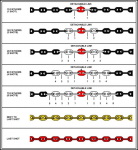
If you are in the US navy...

View attachment 143401

View attachment 143402

What you show is standard Merchant Navy marking ... its not particular to US Navy .... the only US Navy specific item is the use of the term 'shot' instead of the more common term 'shackle' ....

As Cadet .... spent many a mind-numbing hour painting anchor chain ....
 
I use small cable ties lose not cut. Every 5 mts . Red white blue. Then 2red 2 white 2 blue. Then ihope u guessed it 3 red etc . Works for me
 
What you show is standard Merchant Navy marking ... its not particular to US Navy .... the only US Navy specific item is the use of the term 'shot' instead of the more common term 'shackle' ....

As Cadet .... spent many a mind-numbing hour painting anchor chain ....
Agree re use of ‘shackle’. It’s the term the RN uses as well.
 
Why is a, specific, length of chain called a shackle when a shackle has been used for centuries as a word to describe an item to secure something (like an anchor to a chain, or a convict with leg irons). As far as I am aware commercial ships don't deploy 100m nor 200 fathoms of chain - they deploy, say, 10 shackles. A shackle being 15 fathoms or 90'. To further confuse a chain is 22 yards (or a cricket pitch) or 100 links or 4 rods - which I recall using (the chain) in survey work.

So historically a chain as a unit of measure had an accepted definition (on land), a shackle also had a meaning (in a prison) - why did the marine industry set up to confuse....?

OI suspect there are more ships in the American navy, than the UK navy - so why is shackles the 'common' term? I think the merchant navy is now dominated by Chinese ships - I wonder what term they use, shot or shackle. 'Shot' is hardly obvious either.

Jonathan
 
Agree re use of ‘shackle’. It’s the term the RN uses as well.

Why is a, specific, length of chain called a shackle

Its easy to understand use of "shackle" .. as each 15fth is a shackle. Easy to understand as person in charge of anchoring on the focsle .... you count the rode out by the number of painted shackles you see ...

The only other matter is whether Master decides 'in the water' or 'out the pipe'. That is - whether you bury that shackle below water surface or just see it out of the hawse.

ie ..... 6 in water ..... or ..... 6 out the pipe ... etc.
 
Last edited:
If you paint your marks on the chain, you will find it much more complicated (and expensive) to get it re-galvanised. I use cable ties, always in pairs, so that if one falls off, and needs replaced, I know where to put it. On our boat, with an electric windlass, nobody puts a hand near the chain, so no danger of cuts from cable ties. I have found no need to have a mark close to the anchor, as a warning that the anchor will shortly appear. The windlass control on our boat is operated from the foredeck, and if you can't see a b****y great anchor approaching, you're not going to see a mark!
 
We have tried everything to mark the chain. Those little coloured markers were the least reliable. They just fell out where the chain touched bottom. We tried painting the chain but that just wears off. Our current system that definitely wins on durability is cloth markers. We make up strips of coloured cloth and place them at 10m intervals by threading them through the chain and knotting them. They are about 100mm long so easily spotted. We tie two at each marker point and carry spares so if we lose one we can add another as the chain comes up. I don't care what colour they are as long as they are different. We have a whiteboard in the nav station with the colours/chain length marked on. Easily visible from the cockpit.
 
I use blue green red and yellow cable ties every 5m., doubling and tripling as they are repeated. As for the sequence, just set alphabetically in relation to the first letter of the colour.
 
A standard used in yachting industry is….
Red, Yellow, Blue, White, Green
Rub Your Balls With Grease
Then repeat if needed
I’ve worked in ‘The yachting industry’ for years and the only thing I’m convinced of is that there is no standard. Not sure where you get the idea from that your colour code and slightly crude aide memoire is standard?

You can buy sets: Force 4 Anchor Chain Markers | Force 4 Chandlery

Those of a sensitive disposition can Read Your Books With Grace, if they prefer not to grease their bearings, though why you would think that greasing the balls in a bearing was crude, I can't imagine!

One of the things about standards is that there are so many to choose from.
 
I have found no need to have a mark close to the anchor, as a warning that the anchor will shortly appear. The windlass control on our boat is operated from the foredeck, and if you can't see a b****y great anchor approaching, you're not going to see a mark!

Don't fancy hanging onto the forestay, stretching to a foot switch and looking over the bow for a b***y (in our case 'approved sized') anchor. Seeing a prominent mark at 2m wins - even at night, or early morning (helps that the marks are yellow, the chain almost black and the use of a head torch).

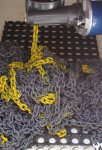
These are the marks - they wear on the outside of the 6mm chain but are retained on the inside of the links. No problems with paint if you use Thermal Diffusion Galvanising - grit blasting is part of the process and our HT chain was supplied for TDG (galvanising) painted (as are all lifting chains), grit blasted and galvanised - without questions. Our chain has a minimum galvanising coating of 100 microns - at least 30% more than most HDG chains. The vertical portion of the chain is the 2m mark.

IMG_0472.jpeg

No chance of fingers in the windlass - its under the deck.

The door mats allow the chain to drain. The door mats have small pimples underneath. The locker slopes aft and has 2 x 1" drain holes

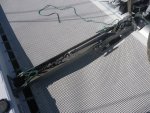
This is the feed to the windlass (through the hawse hole, bottom left) - You would need long legs to use the foot switch and stretch to look over the bow to even see a b***y big anchor, let alone one of a normal size, over the cross beam. Marks are easily seen on the 'U' shaped beam. Its just as difficult a stretch with your foot on the switch and access the windlass - simultaneously - no danger with fingers in windlass.

IMGP5245.jpeg
The 8kg aluminium anchor is retained on passage using the hook and the short, green, dyneema strop. All tension taken off the windlass when on passage. We use the strop as the back up for the rode when at anchor should the bridle fail. The clip for the bridle to the chain is to the right, the triangular device with the slot (for the chain) and the two halyard knots at the end of the climbing rope bridle. The shackle with the orange shackle pin is a 10t shackle with a 2t WLL from Campbell in the US

There is no right way to complete many tasks - its what suits you, is sensible and safe.

Take care, stay safe

Jonathan
 
My approach, and I'm not saying it is perfect, but it has worked for me, is to fit small bright yellow cable ties at 5m intervals. I know I won't be using only 5m of chain, but I like knowing how much is left to bring up when raising anchor. I have one tie at 5m, two ties at 10m, three ties at 15m etc. I find this system very easy as the amount of chain is the number of ties multiplied by 5. Occasionally one pops off, but it is super easy to spot, and super easy to add a replacement.
 
Having never needed to re-galvanise chain ... I shall stay with my paint ....

If it ever got to re-galvanise chain .... then I'm sure I will find ways to clean up the chain .... but as I say - I have no intention so far.
 
Marks at short lengths are useful when retrieving the anchor, I have one at about 3m to indicate when the anchor is just below the water, when it's windy and there are pther boats around it tells me I can jump back to the cockpit to maneuver, the anchor won't damage anything and can be brought on deck and secured at a later moment. I have another mark at 7m where I attach the end of the tripping line (if used), then marks at 10m and so on.
Ex. if weighing anchor in say 4m depth the chain goes vertical bar tight at the 7m mark... problem problem :)
 
Top