analogue autohelm 1000 help?

Hello Erik,

Just came back from vacation in Italy and read your post.
Please drop me a PM with your email-address and I'll send you the PDF.

Regards, Hans (Dutch sailor :-)
 
Whilst I realise this is a VERY old thread, I thought that the following information may be useful to both Ranger26 and anyone else.

I have one of these old units and the switch fell apart.
They are made by a company called LORLIN and have part Number CK1051 RS Components and Farnell sell them, but they have a minimum order.
If you just need one switch try here:http://www.ebay.co.uk/itm/LORLIN-CK...OS-/181208909075?ssPageName=ADME:L:OC:GB:3160

For the sake of a fiver, some Chemical Metal (to repair the brass bush inserts) and some time, I now have a working Autohelm 1000!!
Good luck with any repairs you make, it seemed a shame to scrap the unit for the sake of some time and effort!!

TW, looking at Ralphs picture, does the brown main power wire on the multi plug look like there is copper wire showing? Perhaps that's why his unit was faulty?
Also many thanks to Hans for the details on the unit and the schematic diagrams, very helpful!!

Thank you all for the previous posts, they have been very, very helpful.

Helpful in getting my Autohelm 1000 case opened, and in knowing what to expect once open.

I was hoping the string would be broken, as that would have been fixable. But the string is just fine. And the innards all look in excellent condition.

The unit just won't do anything, like it is dead. I checked the power and it is getting to the motherboard. I put 12volts to the motor, and it runs (in and out, no problem). Then I thought - faulty switch!

Took that apart, and had ball bearings shot at me, and a spring take a leap at freedom! It too looks in good condition, and unlikely to have been broken - before now.

What else could I be missing???
Are there any other tests I can do??
Any motherboard type tests??
Any ideas what could be the problem??

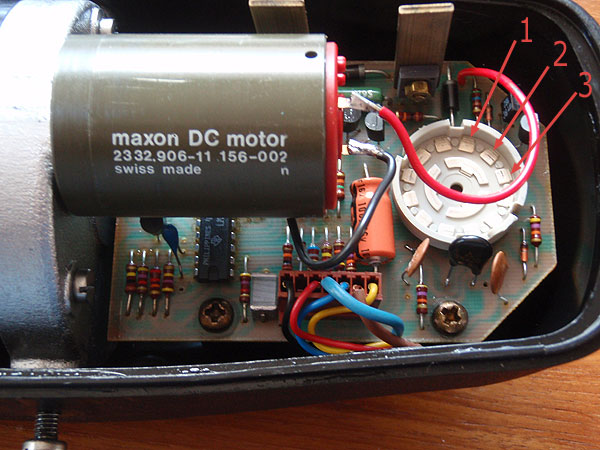
And now that I've screwed up the switch, I need to know which connections under the switch are the the ones to 'use'??? There are 12 "tabs" around the switch, and I do not know which ones are the active ones (for: calm, rough, vane, & off)? In the picture below I labelled 3 of them - as points of reference.

AP_innards-1.jpg


The autopilot used to work, and then one day it didn't work, and hasn't worked since. The day it didn't work, I noticed the control arm was in the fully retracted (in) position (after opening the unit I unscrewed the control arm, so it is not stuck now - but may have been??).

Anyone got any ideas???

In desperation,
Ralph.
 
Last edited:
i ended up replacing the transistors in mine to get it working some time ago, equivalents are available. but the string came off few months ago, so many thanks for the above instructions
 
i ended up replacing the transistors in mine to get it working some time ago, equivalents are available. but the string came off few months ago, so many thanks for the above instructions

Glad to be of help regarding the string. The instructions were modified as this thread developed. In case others want to have a go, the correct and hopefully final versions are in post #13 and post #15.
 
Thanks for the switch info. I have a unit with its switch in bits, hopefully this will save me a lot of time and aggravation.

John
 
help received, but more required!

Thank you all very much for the detailed info and pictures in this thread.
After my tiller pilot AUTOHELM 800 fully extended and tried to continue, I have opened the unit and flipped the switch open. (big disaster)!!! I thought. But thanks to the info and links provided by this thread I managed to get the switch back in and it works as it did before I took it apart.
Now my question to the ones who had theirs in a similar or even equal state: How did you get yours fixed???

The tiller pilot does not retract the rod, it only extends to its maximum and beyond, where it than jams and only by holding the spindle tied, the rod can be screwed back in. The cord is still ok and in the right order around the turns.
When I turn the tiller pilot as if the boat is changing course, the unit either tries to fully extend or does nothing (stops) if I turn it the other way. But not like before on the boat that it retract and than by the swinging of the boat extract again to compensate the change in course.
Is it possible that one of the power transistors has lost it and now the remaining one gives all the power in its direction only?
How can I test this? Without any diagrams of where the different electronic bits are shown, Is there a diagram of this circuit board out there somewhere?

Eventhou its winter, in my area I can still sail once in a while. The tiller pilot really comes in handy.
I think what happend was that I heaved to and had the tiller lock with the tillerpilot in end position. When I changed the sheets and started to sail again, the tiller pilot jammed and never got right again.

Thanks again for the help.


Winny
 
Last edited:
Re: help received, but more required!

It is already a very old thread but I have put some interesting info on our site. How to modify the pilot from Starboard to Portside. Some info about opening the unit and a description about a remote control. Site is in Dutch. However, Google translate is your friend.
Regards, Hans
http://www.virtualware.nl/techniek/autohelm-1000/
 
I realise this is an old thread. Having tried all the tips on this forum to repair my Autohelm 1000 (analogue), the problem seems to be pointing to the photoresistors (LDR) in the compass, which look fried. Does anyone know the spec of these photoresistors? I have measured the size (6.5x5.5x2mm) but seems to be difficult to find on internet. The circuit diagram doesn't show any detail about the compass and its components. Any help appreciated
 
Re: help received, but more required!

It is already a very old thread but I have put some interesting info on our site. How to modify the pilot from Starboard to Portside. Some info about opening the unit and a description about a remote control. Site is in Dutch. However, Google translate is your friend.
Regards, Hans
Autohelm 1000 - Jouet Sheriff

WOW that is the REALLY old Autohelm ..... but many still working ! I expected to see the later analogue AH before Raymarine took them over to produce the ST series.

TorLanal.jpg


I love my AH ... I have the 800 and the 1000 ..... cannot imagine being without. I also have the wired remote ... lead is long enough I can stand at mast ...

What I would like to see - is someone design an interface to connect the 'pulse ' AH to the NMEA0183 of a Plotter .... the old Z interface - I had one and like many people, could never get it to work. Its away somewhere in a box in the barn ... maybe should find it and see if anyone could use it to design a better unit ?
 
I realise this is an old thread. Having tried all the tips on this forum to repair my Autohelm 1000 (analogue), the problem seems to be pointing to the photoresistors (LDR) in the compass, which look fried. Does anyone know the spec of these photoresistors? I have measured the size (6.5x5.5x2mm) but seems to be difficult to find on internet. The circuit diagram doesn't show any detail about the compass and its components. Any help appreciated
I think you will have to do it by trial and error unless you can read the resistance of the remaining LDR. It is used as a switch so the actual value may not be too critical and LDRs are very cheap to buy and experiment with a few. I would not expect them to be fried but more likely corroded. If you get it working again it is worth spraying the PCB with lacquer to protect it (obviously masking off the sliding contact tracks)
Some here: LDR, and here CPC

If you plug a stereo 1/4" jack into the windvane input you should be able to get the motor to drive both ways by shorting the inputs as the windvane just has a couple of reed switches to do the switching. The connections are probably jack shaft to tip and shaft to collar but I would have to check for you. If that works correctly then you are probably right that you have a compass problem.
 
I think you will have to do it by trial and error unless you can read the resistance of the remaining LDR. It is used as a switch so the actual value may not be too critical and LDRs are very cheap to buy and experiment with a few. I would not expect them to be fried but more likely corroded. If you get it working again it is worth spraying the PCB with lacquer to protect it (obviously masking off the sliding contact tracks)
Some here: LDR, and here CPC

If you plug a stereo 1/4" jack into the windvane input you should be able to get the motor to drive both ways by shorting the inputs as the windvane just has a couple of reed switches to do the switching. The connections are probably jack shaft to tip and shaft to collar but I would have to check for you. If that works correctly then you are probably right that you have a compass problem.

Thanks @andsarkit, I think you are right with the trial and error and yes they are cheap. I tested the remaining LDR and its given me 857 ohms in darkness or daylight (this one's clearly busted too). The one I removed gives zero ohms all the time. So am still in the dark about what resistance they are supposed to be (excuse the pun). So trial and error it is! Thanks for the tip about the lacquer and the LDR links. Also thanks for the tip about the wind vane input, I hadn't tried that and I have a few 1/4" jacks lying around. This is a great forum!
 
Better than Lacquer - is Corrosion X ..... designed for electronics etc.
This is the sort of lacquer I have used but unless you are involved in electronics I doubt you would have it to hand.
1677352407300.png 1677352629330.png
Corrosion X looks good but I don't know if it would creep onto the sliding contact tracks and insulate them.
I am surprised that all marine electronics does not have some sort of conformal coating as the salt environment will eventually get in and cause corrosion.
 
Reporting back on progress: The error was indeed the photoresistors (aka LDRs). I replaced them with cheap 5539 LDRs from ebay. The swap out was quite simple with a bit of soldering. The new LDRs are much smaller but they still work. It was the first ones I tried. Once I've lacquered the sensitive parts and replaced those awkward bolts holding the casing closed I will get some time on the water and report back. Also had to open the selector switch which had a rattle inside...loose springy connectors inside. Couldn't put it back together. Had to solder the switch into 'rough' mode, took a while to figure that switch. If anyone needs a switch diagram let me know. I'll be replacing it later with the CK1051 from Lorlin which is what it is apprently. Thanks to all for the tips, and testing the machine through the vane input is a great way to test if its working in the first place.
 
This is truly an ancient thread! I'm currently trying to fix my analogue AH1000. It worked, then worked intemittently, now just 'pulses' rod move fractionally. Already replaced the rotary switch which is a CK1051, confirmed by Lorlin. There's an ebay dealer selling singles. I have the AH1000 circuit diagram if anyones after it.
 

Other threads that may be of interest

Top