Alternative Lifting Keel Mechanism

JumbleDuck

Well-Known Member
Joined
8 Aug 2013
Messages
24,165
Location
SW Scotland
Visit site
My Hunter 490 has a lifting keel: a steel plate about 1' long, 3' deep and 3/4" thick with a 250lb lump of cast iron on the bottom. It is raised and lowered by a stainless strop which goes up, through the mast support post and then down to a Dutton-Lainson brake winch which holds in intermediate positions without a pawl. This system is a pain for several reasons:

  • The winch handle sticks out and forms a significant obstruction in a tiny cabin
  • The winch is very stiff to turn, particularly when lowering as the brake has to be overcome
  • The sheaves - standard Holt-Allen ones - are not up to the force in the strop, which is around 500lb
I now have an incentive to do something about it, as one of the sheaves popped out of the mast support when I was lifting the keel yesterday and the strop did a nice imitation of a cheesewire on the wood. Easily repairable, but surely improvable.

At the moment I am thinking of a multi-part block and tackle, either to the deckhead or to a crane built out the necessary inch or two from the top of the mast support. However, there is only about 4" clearance above the keel when it is raised, so it may be difficult to fit a suitable tackle in. I'm also thinking of a deck mounted winch or of replacing tthe current strop with two, running over cheek blocks beside the support post and then pulled down by a block and tackle.

Any bright ideas would be gratefully received. Hydraulics?

Incidentally, the original system is almost identical to that on the Anderson 22, which is in many respects a large Hunter 490.
 
Back in the days when I threw myself off mountains we used a piece of dinghy kit called a 'Powerbox' to pull back on some internal tubing and flatten out the hang glider wing.

It was in effect a 12 to 1 block and tackle and had a built in jam cleat. The stroke might not be long enough but it is a light and simple solution.
 
Wasn't the dinghy device called a musclebox? I think the problem with that would be the length of movement needed to raise the keel.
I have a similar dilemma with my keel winch - whose name escapes me just now. It is a common piece of kit with 2 handles. I wondered about simply unhooking it when the boat is in the water and the keel is down. Then a moments work to rehook it when I need to lift the keel.
 
Clearly if you stick to wire proper wire sheaves are esential. You could replace the winch with a trailer type which is a ratchet system which would deal with your friction problem. The problem I see with hydraulics is that the distance you would lift the eel with each stroke is likely to be very small, just think of a car jack.
 
Drill the keel 12mm hole from the top, almost to the bottom, weld a nut on the top to take a 3' high tensile M10 bolt. A clearance hole at the mast support and a couple of washers and you can screw the keel up and down as you like (about 900 turns top to bottom)

Ok, drilling a 3' long hole dead straight has its own set of giggles, but has been done. M10 high tensile can take more than 70,000N, more than enough.

Nahh, daft idea, but now that I've written it...
 
I always think the lifting mechanism on my boat is just about perfect.

It's a lead screw (enclosed) along the side of the keel box. It's 50 turns of the winch handle from end to end.

The "nut" on the screw pulls a stainless steel strop over a couple of pulleys to raise and lower the keel.

I can't see why this arrangement can't be applied to other lifting keels.

It has the advantage of being easy to raise and lower, and if you stop winding, the keel stops where it is. No need for a brake or a pawl or other safety mechanism.
 
Pro Dave,

yes but yours is a light keel, and pivoted I believe so there's very little load on the system; if you tried that on my vertically lifting 950lb job the worm drive handle might be a blurr as the keel went down and stayed there !

The system on the Anderson 22 is as Jumbleduck says very similar to his, with a few more sheaves; the Dutton Lainson winch IS a trailer winch, just braked - unlike say Witter versions which it looks very similar to.

I and others like it for its simplicity, which combined with the ballast bulb being veed on top to keep out stones and nasties, gives a reliability I haven't seen on other lift keelers.

The predecessor of the Anderson, the Hunter 701 had a very similar keel but hydraulically raised, which gave problems with seals, pipes etc.

I think Jumbleduck's main problem is interior space, but I agree with such a light keel there must be a way of using a multi-part pulley system, or possibly an electric motor as long as there's a manual backup.
 
Weston tackle?
Probably some sort of cascaded tackle would be best.
But maybe a folding handle on the winch would be a start?
Maybe a different brake mechanism, more like a ratchet block?
 
Pro Dave,

yes but yours is a light keel, and pivoted I believe so there's very little load on the system; if you tried that on my vertically lifting 950lb job the worm drive handle might be a blurr as the keel went down and stayed there !

My keel is far from light. It's lead encapsulated in GRP to give it a fin shaped keel, not a flat plate. The keel weighs 525lbs so not as heavy as yours, but still not a lightweight. And yes it pivots at the front.

The main point is as long as the pitch is fine, a worm drive mechanism is not back driveable.
 
Hmmm,

I know what you mean about worm drives being so down geared, but I wouldn't fancy one without a brake of some kind.

Incidentally the fibre brake on the winch I and Jumbleduck use ( probably different models ) is integral and doesn't normally show at all, and the handle is removable.

But your saying that makes me think; Jumbleduck, if you're reading this, is your DL winch handle removable ?

If not, maybe a different model DL winch might be the simplest answer.
 
Back in the days when I threw myself off mountains we used a piece of dinghy kit called a 'Powerbox' to pull back on some internal tubing and flatten out the hang glider wing.

It was in effect a 12 to 1 block and tackle and had a built in jam cleat. The stroke might not be long enough but it is a light and simple solution.

I've seen similar things which were, I think, a Haltrac hoist inside a casing. Neat, but I need to be able to pull the keel up two feet ...

Clearly if you stick to wire proper wire sheaves are esential. You could replace the winch with a trailer type which is a ratchet system which would deal with your friction problem. The problem I see with hydraulics is that the distance you would lift the eel with each stroke is likely to be very small, just think of a car jack.

My planned repair for the current system, if I repair, is to enlarge the slot in the support post and fit a single 4" diameter vertical sheave centrally, mounted on an axle supported by long stainless cheek pieces which will also reinforce the support.

A trailer winch wouldn't work, because I need to be able to lower 500lb of keel under control. Flicking off a ratchet pawl wouldn't be fun ...

I always think the lifting mechanism on my boat is just about perfect.

It's a lead screw (enclosed) along the side of the keel box. It's 50 turns of the winch handle from end to end.

The "nut" on the screw pulls a stainless steel strop over a couple of pulleys to raise and lower the keel.

I would very much like a picture or two of that, if you could manage it.

Many thanks for the ideas, gang. Please keep 'em coming.
 
Jumbleduck,

just checking; the handle on your Dutton Lainson winch IS removable isn't it ?

My original one had the whole longitudinal ( and 90 degree hand bit ) handle slotting on and off two pins; the replacement of the same model has the longitudinal part fixed, but the 90 degree bit easily removable with a stud & nut.
 
I would very much like a picture or two of that, if you could manage it.

Many thanks for the ideas, gang. Please keep 'em coming.

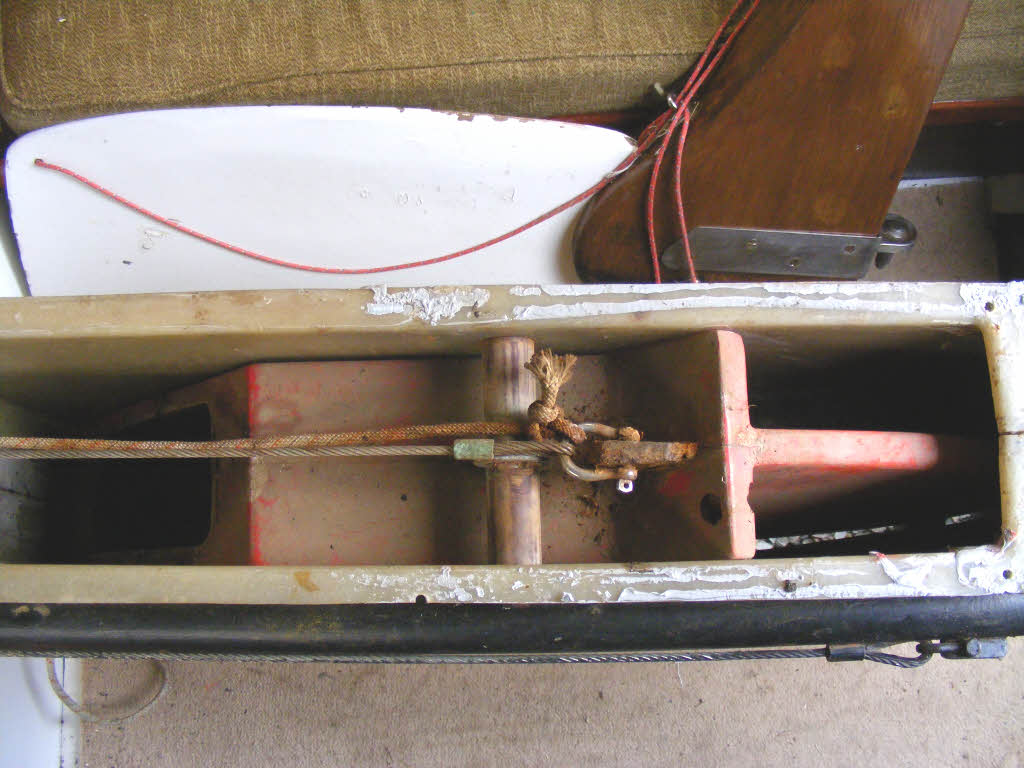
Keel box from above with table removed.

keel.jpg


the black tube along the bottom as seen in this picture is the leas screw enclosed inside a tube. The "nut" in this view is at the right hand end. the wire strop runs to the left, around 2 pulleys and into the keel box from the left. then over the pulley you see to the keel, seen here in the fully raised position.

Here's another view of the keel box with the table top in place and you can see the front of the lead screw where the winch handle goes on. I have just included a link rather than embeding the picture as it's a large image http://ardross.altervista.org/DSCF1061.jpg
 
Interesting thread so far; I have a Stag 28 with a lifting keel - really a big steel centreplate of about 320lbs, so not too heavy but shares the same issues. It is lifted by a trailer winch which is easy enough to use for lifting as it has a pawl, but letting it down means opening the locker to release the pawl and then winding it down under control which sometimes isn't the easiest. And if the removable handle slips off the winch spindle it goes down with a hell of a thump.

So far I'm pondering the possible use of of a worm drive winch inside the locker driven from a continuous rope loop in a handy position outside which might make it possible to raise/lower without faffing about with handles and locker lids...
 
Interesting thread so far; I have a Stag 28 with a lifting keel - really a big steel centreplate of about 320lbs, so not too heavy but shares the same issues. It is lifted by a trailer winch which is easy enough to use for lifting as it has a pawl, but letting it down means opening the locker to release the pawl and then winding it down under control which sometimes isn't the easiest. And if the removable handle slips off the winch spindle it goes down with a hell of a thump.

So far I'm pondering the possible use of of a worm drive winch inside the locker driven from a continuous rope loop in a handy position outside which might make it possible to raise/lower without faffing about with handles and locker lids...

Sounds like you have a Witter style unbraked winch; how about a Dutton Lainson braked model, to lower the keel I just turn the handle, if I stop the keel stops, and there's no load or impetus going down.
 
Sounds like you have a Witter style unbraked winch; how about a Dutton Lainson braked model, to lower the keel I just turn the handle, if I stop the keel stops, and there's no load or impetus going down.

That was my first thought, and would clearly be an improvement on what I have, but I would also like to achieve a few other things -
- the handle location isn't ideal, remote operation would be useful.
- the number of turns required from fully up to fully down is nearly fifty, although little effort is required. Doubling the effort and halving the turns would be good.
- pulling a rope standing up rather than turning a handle while kneeling would be preferred
 
Top