Ais vs marpa

MARPA is just a machine; garbage in, garbage out and all that. You have to use any machine for navigation with a grain of salt, understand its limitations and know how to interpret and verify the data. It has its uses.

 
The other thing that takes me by surprise, is boats that just aren't picked up. Although it's only a very few, one is enough (as the Condor tragically found out a couple of years ago). I've had one small open fishing boat and two small yachts that simply hadn't registered on the radar.

And at this stage, please don't get me on radar reflectors. Suffice it to say the only ones I've ever picked up in any of the tests we've done, are the active reflectors. Without an active reflector, I'm told the main reflecting surface from a yacht, is the hole it makes in the water.

Following this thread with great interest but couldn't reconcile the two statements above; if radar reflecters are so poor, how come there's only a very few yachts you haven't picked up on RADAR?
 
if radar reflecters are so poor, how come there's only a very few yachts you haven't picked up on RADAR?

Because he's seeing their masts, or their engines, or the hole in the water, or whatever it may be, with the reflectors making little difference either way.

Pete
 
I have radar and AIS but am not an expert in either. this thread has been interesting. I have to say that AIS has been convenient especially when passing major ports such as Belfast. You can see on the AIS whether the fast ferry has started its run well before you can see by eye. Since it seems to appear from nowhere and instill panic in all until its wash has passed and the ice in the G&T has settled, this advanced notice is appreciated.
The radar has been of great comfort also in very foggy conditions. When cruising round the Small Isles in thick fog and flat calm it was able to pick up the myriad of buoys that float in 100m waters. It also ganged up with the plotter as it kept telling me I was turning left while I kept thinking it was barmy and why does it keep saying turn to starboard. The radar confirmed the plotter's superior sense of direction and thus we puttered along without major incident.
They are aids, of course, and thus ultimate responsibility falls on the skipper to interpret them accurately. It is quite fun to fire them up and feel like you are the centre of RAF command during the war.
 
It also ganged up with the plotter as it kept telling me I was turning left while I kept thinking it was barmy and why does it keep saying turn to starboard. The radar confirmed the plotter's superior sense of direction

I've not done it (still getting used to the kit) but I can definitely see the appeal in overlaying radar over the chart on the plotter, in poor vis. That gives you the two independent sources of position a prudent navigator needs - if the GPS starts going quietly loopy, the chart and radar image will no longer line up.

Pete
 
feel like you are the centre of RAF command during the war.

:D
from the red glowing chart table in the night, some voices reach the cockpit in the strictest military procedure:

"target acquired"
"target acquired"


"rate of turn 15° to port"


"target ahead, friend or foe?"

target on visual, repeat target on visual

it's a seagull sir

:D
 
Yes, in the erie calm off Canna the odd flock of gulls raised temporary concern.

It is amazing how crippled your senses are when you lose sight on a boat. Your normal internal gyro seems to be pretty useless and, although my hearing is good, I don't fancy using it to check distances from rocks. Perhaps a good way of getting rid of all those random sized and slightly corroded screws that you gather up on board over the years. Fling them off the bow at regular intervals and when you don't hear a plop you are too close to land!
 
I am, quite frankly, surprised at all the replies on this post. I don't suppose anyone, who has posted a reply, has used MARPA or AIS in crossing a busy shipping lane in poor visibility with 2 people on board. If anyone bothered to look at the picture on the opening post, there are 7 ships present. The picture is cropped and there were 3 more going East. Taking out paper and plotting lines is simply not possible. Marpa, with acquisition of up to 10 targets, is quite good especially when the range is down to a mile or 2. AIS, from my first trial is better. Hasn't anyone else done a comparison. Surely I am not the only boat to cross the shipping lanes using both. I am looking for some tips on what collision ranges to use etc. With 2 miles on that picture you can see there were 4 ships in collision zones at the same time. How could it be handled better?
 
.....I don't suppose anyone, who has posted a reply, has used MARPA or AIS in crossing a busy shipping lane in poor visibility with 2 people on board. If anyone bothered to look at the picture on the opening post, there are 7 ships present....

I bet they have and you are going to hear about it quite soon:)


You may be worrying too much, the chances of 7 ships bumping into you are very small. It makes a dramatic picture but they are gone, or not coming your way
When shorthanded there is always a lot to fiddle with. I suggest you switch off one of the systems, on the grounds that you will be better able to give your full attention to what's left .
My pick would be the AIS with the guard zone set at 1 mile or less. Though I must own up that I know nothing at all about radar, except that it is impossible just to look at it and believe what you see.
 
I am, quite frankly, surprised at all the replies on this post. I don't suppose anyone, who has posted a reply, has used MARPA or AIS in crossing a busy shipping lane in poor visibility with 2 people on board.

Not quite a busy shipping lane - we were just approaching near to the eastern start/end of the Singapore TSS so the ships are going everywhere and Col Regs seem to get thrown out the window - albeit the radio is solid with ships talking to each other.

Poor visibility - well, not really, those big yellow blobs are tropical squalls - the lightning from one had just knocked out the AIS so we'd switched to MARPA.

The first time we'd used it in anger - and while it took a bit to get used to (I doubt target #4 is really doing 63 knots), working it with VRM/EBL gave us a good idea of which ships we need to keep a close eye on and which we didn’t.

The plots further away are all dodgy with the movement of Hinewai confusing the MARPA plots for speed -for example, target #2 going at over 50 knots but then it’s 14 miles away so not a worry. But you kept an especially close eye on those ships that looked like they were going to be closish when we closed all the electronics down as another squall rolled over us and you couldn’t even see the bow anymore.

And generally the MARPA was surprisingly good for these.

Like Target#1 - the closest, but safe - it's moved off the EBL, away from us, confirmed by the historic MARPA plot and direction line and looks like it should pass 2 miles or so ahead of us. Target #3 though, while it has also moved off the EBL is showing a totally different direction line to that expected from the plot. Doubtful it has actually changed course since it would give him a very close cross of T#1 - I'd guess they ended up passing green to green OK.

Yes, it was quite an interesting night for the two of us.

P9220119Copy_zps51db7099.jpg
 
I am, quite frankly, surprised at all the replies on this post. I don't suppose anyone, who has posted a reply, has used MARPA or AIS in crossing a busy shipping lane in poor visibility with 2 people on board. If anyone bothered to look at the picture on the opening post, there are 7 ships present. The picture is cropped and there were 3 more going East. Taking out paper and plotting lines is simply not possible. Marpa, with acquisition of up to 10 targets, is quite good especially when the range is down to a mile or 2. AIS, from my first trial is better. Hasn't anyone else done a comparison. Surely I am not the only boat to cross the shipping lanes using both. I am looking for some tips on what collision ranges to use etc. With 2 miles on that picture you can see there were 4 ships in collision zones at the same time. How could it be handled better?

I haven't used AIS yet, but am fitting it. I am more than a little familiar with ARPA, MARPA and rapid radar plotting. I would be hesitant to use AIS as my primary method of anti-collision, as it bases its calculations partly on your own supplied data, and partly on the data supplied by the other ship - there's no way for you to verify that the other operator has his system set up correctly. At least with radar you only have your own equipment and human errors to be concerned with. Following on from the ground-stabilised/sea-stabilised discussion, I would also be concerned that while your class B set will be ground-stabilised (taking course and speed from the GPS), class A units are required to have a compass/gyro-compass input, so the course data from the other ships might be sea-stabilised (or partly). I don't know enough about AIS to know if that is a concern, but I don't plan on using it for anti-collision. I will continue to use MARPA for anti-collision, and AIS to identify the contacts and confirm my situational awareness.

From your screen-shot, I can't tell the scale, but it clearly shows the CPA of each of the 4 contacts of concern and roughly puts them in the order that you "hit" them; if your MARPA was giving you similar information I think you might consider reducing the alarm range in heavy traffic to a mile or less, rather than turning down the volume. I might consider keeping MARPA at a close range scale (3 miles), and ranging the AIS out to get a heads up on the fast heavies. I think this would play to the relative strengths of the systems, but your experience might differ.
 
I would be hesitant to use AIS as my primary method of anti-collision, as it bases its calculations partly on your own supplied data, and partly on the data supplied by the other ship - there's no way for you to verify that the other operator has his system set up correctly.

This is true up to a point, but it's not as if the other ship has someone manually typing in its course and speed every five seconds, who might make the odd typo. AIS transmitters are required to have their own GPS receivers, so the crucial position, speed-over-ground and course-over-ground information is more or less independent of any action or omission by the crew. Yes, they regularly seem to forget to change the navigation status, so you get "anchored" ships proceeding up the Channel at 20 knots, or closing on the Nab Tower with a "next port of call" in Caracas, but those pieces of manually-entered data are only really of casual interest to yachts. It's the position, CoG and SoG that matter, and the black box manages those without crew input.

Following on from the ground-stabilised/sea-stabilised discussion, I would also be concerned that while your class B set will be ground-stabilised (taking course and speed from the GPS), class A units are required to have a compass/gyro-compass input, so the course data from the other ships might be sea-stabilised (or partly).

No, the gyrocompass provides the heading. The course over ground comes from GPS. Both are reported, so your receiver can display the data however it likes (for example it could present separate track and heading vectors out of the other ship, like you usually see out of your own on a plotter)

Pete
 
This is true up to a point, but it's not as if the other ship has someone manually typing in its course and speed every five seconds, who might make the odd typo. AIS transmitters are required to have their own GPS receivers, so the crucial position, speed-over-ground and course-over-ground information is more or less independent of any action or omission by the crew. Yes, they regularly seem to forget to change the navigation status, so you get "anchored" ships proceeding up the Channel at 20 knots, or closing on the Nab Tower with a "next port of call" in Caracas, but those pieces of manually-entered data are only really of casual interest to yachts. It's the position, CoG and SoG that matter, and the black box manages those without crew input.

Even so, if using AIS for collision avoidance you're basically relying on a CPA derived from the calculations from your own AIS box which is based on the information provided from your own box and those transmitted via VHF from another box on another ship, all of which potentially have multiple inputs and if any one of those multiple inputs and calculations are incorrect then the information spewed out by AIS is worthless. Compared to radar there's far more things to potentially go wrong.
 
Even so, if using AIS for collision avoidance you're basically relying on a CPA derived from the calculations from your own AIS box which is based on the information provided from your own box and those transmitted via VHF from another box on another ship, all of which potentially have multiple inputs and if any one of those multiple inputs and calculations are incorrect then the information spewed out by AIS is worthless. Compared to radar there's far more things to potentially go wrong.

They don't have "multiple inputs", they have a GPS receiver each. Which, yes, can suffer inaccuracies, but rarely do.

A radar system doing MARPA actually has more inputs - log paddle, fluxgate compass, perhaps a rate gyro, the rotary encoder that tells it which way the antenna is pointing at any given moment, perhaps some mounting offset, before we even get to the whole magnetron / reflecting target / receiver combination. And some of those inputs (particularly log and compass) are not just theoretically subject to inaccuracy, they regularly are inaccurate, to the point that knowledgeable people like Piers won't use them at all. It also requires a fair bit of operator skill, experience, and concentration.

The fact is that the two systems complement each other. AIS requires a certain amount of cooperation from your targets, but is highly accurate when it works, most of the time. Radar is less precise, but is self-reliant whatever the muppets on the other vessel are doing, and picks up the small fishing boats and (hopefully) yachts that don't have AIS (and it has navigational uses, but we're only considering collision avoidance here). Both are subject to technical faults and failures, but generally not in an interdependent way, so they back each other up.

That's why I have both :)

Pete
 
They don't have "multiple inputs", they have a GPS receiver each. Which, yes, can suffer inaccuracies, but rarely do.

Well actually it does, the AIS on my ship has an input from the gyro system and potentially the Loran-C (don't ask me how that works though), and, as a backup, the magnetic compass.

A radar system doing MARPA actually has more inputs - log paddle, fluxgate compass, perhaps a rate gyro, the rotary encoder that tells it which way the antenna is pointing at any given moment, perhaps some mounting offset, before we even get to the whole magnetron / reflecting target / receiver combination. And some of those inputs (particularly log and compass) are not just theoretically subject to inaccuracy, they regularly are inaccurate, to the point that knowledgeable people like Piers won't use them at all. It also requires a fair bit of operator skill, experience, and concentration.

You don't need any of those inputs if you're merely engaged in simple plotting, which will quickly give you an indication of CPA/TCPA (as we used to do in ye days before ARPA).

The fact is that the two systems complement each other. AIS requires a certain amount of cooperation from your targets, but is highly accurate when it works, most of the time. Radar is less precise, but is self-reliant whatever the muppets on the other vessel are doing, and picks up the small fishing boats and (hopefully) yachts that don't have AIS (and it has navigational uses, but we're only considering collision avoidance here). Both are subject to technical faults and failures, but generally not in an interdependent way, so they back each other up.

Speaking from personal experience, I would never, ever, rely on AIS for collision avoidance, nor use it as a backup; it's really there as a curiosity and early warning tool. The most sensible backup to Radar is compass bearings, whether they be via repeater, hand held or EBL (be they relative or true).
 
Well actually it does, the AIS on my ship....
Speaking from personal experience, I would never, ever, rely on AIS for collision avoidance, nor use it as a backup; it's really there as a curiosity and early warning tool. The most sensible backup to Radar is compass bearings, whether they be via repeater, hand held or EBL (be they relative or true).

Curiosity - assuming your ship is commercial, what is your ship and where does she fit in the spectrum from well funded bridge with ECDIS + all bells & whistles to bare essentials with RADAR + eyeball + whatever is mandatory?
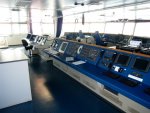
 
Curiosity - assuming your ship is commercial, what is your ship and where does she fit in the spectrum from well funded bridge with ECDIS + all bells & whistles to bare essentials with RADAR + eyeball + whatever is mandatory?

No ECDIS as yet, with no legal requirement to fit until 2017. We do have raster charts, which is basically an electronic photocopy of a paper chart which I quite like as all the detail is there and can't be removed. However it is only an aid, and our primary means of navigation are paper charts, the actual use of which is audited both internally and externally.
ECDIS is a minefield of potential cock ups as it's possible to remove detail such as wrecks, shoals and the like from the screen and merrily sail on, so unless ships staff are fully aware of the same we're going to be seeing a LOT of 'ECDIS assisted' groundings over the next few years. Naturally it'll make the red line merchants even worse.
It's my understanding that even when we have ECDIS fitted in a few years time it will be the policy of my employer (in common with a good few others) that ECDIS will not be our primary means - we will not go paperless - it will merely be there as another aid to the paper chart. Lots of very sensible reasons for that as I'm sure you can imagine; placing absolute faith in an electronic system(s) being one of them, not to mention a potential skills gap. I've heard some rather disconcerting rumours that at least one of the major Nautical colleges is going to stop teaching chartwork to those cadets who sail on paperless ships.
As for the others, we have the usual two radars with an AIS overlay onto the screen, but no separate AIS box with a list of the nearest targets/ships (you have to individually click on each triangle on the screen), which can be rather annoying and may yet change.

Not my ship, but an identical sister.

IMG_0013.jpg
IMG_0010.jpg
 
Last edited:
ECDIS is a minefield of potential cock ups as it's possible to remove detail such as wrecks, shoals and the like from the screen and merrily sail on, so unless ships staff are fully aware of the same we're going to be seeing a LOT of 'ECDIS assisted' groundings over the next few years. Naturally it'll make the red line merchants even worse.
It's my understanding that even when we have ECDIS fitted in a few years time it will be the policy of my employer (in common with a good few others) that ECDIS will not be our primary means - we will not go paperless - it will merely be there as another aid to the paper chart. Lots of very sensible reasons for that as I'm sure you can imagine

With you all the way on this one! I use (recently corrected) paper as my primary for navigation at sea.

For a shorthanded yacht where the chart table is separate from the "bridge", though, a small plotter in the cockpit for pilotage into harbour is worthwhile. I guess on ships you're either familiar with the port and have an exemption certificate, or you have a pilot on board, so the equivalent issue doesn't arise?

Pete
 
This is true up to a point, but it's not as if the other ship has someone manually typing in its course and speed every five seconds, who might make the odd typo. AIS transmitters are required to have their own GPS receivers, so the crucial position, speed-over-ground and course-over-ground information is more or less independent of any action or omission by the crew. Yes, they regularly seem to forget to change the navigation status, so you get "anchored" ships proceeding up the Channel at 20 knots, or closing on the Nab Tower with a "next port of call" in Caracas, but those pieces of manually-entered data are only really of casual interest to yachts. It's the position, CoG and SoG that matter, and the black box manages those without crew input.
No, the gyrocompass provides the heading. The course over ground comes from GPS. Both are reported, so your receiver can display the data however it likes (for example it could present separate track and heading vectors out of the other ship, like you usually see out of your own on a plotter)

Pete

I readily admit to knowing bugger all about AIS, and have found it difficult getting detailed answers from the usual resources, so am fully prepared to have my misconceptions busted here. I was wondering how much the user can control the transmitted data from either Class A or B units? If some units can have external GPS or Loran inputs, can that info be used for transmitted data? What happens if the antenna for the internal GPS is poorly sited, and occasionally loses its fix? Does it continue to transmit a DR? Does it stop transmitting positional and COG/SOG data?
 
Top