
AIS Transponder or Radar or Active Radar Transponder

Here, I've done it for you, just one thread, there are others.

Class B makes you that confident?
No, not confident because I have encountered ships which seem to have no one on watch.

However, maybe we are conflating two issues. The claim is that Ships can filter out Class B vessels which I continue to question. Your posts show that ships can filter out alarms from Class B vessels.
These are two different issues.
In my opinion if there is an Officer on watch then he should not just be relying on alarms. He should be on watch.
I maintain that Class B vessels will still appear but they might be set not to create an alarm in just the same way that I can (and do) have alarms turned off.
 
No, not confident because I have encountered ships which seem to have no one on watch.

However, maybe we are conflating two issues. The claim is that Ships can filter out Class B vessels which I continue to question. Your posts show that ships can filter out alarms from Class B vessels.
These are two different issues.
In my opinion if there is an Officer on watch then he should not just be relying on alarms. He should be on watch.
I maintain that Class B vessels will still appear but they might be set not to create an alarm in just the same way that I can (and do) have alarms turned off.

I don't understand why people continue to refuse to believe that some ships can filter out Class B targets from their displays.

Did you look at the Furuno operator's manual I mentioned as one example? I guess you didn't, otherwise you wouldn't be arguing.

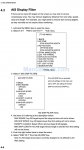
Here's the relevant page. Note that it says "If there are too many AIS targets on the screen you may wish to remove unnecessary ones. You may remove targets by distance from own ship, speed, class and length." That's talking about removing actual targets from the screen, not disabling alarms.

FAR2807.jpg
 
RADAR is the only piece of gear that will save your life
A very interesting statement. Radar will assist the crew but never save your life as it is totally passive.

My selection
  1. AIS Transmit and Receive.
  2. Active Radar Reflector.
  3. Radar.
AIS is really useful should things go ting tong and the CG get a Mayday from you. Lets your pals know then to get the next round in as you are an hour behind them and lets your nearest as dearest see where you are.

Active Radar wakes the officer of the watch up on the big stuff as you look a lot bigger than you actually are.

Radar good if you are keen on learning new stuff.
 
Well, quite a few hits on Google from a decade ago involving one brand of radar - is that furuno model even made anymore?
Can anyone link to a modern big ship display which has the capability to make ais targets completely disappear if they are class b?
Anyway, almost certainly a red herring, from your link -
What does this mean for professional mariners? A quick survey reveals that most mariners do not understand the full scope of Class B filtering settings and, therefore, leave these settings untouched. Most of us would agree that leaving settings we don’t understand alone is a good practice. And those that do understand the settings only use them in busy harbors.
Day to day for the vast majority of small boats transmitting class b getting filtered out does seem maybe a vague possibility but really not one to be worried about imho. If you are convinced that your class b transmissions will make you as safe as safe can be out there then you really have other things to be worried about :)
 
These would be my order of priority depending on funds ... best to start at 2.
1. AIS receiver
2. AIS transponder
3. Echomax dual band
4. Radar


That would be my list as well.
With a largish boat and the cash to go with it, plus plenty of crew, radar is more of an option.


The Vesper 850 yotty AIS can filter targets but cannot switch off B vessels per se:

"Intelligent filtering enables you to de-clutter your display. The WatchMate 850 automatically calculates the closest point of approach (CPA) and time until CPA (TCPA). You can filter target vessels by range, speed, CPA or TCPA. You can customize these settings for different situations – Harbor, Coastal, Offshore and Anchor, making it easy to alter your display and alarms with one button. "

.
 
In some ways it seems to me that all this debate of whether ships can filter out class B transmissions from AIS is largely irrelevant . The main thing is AIS gives you the ability to see all those ships and remember commercial ships must have AIS and must have it switched on (yea I know unless in certain circumstances if for example they fear piracy is an issue)
Remember AIS has a greater range than radar ( of course depending where and how high your antennae is mounted) Being able to see a ships course, speed and distance off whatever the conditions is the thing that allows you to keep clear of them and that is the important thing for your safety.
 
In some ways it seems to me that all this debate of whether ships can filter out class B transmissions from AIS is largely irrelevant . The main thing is AIS gives you the ability to see all those ships and remember commercial ships must have AIS and must have it switched on (yea I know unless in certain circumstances if for example they fear piracy is an issue)
Remember AIS has a greater range than radar ( of course depending where and how high your antennae is mounted) Being able to see a ships course, speed and distance off whatever the conditions is the thing that allows you to keep clear of them and that is the important thing for your safety.
A lot of sense in that.
I've had AIS receive from the days of the first NASA product, I'm sure I was pretty safe without it, but it's a great comfort and gives a lot of insight into what ships actually do.
Also when I got AIS I was able to get a lot better at guessing the ranges of ships by eyeball.

It's good to have SWMBO looking at the real world while I'm looking at the electronics though!
 
I think it depends on where you are sailing.

There is no one installation suits all - unless you have an unlimited budget.

We sail the Australian east coast, I don't recall how long but think 3,000nm. Large commercial traffic is something to remark on, its so rare - maybe 2 or 3 vessels a day. There are lots of runabouts and slight larger fishing boats with no AIS and inadequate lights that might be operating 20nm offshore. We don't get much fog, except now (in winter) but we can have bushfire smoke and reduced visibility due to dust (inland Australia being blown out to sea).

For us AIS would be interesting but would add little, radar is invaluable (as long as you know how to use it). We have Navico's Broadband that will pick up commercial traffic at about 35nm (how much warning do you need!) and commercial traffic is either dead ahead or dead astern. Radar will pick up the small fishing boat or runabout at about 6nm, depends on size. If we see a large commercial vessel that worries us - we ask them, we know where they are what they look like and what we look like - there is no confusion (they always reply very courteously and without delay).

If we were sailing locally in HK or round Singapore our equipment choice would be different.

I hate to mention it but radar is very useful when setting an anchor as you know exactly, better than eyesight at 2am, how far away the jagged bits are (not necessarily accurate on a chart based on a survey by Flinders).

Horses for courses.

Jonathan.
 
Regardless of whether some ships switch off class B reception, you are never going to be worse off by using it, providing you don't make unnecessary assumptions that you have been seen.
 
I think you will find that you can filter Alarms from targets by Time and Distance to CPA, but not the actual target (class A or B) display .

Nope. On the Vesper Watchmate displays, a target that has been filtered out will neither appear on the "chart" nor trigger an alarm. The only clue you have to its existence is a note in the top right of the screen saying something like "27 filtered targets".

There are several filtering criteria, but class A/B is not among them on these units.

Pete
 
Only Class A can filter Class B vessels.

There's absolutely nothing inherent to the system that makes that so. And in fact, since the filtering is done in the display unit which is usually separate from the transmitter, the statement doesn't even make sense. Is my Axiom plotter a "class A" or a "class B" device? Does it magically change if I buy a new AIS unit tomorrow? If I'm feeding the plotter only with NMEA0183 VDM sentences, it can't even *tell* what type of transmitter I have installed - should it offer me the filter button or not?

If someone (with suitable programming skills) wanted to add a "hide Class B targets" button to OpenCPN, for example, they could easily add it to their personal copy. They could then submit a pull request on GitHub and it would be purely a decision for the core OpenCPN team whether or not they wanted that feature in the main public version. I don't see any particular reason they'd say "no". At no point is the class of transmitter installed on the OpenCPN user's vessel of the slightest relevance.

Pete
 
Top