AIS Transponder or Radar or Active Radar Transponder

you have the power to run it (I would suggest that you need to be running the engine if using it for an extended period).

Again, modern radar is not like old-school magnetron radar. Mine has a maximum power draw of 17 watts, or 1.4 amps at nominal 12v. It wouldn't surprise me if there are plotters drawing more than that, and autopilots certainly will. Do people need to run their engines all the time to feed those too?

Pete
 
My own preference would be for AIS receiver followed by active radar reflector.

An AIS transmitter is a much more complex piece of kit. Much more to go wrong, it is not guaranteed to be accurate and up to date and the big ships can ignore you anyway.

As I imagine all big ships (all I really care about) use radar all the time the active reflector seems both simpler and more reliable - as well as being much lower power consumption.
 
Thanks for all the responses. I was interested whether there were any perspectives or anything unusual that had escaped me, fortunately not although rather better explained than I could have articulated the issues. I have used an AIS receiver to the plotter for about 12 years and have found it to be excellent. I think I will go initially for AIS transponder, then a Radar upgrade and lastly a Radar Active Transponder. I put the Radar Transponder last as being a catamaran there is not the heeling attenuation of my reflector signal and I am advised by other boats with radar that I return a particularly strong signal despite being a small sailing catamaran.
 
On balance, I think I'd put radar above AIS transmit because of its independence and its versatility. The AIS transmitter relies on various external systems, and only does one job - making you visible to others, who should in any case have other means of detecting you. But depending on equipment price and the way they intended to use their boat, I could see someone making the opposite call.
RADAR is the only piece of gear that will save your life - it shows moored obstructions, harbour walls, cliffs, buoys, ALL other moving vessels of all sizes with or without AIS , and their direction of travel, likelihood of collision, not just in fog but at night. Approaching Cherbourg in driving night rain with typical tide under the keel, how is AIS more useful than RADAR in locating the entrance safely? And many other similar situations. AIS B does have purpose and value, of course. But if you want to be as much in control of your passage as possible, RADAR.

PWG
 
I reckon many more ships monitor radar than monitor AIS (integrated displays are still not common). So an active radar transponder would give slightly better protection than an AIS transceiver.
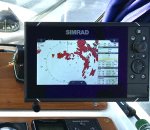
Really?? Blimey, I must be ahead of the game, I can even DSC call directly from the radar display.

FAE1E8AD-EF8B-4369-B4A1-3A4EB8AC57A2.jpeg
 
Really?? Blimey, I must be ahead of the game, I can even DSC call directly from the radar display.

Ships were compelled to fit AIS receivers; many of them complied by fitting standalone units which were located somewhere in the wheelhouse. Integrated radar/AIS displays were initially quite rare on ships but, as ships upgraded their electronics, more were fitted. But the one thing ships do have is a radar display, so an active radar transponder is almost certain to show up, regardless of the state of the ship's electronics.

Of course, there's also the fact that the AIS receivers on ships can turn off Class B reception, so even with a Class B transceiver there's no guarantee the ship will see you.
 
There's no guarantee that the ship will have anyone looking at any of the electronics.
The other vessel might not be a big ship, it could be anything, maybe another leisure vessel, maybe a fishing boat.
 
Approaching Cherbourg in driving night rain with typical tide under the keel, how is AIS more useful than RADAR in locating the entrance safely?
It's not! And I wouldn't expect it to.
It's Horses for Courses.
A Chart Plotter will guide you safely to the entrance, assuming that you know how to use it. Coupled with AIS, it will also tell you if a leaving ship is also going to appear at the entrance where RADAR will only see the harbour wall.
 
  • Like
Reactions: C08
peter gibbs said:
Approaching Cherbourg in driving night rain with typical tide under the keel, how is AIS more useful than RADAR in locating the entrance safely?

Why would you need radar to locate Cherbourg entrance?
The GPS will do that for you, even the most basic 20 year old hand held model.

What most people seem to do with radar these days is to overlay it on the chart plotter display and then convince themselves that the radar image agrees with where the GPS thinks they are. Sometimes with a bit of NorthUp Error thrown in?

A GPS, basic or chart plotter, is a far higher priority than any of the gadgets in the thread title.
If we're playing silly games prioritising things, I'd get a second GPS before buying anything else!
Assuming we start off with a compass, then a depth sounder and some charts before buying the first GPS! Maybe Almanack needs to be in that list?
 
Which to buy, coastal and XChannel sailing?
Radar assuming you have a chartplotter. As others have said big ships can ignore class b ais and a lot of boats still don't have ais. Radar does have its faults, mainly us mere mortals trying to understand what the display is telling us, but it doesn't rely upon the other vessel or even land having to transmit a signal.
 
peter gibbs said:
Approaching Cherbourg in driving night rain with typical tide under the keel, how is AIS more useful than RADAR in locating the entrance safely?

Why would you need radar to locate Cherbourg entrance?
The GPS will do that for you, even the most basic 20 year old hand held model.

What most people seem to do with radar these days is to overlay it on the chart plotter display and then convince themselves that the radar image agrees with where the GPS thinks they are. Sometimes with a bit of NorthUp Error thrown in?

A GPS, basic or chart plotter, is a far higher priority than any of the gadgets in the thread title.
If we're playing silly games prioritising things, I'd get a second GPS before buying anything else!
Assuming we start off with a compass, then a depth sounder and some charts before buying the first GPS! Maybe Almanack needs to be in that list?
Thanks. Apart from the plotter GPS there is GPS on the DSC and I also have an old Garmin hand held.
 
We have AIS Transponder, Radar Reflector, and Radar on Lady G.
Not used the Radar once since we bought her until a couple of weekends ago sailing across Christchurch Bay as the fog came down.

It was extremely comforting to be able to ping contacts and get the helm to confirm either an AIS target or nothing - either way, it helped us navigate safer, I was surprised how effective the resolution was even on our steam-driven 2002 version of radar. Am now seriously considering the Chirp Doppler Stereo Surround Sound Dolby version which will interface with the Axiom rather than legging it up and down the companionway steps.
 
Particularly as ships can filter out class B AIS. As more people leave AIS transmitting when in marinas, the more likely this is likely to happen to de-clutter screens.
This statement is often made but whenever queried results in no proof. Can you give an example of a ship AIS system which has this feature to filter out class B?
 
Of course, there's also the fact that the AIS receivers on ships can turn off Class B reception, so even with a Class B transceiver there's no guarantee the ship will see you.
Can you provide an example of a ships AIS system which allows the filtering of AIS class B?
 
A
Can you provide an example of a ships AIS system which allows the filtering of AIS class B?
As far as I know (and I don't claim to be an expert), it's not a case of a simple button to kill all class B AIS returns, but various types of filtering are possible with some radar/AIS setups. See
https://www.panbo.com/class-b-ais-filtering-the-word-from-dr-norris

I have a Class B transponder and I certainly operate 'filtering' - if I get in crowded waters in good visbility, I turn the thing off to stop the constant alarms. That filters out Class A as well as B.:)
 
Top