AIS System - Where to Start?

I wonder if it would work to create your own protocol. So to design a device with N2k and ethernet ports. You connect N2k, the device is smart and knows the type of input and you then you have a central hub. The end devices would still get N2k output. I am not sure if this is nonsense for you @PaulRainbow or not - I know people are reading N2k by arduino and I could create arduino prototype of something like this.

I haven't seen the full standard for Onenet yet. But, it would make a certain amount of sense to have it work in conjunction with N2K, perhaps having instruments that support both, (MFDs would almost certainly have this) whereby you could have a cluster of displays (think ST60s, i70s, GMI20s etc) connected together by N2K, then joining the Ethernet based part of the network.
 
I might already add it it but here it is:
For those who are more adventurous, there is AIS receiver for Rasbery PI, for 50 quid: dAISy HAT - AIS Receiver for the Raspberry Pi
?
Though on these forums few venture beyond paying to get expensive boxes fitted. A RPi ( & opencpn) can also use a cheap TV dongle to receive ais, not sure I'd trust that though.
The Quark devices are also popular.
If you can actually find a Pi zero then it's a fantastic addition to any boat with electronic data, hard to think of anything you'd realistically want to do with data on a boat which it can't do. For a few hundred milliAmps.
Welcome to OpenPlotter’s documentation! — OpenPlotter 3 documentation
Then you get pretty plots on any device onboard which can look at a web page. Really useful, esp for battery voltage/current.
NMEA is in the stone age compared to signalk. An expensive stone age.
 
A genuinely useful thread, this, overall - learned a bit more about AIS B+ and a lot about the Onwa offering (despite being dreaded Garmin plotter owners ourselves!).
 
As another has pointed out - OP is on a budget ... does not have a big boat .... his original script was seriously budgeted !!

I am NOT ramming Onwa down anyones throat - but its a logical suggestion along with Matsutec and other budget priced all in one gear. I could say the same about many threads that ram Garmin ... Raymarine ... Emtrac ... etc down peoples throats ... especially when its a forumites business to sell such.

At times I wonder if PBO has become PCCO ... Practical Credit Card Owner !!

As to ....

Bodging a few bits of kit together, where one might "talk" to to the next, doesn't come close to a proper, fully integrated, system where everything onboard can communicate and share data.

Coming from Paul - that is a sad statement ... for someone who installs and should know all gear - I do not presently have 'bodged' gear on board - those days are long gone. Maybe Paul - you should look at NMEA4WiFi units before slagging of.

Just to close of - many people such as I accept NMEA0183 because of its ease of setup, its able to use light easily routed cable .... and once fed to such as the NMEA4WiFi can provide more than most require.
 
As another has pointed out - OP is on a budget ... does not have a big boat .... his original script was seriously budgeted !!

I am NOT ramming Onwa down anyones throat - but its a logical suggestion along with Matsutec and other budget priced all in one gear. I could say the same about many threads that ram Garmin ... Raymarine ... Emtrac ... etc down peoples throats ... especially when its a forumites business to sell such.

At times I wonder if PBO has become PCCO ... Practical Credit Card Owner !!

As to ....


Coming from Paul - that is a sad statement ... for someone who installs and should know all gear - I do not presently have 'bodged' gear on board - those days are long gone. Maybe Paul - you should look at NMEA4WiFi units before slagging of.

Just to close of - many people such as I accept NMEA0183 because of its ease of setup, its able to use light easily routed cable .... and once fed to such as the NMEA4WiFi can provide more than most require.

1669407361138.jpeg
 
I have used an Onwa KS200A before and it worked well. Can be bought from ebay for £317, add an SMA GPS aerial for ~£10 and deck mounted aerial for ~£30 so call it £360 total. A bit less than the £500 noted earlier I think, leaving room for something from Quark to interface to NMEA2000 and wifi if required.
 
Last edited:
The big problem here is not really what an OP wants in any of these threads ... but what happens with the replies.

As can be seen - odd 'members' are easily provoked into slagging off others suggestions. Odd members have definite solidly held views and hard to dislodge. Odd members like to 'experiment / DIY' .

Too long - so-called Leading Brands have dictated to the market and market has fallen in line and believed the hype. In its early days - of course - they were the answer .... but as with Computers and many other items in our lives - those 'leading brands' have literally not kept pace with surrounding world. They plug on about how great and integrated they are - but that usually means sticking with their label.
A good example to compare : IBM computers (separate dept to the Chip dept). For years IBM PC's led the world and were held up as THE PC to have .... hiding the fact that a little known Company in C hina was actually production ... Lenovo. There was another Company that was heavily into component supply to all the major PC brands - but those brands made sure only their label was known. That supplier was in fact literally the worlds largest component supplier .... ACER .... yes ACER. What did they do ? Decided to come out of the shadows and produce an own brand product. Of course the 'main stream' boys now had a problem .... and they fought a hard battle trying to maintain their lead ..... such that in the end IBM was forced to call it a day and hand over PC market to Lenovo and concentrate on its Chip business.
ACER today still supplies parts to others ... has a thriving own label line of products ... in fact they are starting to suffer from other competition ...

It may sound an extreme comparison ... but Garmin and the other Mainstream brands are fighting a losing battle IMHO against the new boys on the market. No matter how much they crow on about integration and their proprietary protocols - its a road that can only go down. Computers / Cars / RC / Music ... just those as example show that opening up and making integration non brand dependent is a better path.

My purpose on such threads as this - despite Pauls 'Yawn' ... is not to actually promote sales of Onwa .. its just a brand that fits my intention of illustrating alternative to more expensive solutions that many small to medium range boaters basically do not need. I don't care what brand a person buys - my hope is that the person may be able to solve his requirements using something I or another forumite suggests without 'breaking the bank'.

My 600 quid all in setup .... provides full WiFi and USB GPS / AIS data to anyone on board from my budget plotter and WiFi-NMEA unit. If I had other instruments such as Wind etc. - they can be added by just connecting a couple of simple wires and then be part of that WiFi and USB network.
Trouble is when some are blinded by their own limitations - that falls on deaf ears.
I am always ready to accept others suggestions / info ... to modify my own views etc. - but not when its just pure bias.
 

OOOOH you are awful !!

WzBQ68o.gif
 
I don't have the money to spend at the moment on a 'proper' AIS/plotter set-up, and I don't think I really need one. In a few years time I hope to do more offshore sailing so I will need one, at which time I'll spend the money. I could try to stretch to the cheapest possible plotter-based AIS solution now, but in a few years the next generation of electronics will come along and it will have been a waste.


On a slightly different tack, the OP has made his choice and I think he has done well. With the mobile he has a self contained unit that gives him:

A VHF portable radio
(Independent backup to his ship's VHF)
DSC calling
A unit that can be used in an emergency, perhaps a liferaft/grab bag. Waterproof, floats, strobe light
Basic GPS with waypoint screen
(Independent backup to his ship's plotter)
AIS receive screen

Plus
He has bought a unit that is unlikely to ever be obsolete, working off its own batteries it will always be a useful piece of kit, even if he does get around to buying/affording a plotter with full AIS or even if his next boat is a Swan 45.

All for around 300 quid.
.
 
The big problem here is not really what an OP wants in any of these threads ... but what happens with the replies.

Indeed, as can be seen in your replies.

It may sound an extreme comparison ... but Garmin and the other Mainstream brands are fighting a losing battle IMHO against the new boys on the market. No matter how much they crow on about integration and their proprietary protocols - its a road that can only go down. Computers / Cars / RC / Music ... just those as example show that opening up and making integration non brand dependent is a better path.

Almost fell of the sofa laughing here. So you seriously think that Onwa et al will see of the likes of Garmin, Raymarine, Simrad ? I think i'll beg to differ with you.

Onwa no doubt has a place in the market, supplying budget end plotters etc, nothing wrong with that and i have never said different.

As for "making integration non brand dependent", this just highlights your lack of understanding. I fit electronics from pretty much every manufacturer, i have no interest in what make a customer wants. Some systems might be all one make, but others may consist of equipment from several manufacturers and of various vintages.

For instance, Raymarine autopilot, Garmin plotter, Emtrak AIS, Standard Horizon VHF, old Seatalk ST60s, all living happily together using combinations of Seatalk, STNG, NMEA 0183 and N2K.

No problem if you know what you're doing.

My 600 quid all in setup .... provides full WiFi and USB GPS / AIS data to anyone on board from my budget plotter and WiFi-NMEA unit. If I had other instruments such as Wind etc. - they can be added by just connecting a couple of simple wires and then be part of that WiFi and USB network.
Trouble is when some are blinded by their own limitations - that falls on deaf ears.
I am always ready to accept others suggestions / info ... to modify my own views etc. - but not when its just pure bias.

As i've said on several occasions, if you're happy with your installation that's fine by me. But, then you come out with drivel such as suggesting anything more modern than 0183 "belongs in the bilge", or "you won't fit N2K because it uses 2 resistors".

"blinded by their own limitations" made me chuckle. Especially as you have no idea what my own setup consists of.

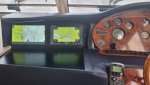
For instance, my lower helm looks like this:

20221126_104450.jpg

Two 10.4" displays, costing £150 each Each can be used stand alone or a mirror of the flybridge plotter. No cost for using either, all part of owning the Garmin plotter (similar available from other suppliers).

All nav data, engine data and tank levels available on the N2K network using equipment from various suppliers. The N2K data is fed to a RPi as 0183 via USB, where the Pi processes the data and broadcasts it throughout the boat by wifi using the onboard router. The Pi is also fed data from the battery monitor, solar controller and mains charger. Anyone onboard with a smart phone or tablet can view any/all of the data via a browser.

That's at least 6 or more manufacturers equipment, all living nicely together and more than a little bit of experimenting and DIY.
 
I have used an Onwa KS200A before and it worked well. Can be bought from ebay for £317, add an SMA GPS aerial for ~£10 and deck mounted aerial for ~£30 so call it £360 total. A bit less than the £500 noted earlier I think, leaving room for something from Quark to interface to NMEA2000 and wifi if required.
I think I was the one to quote £500 - but that was if adding the wifi/NMEA2k via Onwa’s own box. Agree it could be done cheaper (but a bit beyond my knowledge).

No doubt it’s keen value either way.
 
For instance, Raymarine autopilot, Garmin plotter, Emtrak AIS, Standard Horizon VHF, old Seatalk ST60s, all living happily together using combinations of Seatalk, STNG, NMEA 0183 and N2K.
That kind of highlights the problem with Raymarine, that they have all these proprietary protocols in the first place.
I could easily see Raymarine losing out to the likes of Onwa.
 
That kind of highlights the problem with Raymarine, that they have all these proprietary protocols in the first place.
I could easily see Raymarine losing out to the likes of Onwa.

They are definitely a pain. Buy yourself a nice new Axiom MFD and an Evo autopilot and you cannot directly connect them together, the Axiom is N2K and the Evo is STNG.

I think the big names will lose out on the lower priced end of the market, simply because they don't aim for that end of the market. I can't see the likes of Onwa eating into the high end electronics, they don't cater for it and that's likely by design.

Different horses, different courses and there's nothing wrong with that.
 
Last edited:
That kind of highlights the problem with Raymarine, that they have all these proprietary protocols in the first place.
The best thing about ethernet / wifi is that it's ubiquitous - it's everywhere and it's in all these cheap devices we can buy from Amazon or AliExpress.

As a networking protocol, and especially considering when it was designed and implemented, NMEA 2000 makes a lot of sense. Ethernet has a MAC layer and an IP layer, and devices obtain an IP address with a DHCP request - there must be a DHCP server on the network handing them out, or you assign IP addresses manually. This is a lot of complexity for a handful of depth-wind-speed-GPS transducers and displays to view them on, especially considering that 20 years ago a big high end home PC was about as powerful as today's tablets, mobile phones and raspberryPis. On home networks the DHCP server is usually a router, that connects the home LAN to the internet - should the boat's plotter be the network's DHCP server, or the AIS-wifi gateway? What if you connect your mobile phone to the network? Will it have 2 IP addresses? When NMEA 2000 was designed the idea of connecting a boat to the internet was almost inconceivable.

NMEA 2000 is only rubbish if you ignore the context in which is arose - if you have separate wind, speed and depth transducers, do you want to be running three separate ethernet cables through confined spaces the whole length of the boat? (ethernet cables are thicker than the previously-used serial / NMEA 0183 cables) Alternatively, perhaps you prefer to fit a network switch in the bow, which requires its own power supply?

NMEA 2000 has a single network backbone which runs fore-to-aft and it supplies power so you can fit instrument displays on the mast or a P70 autopilot by the tiller - you connect each with a T-connector and single cable and it just works. NMEA 2000 was based on the existing automotive CAN bus, so your boat's engine can be integrated into the system without needing any proprietary additions.

If I was designing my ideal boat networking protocol now then it would look somewhere between NMEA 2000 and ethernet - the depth transducer wouldn't require an IP address, but would be identified by its manufacturer ID / serial number: other devices would recognise that it's transmitting depth data because it would be transmitting an NMEA-style sentence; the network would supply power and wouldn't require hubs or switches. But it would be pointless to invent a new networking protocol now because the market is so small, and it adoption of it would make devices prohibitively expensive compared to £50 wifi-enabled tablets and such from China - no-one would use it. (NMEA OneNet is really just a standard for integrating NMEA 2000 and ethernet.)

I've cussed SeaTalkNG myself, but similarly it must've made a lot of sense from Raymarine's perspective at the time - their existing SeaTalk was a serial protocol, similar to NMEA 0183 but different from it and incompatible (I guess it was inherited from the old Autohelm ST50 displays?). So what's Raymarine going to do? They can't just introduce a range of a new products overnight, making them incompatible with their old range; they don't have the design and development capacity for that, and people want to upgrade their existing installations anyway, and migrate from one to the other. So SeaTalkNG allowed Raymarine's customers to connect new devices to existing Raymarine networks more or less seamlessly - effectively it was two plugs in one, SeaTalk1 or NMEA 2000 data, and the new device used whichever one of those two protocols it found on the plug.

It looks like Raymarine are dropping SeaTalkNG from their plotters now - presumably they're migrating away from supporting SeaTalk1 and in future they'll use a mixture of NMEA 2000 over SeaTalkNG and NMEA 2000 with standard NMEA 2000 connectors.

I know I've written a lot, but the point I'm trying to make is that these proprietary don't exist just because - Raymarine didn't create them just to be stubborn. This kind of problem exists in all industries and I would guess that speed of migration to newer tech depends on the size of the market; wifi / ethernet doesn't solve all problems, but mass-market hardware is cheap so certain problems are now solved in software instead.

I think there's a lot to be said for the fact that your boat can have its original ST50 transducers and displays (the ST50+ was released in 1993, so the tech predates that) and have it integrated with the latest generation of autopilots and chartplotters and it all just works. 30 years of backwards compatibility! How many of you connect your tablet at home to a 386 or 486 PC?

Also, I'm sure NMEA can be a nightmare to debug if it goes wrong but compare it to, for example, token ring or 10base2 - that was the era in which it NMEA 2000 was designed.
 
The best thing about ethernet / wifi is that it's ubiquitous - it's everywhere and it's in all these cheap devices we can buy from Amazon or AliExpress.

As a networking protocol, and especially considering when it was designed and implemented, NMEA 2000 makes a lot of sense. Ethernet has a MAC layer and an IP layer, and devices obtain an IP address with a DHCP request - there must be a DHCP server on the network handing them out, or you assign IP addresses manually. This is a lot of complexity for a handful of depth-wind-speed-GPS transducers and displays to view them on, especially considering that 20 years ago a big high end home PC was about as powerful as today's tablets, mobile phones and raspberryPis. On home networks the DHCP server is usually a router, that connects the home LAN to the internet - should the boat's plotter be the network's DHCP server, or the AIS-wifi gateway? What if you connect your mobile phone to the network? Will it have 2 IP addresses? When NMEA 2000 was designed the idea of connecting a boat to the internet was almost inconceivable.

NMEA 2000 is only rubbish if you ignore the context in which is arose - if you have separate wind, speed and depth transducers, do you want to be running three separate ethernet cables through confined spaces the whole length of the boat? (ethernet cables are thicker than the previously-used serial / NMEA 0183 cables) Alternatively, perhaps you prefer to fit a network switch in the bow, which requires its own power supply?

NMEA 2000 has a single network backbone which runs fore-to-aft and it supplies power so you can fit instrument displays on the mast or a P70 autopilot by the tiller - you connect each with a T-connector and single cable and it just works. NMEA 2000 was based on the existing automotive CAN bus, so your boat's engine can be integrated into the system without needing any proprietary additions.

If I was designing my ideal boat networking protocol now then it would look somewhere between NMEA 2000 and ethernet - the depth transducer wouldn't require an IP address, but would be identified by its manufacturer ID / serial number: other devices would recognise that it's transmitting depth data because it would be transmitting an NMEA-style sentence; the network would supply power and wouldn't require hubs or switches. But it would be pointless to invent a new networking protocol now because the market is so small, and it adoption of it would make devices prohibitively expensive compared to £50 wifi-enabled tablets and such from China - no-one would use it. (NMEA OneNet is really just a standard for integrating NMEA 2000 and ethernet.)

I've cussed SeaTalkNG myself, but similarly it must've made a lot of sense from Raymarine's perspective at the time - their existing SeaTalk was a serial protocol, similar to NMEA 0183 but different from it and incompatible (I guess it was inherited from the old Autohelm ST50 displays?). So what's Raymarine going to do? They can't just introduce a range of a new products overnight, making them incompatible with their old range; they don't have the design and development capacity for that, and people want to upgrade their existing installations anyway, and migrate from one to the other. So SeaTalkNG allowed Raymarine's customers to connect new devices to existing Raymarine networks more or less seamlessly - effectively it was two plugs in one, SeaTalk1 or NMEA 2000 data, and the new device used whichever one of those two protocols it found on the plug.

It looks like Raymarine are dropping SeaTalkNG from their plotters now - presumably they're migrating away from supporting SeaTalk1 and in future they'll use a mixture of NMEA 2000 over SeaTalkNG and NMEA 2000 with standard NMEA 2000 connectors.

I know I've written a lot, but the point I'm trying to make is that these proprietary don't exist just because - Raymarine didn't create them just to be stubborn. This kind of problem exists in all industries and I would guess that speed of migration to newer tech depends on the size of the market; wifi / ethernet doesn't solve all problems, but mass-market hardware is cheap so certain problems are now solved in software instead.

I think there's a lot to be said for the fact that your boat can have its original ST50 transducers and displays (the ST50+ was released in 1993, so the tech predates that) and have it integrated with the latest generation of autopilots and chartplotters and it all just works. 30 years of backwards compatibility! How many of you connect your tablet at home to a 386 or 486 PC?

Also, I'm sure NMEA can be a nightmare to debug if it goes wrong but compare it to, for example, token ring or 10base2 - that was the era in which it NMEA 2000 was designed.

Highlighted part is illustration of misleading info. Yes of course a 'network' requires a base be it server or WHY. But that is so easily solved today by use of purpose designed Plexors ... I use the NMEA2WiFi unit ..... no bigger than a packet of cigs. The later version is NMEA4WiFi ..... same size but double the connections. There are many others serving this purpose.

Despite the implementation of OneNet / Ethernet by some - Its not what I need ..... my Plexor provides all I need and does not need high tech knowledge to install. A few short light wires and my whole boat is now served from a small box siting quietly in the corner.

I had gear with N2K, in fact it still works ... but I hated its cabling and the need for terminating resistors ... blimey - I left that sort of cr** behind from the old PC Network days !! I remember the reaction of a pal of mine who's business is Computer Servicing / Maintenance ... he couldn't stop laughing at the cabling supplied with the gear. Despite being slagged of by some - I fully understand why some prefer N2K ... but evolution has brought about a solution to the old limitations of 0183.
I think that a misconception has grown up around this matter. Evolution is not so much the format of data - but how its used .... whether the data is in 0183 or N2K delivery - the fact is that systems now cater and deliver that info simply and reliably.

What is amazing today .... you could have an old Magellan Hand Held GPS with B&W data only screen - but with modern units such as Plexors - can provide GPS data to any tablet / PC / MFD you want .... old or new - evolution is providing avenues you can follow.

I agree that high end market will remain with the established brands to a large extent - but as I still have working connection with Shipping - I can tell you that those names are being seen less as time moves on.
For Yotties ... the small to medium size boater is keen on what he pays out ... so those budget brands will be serious contenders.

I'll finish this on a bit of info that some should take note of :

Its well known that I am a keen Modeller ... have an extensive RC Model range of boats / cars / planes / heli's and drones. Have been in the hobby over 55yrs ... about same as yachting ..
Over last few years - the leading brands who insist on proprietary Protocol FW formats have been losing market to budget Multi Protocol Module radios. A typical established 8ch proprietary FW radio would cost anywhere from 500 to 1000 euros and RX's would be anywhere 30 to 100 euros a piece. A MPM Radio capable of connecting to near all those proprietary FW formats AND with 16ch not 8 ..... touch screen programming .... fully user assignable channels would set you back about 200 to 300 euros depending on such as the gimbals you choose. The RX's can be had for as little as 5 euros for parkflyer ... to same as proprietary if you wish.
The point is that the fact the established brand from yesteryear insists on trying to control market with proprietary FW is in itself the doom factor. JR - one of the best and was my choice for many years before MPM went bankrupt. Futaba hangs on because of its Industrial connections. Spektrum hangs on because of marketing ploys but is losing ground every day.

I am sure similar will happen here .......
 
Top