AIGFS

I thought the whole point of AI was that it didn't have to be "pointed" at anything, that it was "smart enough" to figure things out on its own. If I want a summary of current research in the field of, for example, atmospheric science there are compendia of scientific abstracts which do just that. The fact that ChatGPT "parrots" what it finds as it trolls the internet means that it is a poor example to use to justify other aspects of AI assisted analysis.
 
It doesn’t need to be pointed at anything specific during training. Modern GPT models are trained on effectively all text ever written by humans. That produces a language model that can interact with humans in any language naturally, but it needs to be pointed to source material to interpret in order for the answers to be valid and trustworthy. In a law firm you might point it at case law books and it can find relevant text, or at the case management system so it knows the house style for letters.
In the case of weather, it will train on all available data both in the field of weather and any relevant other data such as flight logs and shipping, gas and electricity consumption geospacial data etc. so it can work out what’s related. It would take human scientists thousands of years to achieve the same outcomes, if they ever even tried to make a correlation. Importantly, regular re-training can spot new trends, for instance when gas boiler are replaced by heat pumps the weather will certainly be affected.
As with GPT, it will also need relevant data for a given day, so the system will be able to decide what to reference and automatically access that data to provide a forecast. This will likely be iterative as it is now, with a big model working alongside localised refinement models.

The word is trawl, not troll. Trolling is a different thing and entirely human.
 
In which case, meteorology is well served. Ship data have been exchanged freely between nations since the 185os and all are available to all weather services in digitised format. A small amount of earlia data are also available. I cannot now recollect when aircraft data were first systematically collected and archived, presumably post ww2. Most, along with radio-sonde data are available through international agreement, via WMO. Some satellite imagery are available from the 1960s but infrared and microwave sounding data are available from 1979. RNSS-RO data are available operationally since 2007.

The quality/time/space/resolution of all the various in situ systems has changed and, generally improve of the period referred to. Nowadays, the largest quantity of data are from satellite. A major problem in the later years of the last century was the integration of these with accurate in situ data. A serioys problem is in the vastly different data volumes. For these reasons, at least in part, initial trials of AI forecasts have used the carefully produced ERA5 data. It has yet to be seen if use of raw observational data Wii do better.

As someone who has been closely involved with NWP prediction, satellite systems, data and observations, I know enough to be cautious when new ideas are being trialled. AI forecasting is on the way but those involved in operational use will proceed carefully and cautiously. Safety of life, property and commercial interests will be at stake.
 
Ship data have been exchanged freely between nations since the 185os and all are available to all weather services in digitised format.
It was just one example that’s easy to see the benefit of. Knowing how much fuel was burned, where and when gives a clear mapping to emissions and most people can see the link from there to the weather. Same with home heating. The advantage of AI/ML is that we don’t have to spend years with teams working out how those things have an effect. The data os processed, the patterns are found, and the outcomes follow. When the patterns change the model will spot the changes immediately on retraining without having to tweak parameters. New tech like electric cars and heat pumps or even wind farms and solar won’t trip up forecasting and more importantly won’t need research ahead of time to incorporate because for forecasting it doesn’t matter why they cause an effect, the science can come later.
 
It was just one example that’s easy to see the benefit of. Knowing how much fuel was burned, where and when gives a clear mapping to emissions and most people can see the link from there to the weather. Same with home heating. The advantage of AI/ML is that we don’t have to spend years with teams working out how those things have an effect. The data os processed, the patterns are found, and the outcomes follow. When the patterns change the model will spot the changes immediately on retraining without having to tweak parameters. New tech like electric cars and heat pumps or even wind farms and solar won’t trip up forecasting and more importantly won’t need research ahead of time to incorporate because for forecasting it doesn’t matter why they cause an effect, the science can come later.
Not sure what you are saying. My text that you picked relates to the establishment of marine archives back to the late 1800s. I have sometimes misread your posts. You have repeated the compliment!
 
Not sure what you are saying. My text that you picked relates to the establishment of marine archives back to the late 1800s. I have sometimes misread your posts. You have repeated the compliment!
I’m saying that shipping affects weather. It’s well understood at this point, same for air traffic. We have the date to understand where and how much fuel was used, and therefore emissions, and therefore the effect on weather of those things.

There are thousands of such examples which will feed AI models with no understanding necessary just by supplying the data. Humans couldn’t replicate that if they were given a thousand years to work the problem. Current weather models use a tiny percentage of data, and that data is skewed heavily towards weather observations
 
I’m saying that shipping affects weather. It’s well understood at this point, same for air traffic. We have the date to understand where and how much fuel was used, and therefore emissions, and therefore the effect on weather of those things.

There are thousands of such examples which will feed AI models with no understanding necessary just by supplying the data. Humans couldn’t replicate that if they were given a thousand years to work the problem. Current weather models use a tiny percentage of data, and that data is skewed heavily towards weather observations
You still seem unwilling to accept the point that I was making in #23, that meteorologists recognised long ago the need for historical data back in an age when slide rules, logarithms and mechanical calculators were the height of technology. It is only due to the foresight shown by our predecessors that we have data useful in an AI context.

However, you are demonstrating the dangers of just putting everything into the pot without understanding. Increases in shipping, and energy use in general, are having significant effects on climate. Understanding the physical processes is vital to developing amelioration and mitigation strategies. When it comes to day-t0-day operational forecasting, whether by AI or physical models it comes down to practical issues around time and apace scales and what is achievable. In all weather forecasts the aim is to arrive at the best forecast possible. It will never be the best possible forecast.
Knowing how much heat each of your neighbours is emitting could conceivably help to predict wind in your garden for the next few minutes. It would not help for the next few hours over which the large pattern over the UK dominates. Beyond a day or so, global patterns are the major determinants. Any correlation with ships crossing oceans will not be measurable. Current global AI produces data on a scale of around 25km. In practical terms, we cannot measure the atmosphere on that scale.
I am not decrying the AI concept. I am simply saying that its development and use are not likely to work well without understanding. That includes an awareness of predictability limitations in space and time.
 
Last edited:
....Current global AI produces data on a scale of around 25km. In practical terms, we cannot measure the atmosphere on that scale.
I am not decrying the AI concept. I am simply saying that its development and use are not likely to work well without understanding. That includes an awareness of predictability limitations in space and time.
Scale, therein lies one of the flaws in his arguments. High altitude aircraft emissions have documented impacts on weather and climate but some of the other variables that he has suggested could be included in the AI analysis mix are hardly likely to be measurable at a global scale and if they can't be measured at that level it will be difficult to achieve any sort of dependable cause-effect relationship. Your point regarding understanding is important because, without understanding the subject matter, a user of the AI generated information is unable to determine if the information presented is correct. He has already acknowledged that results could be generated that seem plausible but are wrong. In order to know that the results are, in fact, wrong how else, other than understanding the subject and the data, can a user know to trust what they have been given?
 
Measurable can mean many things. What specifically have I said that you think cannot be included in the data set.
And no, understanding isn’t necessary, that’s why weather research has traditionally been so slow. It’s a nice to have as a separate subject but far from a requirement to predict weather.
 
Measurable can mean many things. What specifically have I said that you think cannot be included in the data set.
We cannot measure temperature, humidity, wind, everywhere. We can only infer values for much of the globe at any particular time.
And no, understanding isn’t necessary, that’s why weather research has traditionally been so slow. It’s a nice to have as a separate subject but far from a requirement to predict weather.
Nonsense. Ever since WW2, researchers and developers of forecasts have generally been thinking ahead of the technology of computing and observing. You are too quick to decry the work of some top rate scientists who had no option but to work on Leo, Ferranti Mercury ….. Cray YMP etc.
 
They’ve been doing the best they could with the tools available at the time. Just because I understand progress doesn’t mean I don’t value what came before. We’re hitting a step change in how we do this stuff. I don’t know why you keep starting threads on a subject you clearly have no interest in only to bash it at every opportunity. Don’t you have anything better to do?
 
They’ve been doing the best they could with the tools available at the time. Just because I understand progress doesn’t mean I don’t value what came before. We’re hitting a step change in how we do this stuff. I don’t know why you keep starting threads on a subject you clearly have no interest in only to bash it at every opportunity. Don’t you have anything better to do?
I just dislike sweeping, incorrect statements.
For many years now, scientists working on weather prediction have been looking ahead and pushing the boundaries. The most extreme example was in 1920 when Richardson envisaged parallel processing.
Very much from the sidelines, it concerns me that you, an expert in AI, do not seem to recognise that applying AI/ML to the atmosphere is such a difficult problem. Like its predecessors, NWP and, earlier, frontal theory, it will lead to a better end product. How much better, I do not know. I am sure that weather forecasts will never be totally correct. It does, of course, depend on how you define accuracy and how you measure it.
 
it concerns me that you, an expert in AI, do not seem to recognise that applying AI/ML to the atmosphere is such a difficult problem
Perhaps that’s your problem, you aren’t acknowledging that experts know what they're talking about. I fully understand the problem, have worked on the problem, have succeeded with AI in many domains despite being assured it was impossible by experts. The main difference between you and I is that you only understand one of these subjects (albeit with outdated knowledge). I understand both, and have worked directly on the problem.
I’ll leave you to shout at the clouds now, you have no interest in understanding the subject so it’s not worth my time helping you to understand it.
 
Perhaps that’s your problem, you aren’t acknowledging that experts know what they're talking about. I fully understand the problem, have worked on the problem, have succeeded with AI in many domains despite being assured it was impossible by experts. The main difference between you and I is that you only understand one of these subjects (albeit with outdated knowledge). I understand both, and have worked directly on the problem.
I’ll leave you to shout at the clouds now, you have no interest in understanding the subject so it’s not worth my time helping you to understand it.
I do not have a problem. Like anyone with a science background, I am aware of the dangers of taking unverified claims on trust. I will certainly await developments with interest. As I have said, AI is likely to lead to improvements in ensemble forecasts. Whether a fully data driven model will perform as well as or better than, say, AIFS, must be uncertain. I certainly am not an AI expert but I have worked with fluid dynamics over a lifetime. You may have forgotten L F Richardson’s famous quote. “Big whirls have little whirls feeding on their vorticity. Little whirls have smaller whirls and so on to viscosity.”

That is very true and determines predictability in a turbulent fluid. I hope that I live long enough to see how AI forecasting works out. It is only right that scientists are sceptical. In a physical world, nothing should be taken on trust.
 
I will certainly await developments with interest.


For most sailors, the real benefits of AI/ML forecasting will come - assuming they come at all - with the implementation of hi res regional models.

I am a racing navigator - but I only do about two or maybe three real ocean races a year.

Much of my racing is better described as coastal or even inshore racing. I also do some small one design/dinghy racing, and a lot of recreational sailing.

So for sailing, I use the hi res regional models much more than I use global models. Indeed, pretty much anytime I want to know what the weather is going to be for the next day or two - which is every day - I consult a regional model, not a global model.

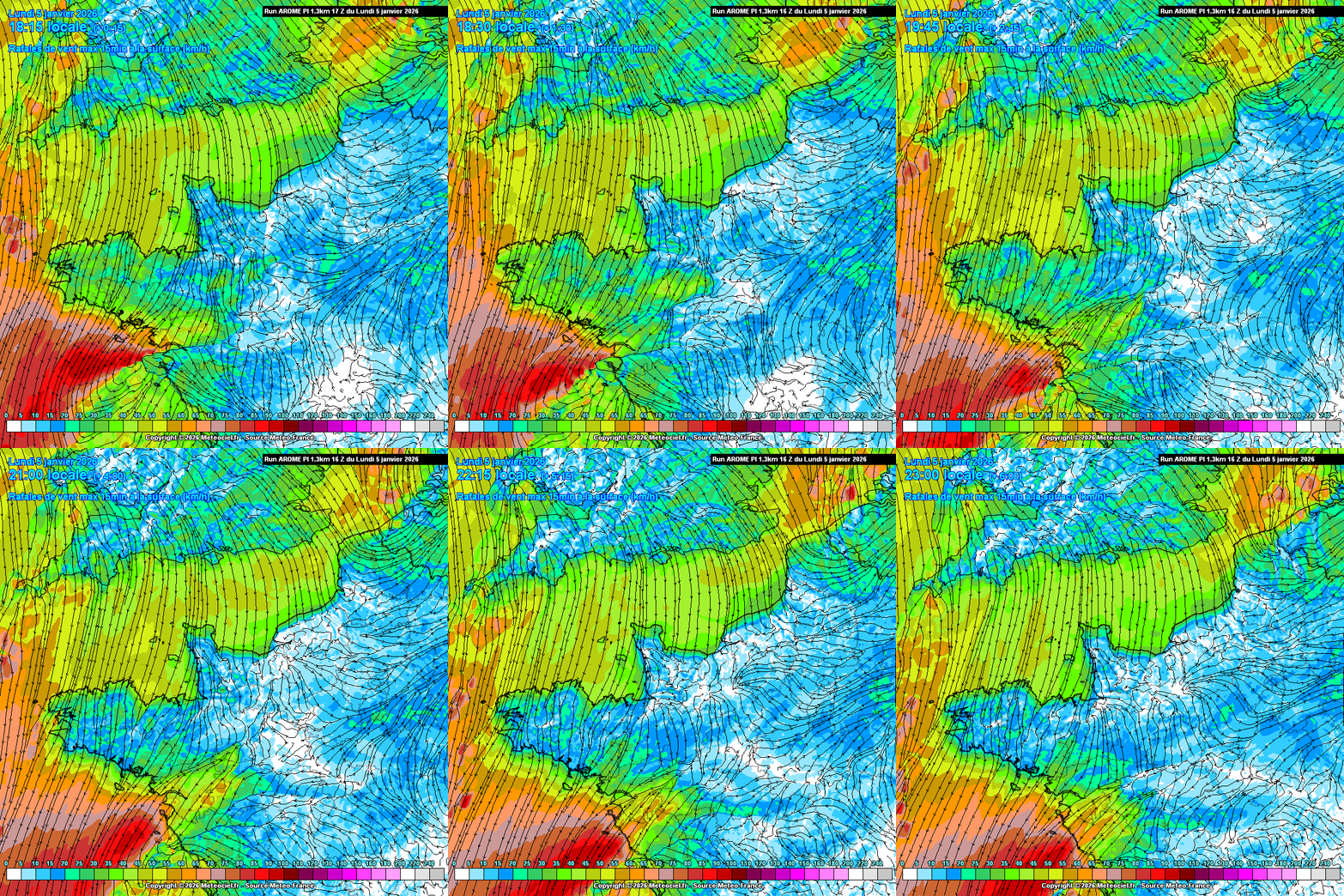
Mostly i am talking about Arome HD in Europe and the Caribbean, HRRR in the US.

If i think about the ratio, for me it's probably 10:1 use of regional vs use of global models.

Many, if not all, of the big NWO's have AI hi res models in development now, and private organizations are also working on them.

I am not sure if any are operational to the point of data download yet - I haven't seen any. But this is where I am really hoping for improvements in forecasting.

Of course, there really is no hi-res equivalent to the ERA-5 reanalysis for training. Mostly what they are training on is just the analysis for the existing hi res models, and they don't go back that far in time, but I think these new models will still be very successful.

One thing that I expect will change is the time step, and update frequency. NOAA's HRRR is a lower res model than Arome, (~3km vs ~1.5km), but HRRR is run 24 times a day with new initialization data, vs 5 times a day for AROME. Also, one HRRR version has 15min time steps vs 1Hr for Arome. These are in part tradeoffs imposed by computational limitations. Apparently,these limitations nearly disappear for AI models - I think NOAA said their AIGFS uses something like 1/1000 of the computational resources of the GFS. So - can we look forward to nearly continual updates of the hi res models? Maybe.
 
Last edited:
For most sailors, the real benefits of AI/ML forecasting will come - assuming they come at all - with the implementation of hi res regional models.

I am a racing navigator - but I only do about two or maybe three real ocean races a year.

Much of my racing is better described as coastal or even inshore racing. I also do some small one design/dinghy racing, and a lot of recreational sailing.

So for sailing, I use the hi res regional models much more than I use global models. Indeed, pretty much anytime I want to know what the weather is going to be for the next day or two - which is every day - I consult a regional model, not a global model.

Mostly i am talking about Arome HD in Europe and the Caribbean, HRRR in the US.

If i think about the ratio, for me it's probably 10:1 use of regional vs use of global models.

Many, if not all, of the big NWO's have AI hi res models in development now, and private organizations are also working on them.

I am not sure if any are operational to the point of data download yet - I haven't seen any. But this is where I am really hoping for improvements in forecasting.

Of course, there really is no hi-res equivalent to the ERA-5 reanalysis for training. Mostly what they are training on is just the analysis for the existing hi res models, and they don't go back that far in time, but I think these new models will still be very successful.

One thing that I expect will change is the time step, and update frequency. NOAA's HRRR is a lower res model than Arome, (~3km vs ~1.5km), but HRRR is run 24 times a day with new initialization data, vs 5 times a day for AROME. Also, one HRRR version has 15min time steps vs 1Hr for Arome. These are in part tradeoffs imposed by computational limitations. Apparently,these limitations nearly disappear for AI models - I think NOAA said their AIGFS uses something like 1/1000 of the computational resources of the GFS. So - can we look forward to nearly continual updates of the hi res models? Maybe.
I am always sceptical about fine scale models generally. Remamber that predictability decreases as resolution increases. The near ultimate is gusts and squalls. I have some direct experience (totally undistinguished) in Fireflies and my daughter was world class in ladies Laser radials in the 80s. Her brothers are/were far better than I ever was. We are all well aware of how much wind can vary over small scales and short times.

Hi-res models cover small areas. In both model and real worlds, their prime inputs are global models/weather systems in which they are nested. Weather moves over the area. Depending on where you are, the benefits of finer scale data can be lost quickly as actual and model weather crosses the area, take a look at the area covered by, say, AROME, and see how quickly the area where you are sailing becomes affected by air coming from an area over 100 miles away. Bear in mind that effective resolution of a physical NWP model is about 5 grid lengths.

I have no idea just how small a scale will learning be valid for small scale modelling. Will they use fine scale learning or will they use AI for the larger scale and NWP for fine scale models within a larger scale pattern. We are entering a brave new world for forecasts and AI models.
 
Last edited:

Other threads that may be of interest

Top