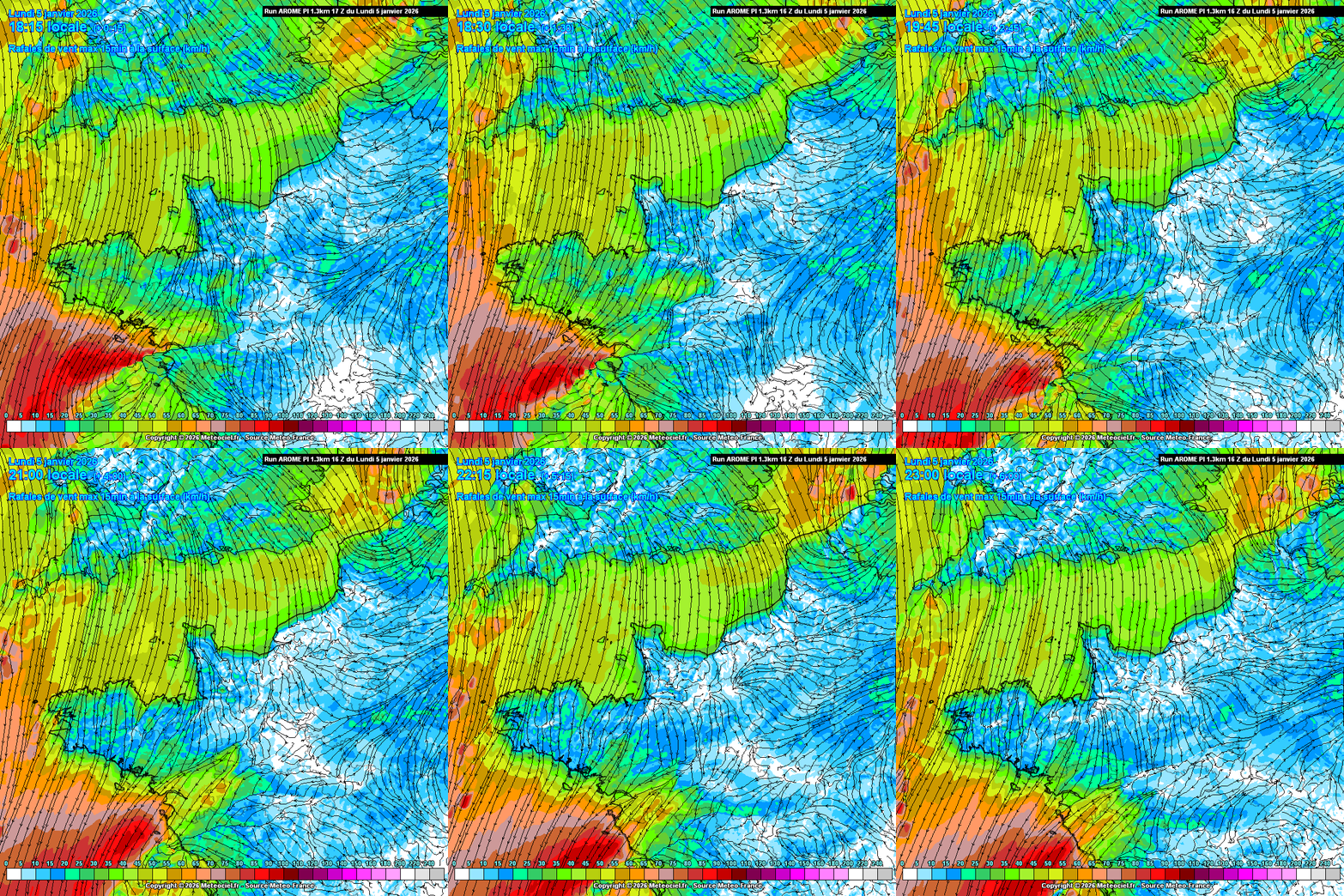
AIGFS

I thought the whole point of AI was that it didn't have to be "pointed" at anything, that it was "smart enough" to figure things out on its own. If I want a summary of current research in the field of, for example, atmospheric science there are compendia of scientific abstracts which do just that. The fact that ChatGPT "parrots" what it finds as it trolls the internet means that it is a poor example to use to justify other aspects of AI assisted analysis.
 
It doesn’t need to be pointed at anything specific during training. Modern GPT models are trained on effectively all text ever written by humans. That produces a language model that can interact with humans in any language naturally, but it needs to be pointed to source material to interpret in order for the answers to be valid and trustworthy. In a law firm you might point it at case law books and it can find relevant text, or at the case management system so it knows the house style for letters.
In the case of weather, it will train on all available data both in the field of weather and any relevant other data such as flight logs and shipping, gas and electricity consumption geospacial data etc. so it can work out what’s related. It would take human scientists thousands of years to achieve the same outcomes, if they ever even tried to make a correlation. Importantly, regular re-training can spot new trends, for instance when gas boiler are replaced by heat pumps the weather will certainly be affected.
As with GPT, it will also need relevant data for a given day, so the system will be able to decide what to reference and automatically access that data to provide a forecast. This will likely be iterative as it is now, with a big model working alongside localised refinement models.

The word is trawl, not troll. Trolling is a different thing and entirely human.
 
In which case, meteorology is well served. Ship data have been exchanged freely between nations since the 185os and all are available to all weather services in digitised format. A small amount of earlia data are also available. I cannot now recollect when aircraft data were first systematically collected and archived, presumably post ww2. Most, along with radio-sonde data are available through international agreement, via WMO. Some satellite imagery are available from the 1960s but infrared and microwave sounding data are available from 1979. RNSS-RO data are available operationally since 2007.

The quality/time/space/resolution of all the various in situ systems has changed and, generally improve of the period referred to. Nowadays, the largest quantity of data are from satellite. A major problem in the later years of the last century was the integration of these with accurate in situ data. A serioys problem is in the vastly different data volumes. For these reasons, at least in part, initial trials of AI forecasts have used the carefully produced ERA5 data. It has yet to be seen if use of raw observational data Wii do better.

As someone who has been closely involved with NWP prediction, satellite systems, data and observations, I know enough to be cautious when new ideas are being trialled. AI forecasting is on the way but those involved in operational use will proceed carefully and cautiously. Safety of life, property and commercial interests will be at stake.
 
Ship data have been exchanged freely between nations since the 185os and all are available to all weather services in digitised format.
It was just one example that’s easy to see the benefit of. Knowing how much fuel was burned, where and when gives a clear mapping to emissions and most people can see the link from there to the weather. Same with home heating. The advantage of AI/ML is that we don’t have to spend years with teams working out how those things have an effect. The data os processed, the patterns are found, and the outcomes follow. When the patterns change the model will spot the changes immediately on retraining without having to tweak parameters. New tech like electric cars and heat pumps or even wind farms and solar won’t trip up forecasting and more importantly won’t need research ahead of time to incorporate because for forecasting it doesn’t matter why they cause an effect, the science can come later.
 
It was just one example that’s easy to see the benefit of. Knowing how much fuel was burned, where and when gives a clear mapping to emissions and most people can see the link from there to the weather. Same with home heating. The advantage of AI/ML is that we don’t have to spend years with teams working out how those things have an effect. The data os processed, the patterns are found, and the outcomes follow. When the patterns change the model will spot the changes immediately on retraining without having to tweak parameters. New tech like electric cars and heat pumps or even wind farms and solar won’t trip up forecasting and more importantly won’t need research ahead of time to incorporate because for forecasting it doesn’t matter why they cause an effect, the science can come later.
Not sure what you are saying. My text that you picked relates to the establishment of marine archives back to the late 1800s. I have sometimes misread your posts. You have repeated the compliment!
 
Not sure what you are saying. My text that you picked relates to the establishment of marine archives back to the late 1800s. I have sometimes misread your posts. You have repeated the compliment!
I’m saying that shipping affects weather. It’s well understood at this point, same for air traffic. We have the date to understand where and how much fuel was used, and therefore emissions, and therefore the effect on weather of those things.

There are thousands of such examples which will feed AI models with no understanding necessary just by supplying the data. Humans couldn’t replicate that if they were given a thousand years to work the problem. Current weather models use a tiny percentage of data, and that data is skewed heavily towards weather observations
 

Other threads that may be of interest

Top