franksingleton
Well-Known Member
I tried to explain earlier. I will try again.I think in another thread you also indicated a distrust of these models.
Why is this?
As someone who has to make decisions, who has to point the boat one way or another, I find them _extremely_ useful.
For coastal and inshore races that last say up to two days, I typically only occasionally look at global models once the race has begun.
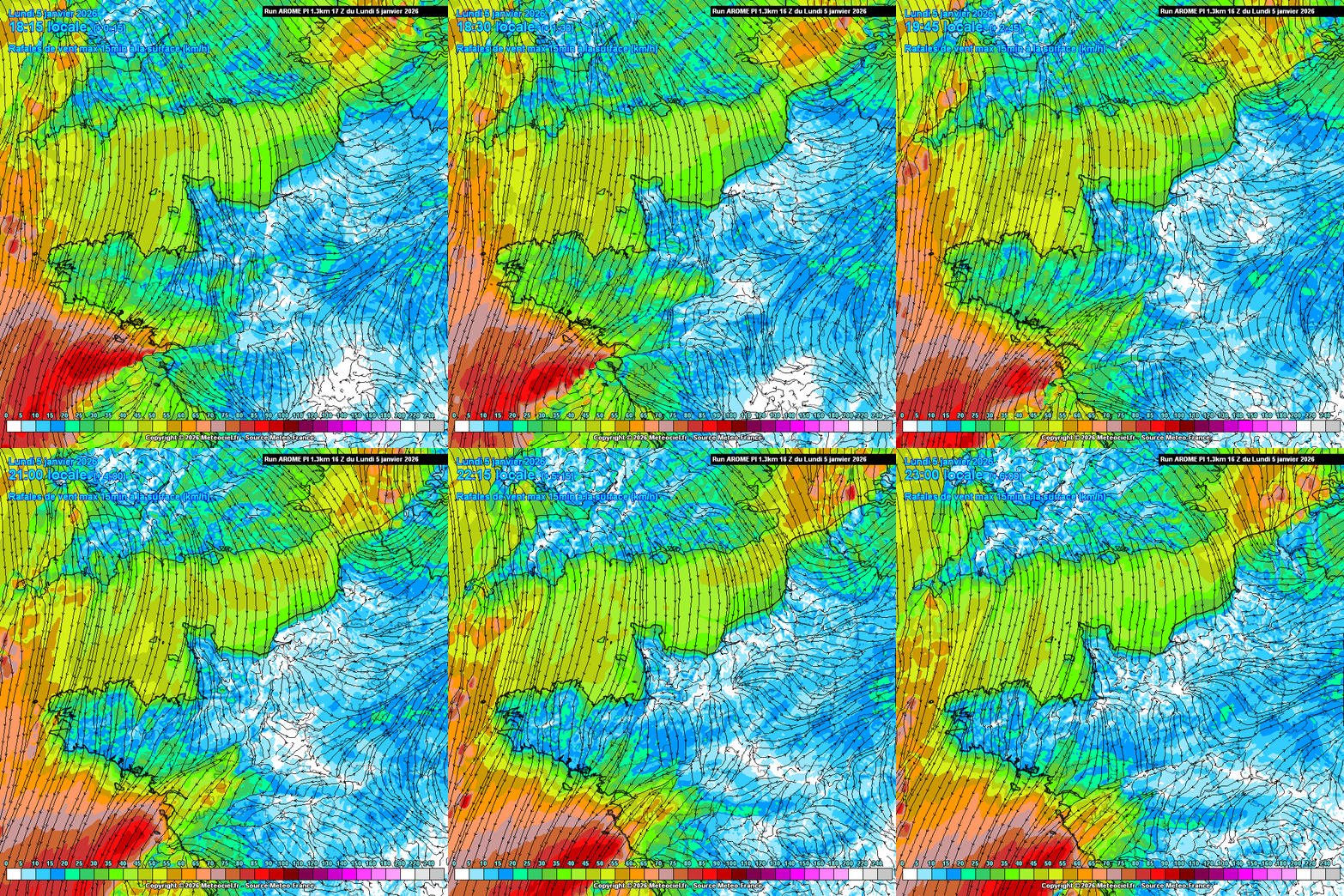
I have used HRRR for racing more than Arome, and much more than UKV, so I can mostly talk about that. The 1hr update frequency is really valuable. I pay close attention to whether f0, f1... match what I see - my instruments, and local weather stations - and when it does, i often go with it.
If the model initializes well, and it says if i go left, i can tack on a header in 3 or 4 hours - there is a good chance I am going to do that. And, I trust the high res model much more for the timing of the header than a global model. The global models take longer to assimilate data, longer to run and longer to release, so they are already old by the time i get them.
Another thing they can be really good at is local variation in wind speed and direction - which side of the course is going to have more pressure? Is one side going to have a slightly more favourable angle?
Have I ever been misled by these models - yes. But I think in part, it is my fault for not using the model correctly. For example, if a new run comes out suggesting a big change in the race strategy - maybe wait for the next run to see if it is confirmed.
Racing puts you in a situation where no decision is not an option, and you also can't wait forever to make a decision. So, the question is; what information are you going to use to help you make those decisions? Hi res models are not perfect, but they are probably the best thing available.
I am really looking forward to the new AI hi res models.
See Numerical weather prediction models. The area covered by UKV is 622 km from east to west, 810 km north to south. The starting point has no fine scale data outside that area. At a fairly normal speed a weather feature can, typically, move at 20 kts, 40 km/r roughly. So, if you are near the west of the British Isles, in a very few hours the weather that you experience will have originated in an area where the computation grid is 4km spacing ie from an area where the effective resolution is about 20 km.
The outer domain for UKV is 950 x 1025 km, beyond that the UK UM has a 10 km grid, 50 km effective grid.
As I said earlier, the main input to UKV is the gloral model. It can, or should, improve on the global model but, depending on where you are, maybe only for a short time. My word “distrust” was mot well chosen in isolation. I should have said something like, “distrust claims to be better or more useful.” Small weather details have short lifetimes. Beyond very few hours, UKV and any other detailed model will only show what could happen. Such models cannot, for example predict that a shower will form over a specific area.
Doing a Channel crossing, my main input would be the global model. In the event of the weather being marginal, as happened 0n our return this year, I might, but rarely have done, take a look at UKV and/or AROME.
Detailed models have their short term uses especially in severe weather where they are a valuable asset for specific locations. For the reasons above, their use is limited. Great for telling me if I can walk down to the village and back in the dry this morning.
Last edited:
 )
)