
Adding anchor warp to existing chain

The diagram is wrong. Over the tops of the pulleys, there are only two strands which are taking all the load as the tension must be transferred through the rope. Statically it doesn't work in my view.
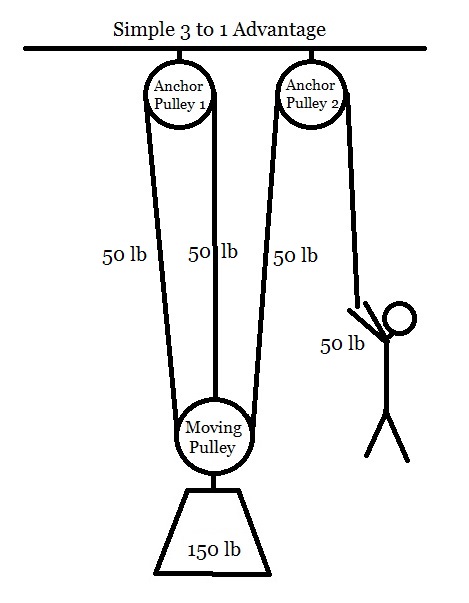
3-to-1-Two-Pulleys-up-Top.jpg


If the string in the picture has a breaking strain of 50lb you can still use it to lift 150lb if it is trippled up .... any single strand still has a breaking strain of 50lb.

With a 3-strand splice on a link, with all 3 strands used you have doubled up to 6 strands on the link itself, so the attachment at the link is stronger than the rope - even though the double-back on the link weakens the strands (and why for a really strong splice you would use a thimble.)

Because it is a splice, it tapers back to 3 strands of the original rope - the 3 strand rope remains the weakest link, not the splice.

If you only use 2 strands, then that is doubled up to 4 in the splice so it is still pretty much as strong as the rope itself which is only 3 strand. With the doubled-back strands weakened, it appears to be 97% as strong as the original rope - which is close enough to be considered workable.

That is the theory behind the 2-strand claim, I don't particularly like it and used all 3 strands on my splice, but it appears correct.

Perhaps someone more knowledgable can provide clarification.
 
We also have a Quick windlass and have chain and then octoplait.
We find the windlass is able to pull the chain and the octoplait but the join does not go smoothly round and into the locker, indeed it has twice bent the plastic lever which stops the chain jumping off the drum. So the method now is to use the windlass to bring the octoplait in almost to the join - though often this is quicker and easier by hand as there is little tension until the chain gets off the bottom. Then an extra pull of a couple of feet by hand and quickly push the join through the hole into the locker and wrap the chain around the drum to then continue using the windlass.
 
For those of you with rope / chain rode, does your rode pass through the windlass then down the chainpipe into the locker or do you have an open chain locker.

I used to have all-chain, which would be my preference, but the bow of the boat is quite fine and overhanging and just isn't buoyant enough to support the weight properly. I'd rather put the weight I can carry into the anchor than into chain, so I have a mere 20m and the rest rope.

I've gone a size larger on the rope than I perhaps should have, and on the way into the locker the rope/chain splice occasionally gets wedged in the narrow right-angled chainpipe built into the windlass. A quick yank pulls it through though. That apart, the octoplait feeds through neatly and lays into the bottom of the locker all on its own. I don't think it's ever tangled coming back out. The rope is actually better behaved than the chain, which tends to build up into a pyramid that needs to be knocked over a couple of times during each retrieval. I expect three-strand would be slightly less compliant (though maybe not enough to be a problem) as it's less floppy and flexible than plait.

Pete
 
I used a back splice to join 8mm chain to 14mm 3-strand nylon. One of the reasons I went for a part-rope rode is that I don't have a windlass, I can recover this by hand.
 
The diagram is wrong. Over the tops of the pulleys, there are only two strands which are taking all the load as the tension must be transferred through the rope. Statically it doesn't work in my view.

You might be concerned though, about only using two strands to hold your chain instead of all three. In a sense, you have reduced the strength of the rope from three strands to only two!

The truth is, this splice is stronger than the three strands, as the two strands that are working are folded over and tucked back into the rope. This creates a 2:1 on each strand, meaning that there are actually 4 strands holding the force of the chain! That's right, you started with three strand rope and ended up holding the chain with four strands.

https://www.riggingdoctor.com/life-aboard/2017/5/25/rope-to-chain-splice

Differences of opinion I guess.
 
The diagram is wrong. Over the tops of the pulleys, there are only two strands which are taking all the load as the tension must be transferred through the rope. Statically it doesn't work in my view.

Please explain
* The tension on the rope must be the same at all points or the pulley would just rotate (assume no friction for simplicity). Put another way, if the tension was different at any point, the rope would move in that direction. Thus, the tension up, around the pulley, and back down are all 50 pounds.
* There are 3 ropes on the moving pulley = 150 pounds.

Textbook engineering statics.
http://i.imgur.com/3y1h2Vd.jpg
 
Thanks Bob - what diameter chain and rope? Leaning towards 3-strand; I would live with the reduced flexibility in return for hopefully a better journey through the windlass and down
 
^^ This. I've used this splice for years. Very smooth through the windlass.

+1.

The Rigging Doctor's pictures shown in thinwater's link show the splice I use, although I took the design of it from Brion Toss' excellent book. It does not diminish the strength of the splice through putting only two strands through the chain as there are effectively 4 strands sharing the load and they lie neater anyway which probably increases their strength compared to three strands through the chain link.
 
Last edited:
But you do need a gypsy that will accept both rope and chain.

OR

You need to retrieve rope by hand, which can be fairly easy (and neatly coil) then feed the splice through the gypsy to 'attach' chain to windlass, then retrieve chain - trying to keep the rope separate from the chain (and then take the neat coil of rope and hang away from the chain (to keep the chain as dry as possible). If you have 'enough chain you might find you only need the rope occasionally.

Wet salt rope (and muddy damp chain) will reduce chain life considerably.

Jonathan
 
Last edited:
Thanks Bob - what diameter chain and rope? Leaning towards 3-strand; I would live with the reduced flexibility in return for hopefully a better journey through the windlass and down

Sorry, but not on the boat and don't have the sizes to hand but will get them at the weekend.
Be aware that when we bought the boat it had chain attached to 3-strand. The joint was much bigger than we have with the octoplait and the 3 strand was very stiff itself. Octoplait if very soft/easy to handle/flakes nicely in the locker and the join (at least mine is) thinner but longer but makes the chain less flexible over the length of the join.

I used this splice: https://jimmygreen.com/content/182-anchorplait-splicing-instructions-2
 
Last edited:
Octaplait construction is about 20-30% less abrasion resistant than 3-strand when rubbed side-to-side over rocks (I've done side-by-side testing for publication). The stands are more prone to being plucked out and cut. This is true of any relatively loose braid, including Dyneema braids.

Chafe over the bow roller and on relatively smooth surfaces is not as weave dependent.
 
I wonder if hardened, old, 3 strand nylon has the same abrasion resistance as new nylon?

Jonathan

Maybe I will test that. But I need to understand the question Do you mean:
* Old nylon vs. new nylon.
* Old 3-strand vs. old octaplait.
* Hard lay 3-strand vs. soft lay 3-strand. I know the answer to this one. Hard lay is MUCH more abrasion resistant, more than double.
 
Old 3 strand that has become hard, its aged, vs the same cordage bought new and is still soft and flexible. If it is easy - old 3 strand vs old octaplait (though I suspect old octaplait will still be less abrasion resistant) - but I should not guess (nor speculate).

Jonathan
 
I have a south Pacific windlass and the instructions recommend 3 strand nylon as a lot of octoplait is to soft for the gypsy to grip. My 3 strand is back spliced on to the chain and this goes round the gypsy ok. Problem with 3 strand is that it requires assistance to fall into the locker which does make retrieval slower.
 
I've got to believe that much of the behavior is dependant on the specific windlass, rope, and locker geometry. Otherwise there would not be so many conflicting posts.

I had a V700 with a combination rode (50 meters chain, balance 3-strand) on my PDQ, and these are the facts:
* Normally I anchored on the all-chain portion, since anchoring, for me, in the Chesapeake is very, very seldom over 3 meters. However, during anchor testing I often laid out rope when testing at very long scope.
* The rope recovered faster and mounded less than chain. No problems at all, not ever. No tangles. I did have a large, deep locker.
* An elongated splice (weave through multiple links, AKA shovel slice in the US) would not wrap around the gypsy. Yes, I plaid with a looser weave.
* A back splice would jam ~ 40% of the time during recovery. More when new, better as it aged. Yes, I played with a soft splice.
* A 4-strand splice (AKA irony splice in the US) flies through the windlass.
* Never tried octaplait. Why would I, if it chafes more easily, which it provably does?

Curiously, others have completely different experiences. Thus, it depends on the geometry. It is also a shame that some have to choose ground tackle (rode and anchor) based on boat design. That's a poor selection basis, but I understand the need.
 
Maybe this is something that is widely known and used but just in case it’s not…a very knowledgeable chap at our boatyard has just told me to splice my rode about a foot from the end of the chain. This way the loose bit can be fed easily on to the gypsy without having to manually pull the slack up.
Edit This of course will only be of any use on those windlasses which have two drums. Like mine.
 
Last edited:
Top