Acetal for engine mount shims .

Thanks for reply. Do you have some figures for that? And/or what are you basing your opinion on. Most sources i find say it is particularly dimensionally stable.
Weaknesses seem to be chlorine and mineral acid.
Polyoxymethylene - Wikipedia
Its resistance to compression is ~20th of that of steel; it's dimensionally stable by polymer standards.
 
Good points, thank you. My mounts are Aluminium. Not much rust. So they are spacers nit shims. It is what it is if i want the shaft down the centre of the tube and the height in the r&d miunt to be within tolerance.
If it is 20mm out then packing under each individual mount is perhaps not a good idea. Had exactly the same issue with mu new installation where a combination of a change in gearbox and mis measurement (not by me!) resulted in a similar shortfall in bed height. Proper answer was a 20mm hardwood strip the whole length of the beds screwed and glued. I did suggest individual spacers and installer refused.

So, suggest you do it properly and raise the whole beds. Mine are solid timber but if yours are GRP then glass over.
 
If it is 20mm out then packing under each individual mount is perhaps not a good idea. Had exactly the same issue with mu new installation where a combination of a change in gearbox and mis measurement (not by me!) resulted in a similar shortfall in bed height. Proper answer was a 20mm hardwood strip the whole length of the beds screwed and glued. I did suggest individual spacers and installer refused.

So, suggest you do it properly and raise the whole beds. Mine are solid timber but if yours are GRP then glass over.
Phew, cheers for that. Engine in and staying in. I only need 20mm at for'd end of engine. 6mm would do at aft end. Mine are fibreglass beds with encapsulated 1/2" steel into which engine mount bolts are tapped. But i will give it another coat of looking at.

Mine was a "professional" reinstall last year.
 
Phew, cheers for that. Engine in and staying in. I only need 20mm at for'd end of engine. 6mm would do at aft end. Mine are fibreglass beds with encapsulated 1/2" steel into which engine mount bolts are tapped. But i will give it another coat of looking at.

Mine was a "professional" reinstall last year.
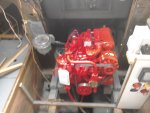
Then perhaps hardwood and epoxy the edges. However as you can see from the photo I have just used Danboline, same as the original 1979. You can just see the 20mm spacer bottom left. I would still run the spacer forward to the front of the bed and aft about 10c m. How did they get it so far out?
 

Attachments

  • IMG_20220906_122129.jpg
    IMG_20220906_122129.jpg
    605.8 KB · Views: 29
Thanks for input. Google tells me acetal good for continuous operating temp of 115C. And very stiff and good dimensional stability. Also unaffected by repeated heating and cooling. My alternator is limited to 100C. Also oceonflex cables will melt before then i think.
Creep occurs without thermal input. It is the very slow change of shape that takes place under load, even at room temperature. As a demo we hang a weight on about a metre length of solder wire. In a week it will extend by several centimetres.
 
Can you use hardwood strips? I have under mine for the last 10 years with now problems. M16 mounts
Thank you, that gets me thinking acetal is ok. I can't quickly find any figures but acetal is a lot harder etc than wood. They make bearings out of acetal.
 
I think a previous owner of my boat might have been faced with the same problem as the OP. Presumably when doing an engine change.

She has wooden engine beds encapsulated in GRP.
Bolted on top of the these are lengths of mild steel strip, ca 50mmx10mm in cross-section.
Where the four current flexible mounts are located, short lengths of the same size m/s strip have been welded, tapped to take the two machine screws holding down each flexible mount.
 
I would use spacers rather than extended studs, most av mount manufactures have max thread spec which can be quite short.
As I understand from previous research in this area, a long time ago, around 10mm or 3/8th of an inch was max thread length. Had an engine that kept breaking injector pump springs due to excessive thread length causing vibration including, importantly, "Harmonics" Ended up with spacers under the mounts and problem solved.
 
Thank you, that gets me thinking acetal is ok. I can't quickly find any figures but acetal is a lot harder etc than wood. They make bearings out of acetal.
Acetal was developed to compete with aluminium castings. Wood creeps according to my googling. If hardwood is satisfactory it seems to me acetal is ok.
 
As I understand from previous research in this area, a long time ago, around 10mm or 3/8th of an inch was max thread length. Had an engine that kept breaking injector pump springs due to excessive thread length causing vibration including, importantly, "Harmonics" Ended up with spacers under the mounts and problem solved.
It does seem a crude arrangement although seemingly endorsed by engine suppliers such as Beta, whose sales literature photos mostly show their engines mounted in this way.

One major disadvantage seems to me to be that unless there is sufficient exposed thread above the mount to accommodate two nuts locked together, or a stud extractor, so that the studs can be removed, it will be impossible to renew the flexible mounts without lifting the engine.
 
It does seem a crude arrangement although seemingly endorsed by engine suppliers such as Beta, whose sales literature photos mostly show their engines mounted in this way.

One major disadvantage seems to me to be that unless there is sufficient exposed thread above the mount to accommodate two nuts locked together, or a stud extractor, so that the studs can be removed, it will be impossible to renew the flexible mounts without lifting the engine.
Strange that you should mention Beta! It is an acceptable solution with limitations.
 
It does seem a crude arrangement although seemingly endorsed by engine suppliers such as Beta, whose sales literature photos mostly show their engines mounted in this way.

One major disadvantage seems to me to be that unless there is sufficient exposed thread above the mount to accommodate two nuts locked together, or a stud extractor, so that the studs can be removed, it will be impossible to renew the flexible mounts without lifting the engine.
My yanmar, i can undo the engine bracket/foot complete with engine mount and remove. Obviously one at a time and supporting engine appropriately.
 
Thank you, that gets me thinking acetal is ok. I can't quickly find any figures but acetal is a lot harder etc than wood. They make bearings out of acetal.
Not sure why you are worried about "hardness" nor rust, nor cost. Mahogany, Iroko, Teak or even good quality ply will be fine. Bed down in CT1 or similar. As I suggested extend 10cm fore and aft of the mount and maybe put a couple of screws towards the ends. That will outlast the engine!
 
Top