
1994 Fairline Targa: Electrics Confusion

Paul - thanks - I recall seeing ss tube on the boat but wasn't sure what it was for. When next at the boat I'll test it for fit.
Is there a YouTube video of this pump being operated?
Nothing to it, just stick the handle in the hole and pump it up and down. I think you will find the black lever at the bottom selects where it pumps from, usually a manual pickup next to each electric pump.

A Brother label printer would be a good investment for you.
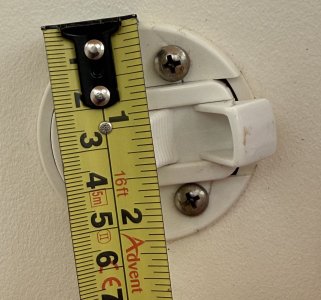
 
Maybe from Southco google should help.
The existing latches have Soutco printed on their reverse - so you're bob on with this.
Their website has literally hundreds of latches. I measured mine in the photo to be between 5 and 6 cm across (2 and 1/4 inch?). The site asks for depth of wood on cupboard door - something I didn't measure! Is the thickness of the doors on the cockpit fridge and cupboard next to it the same size? Have you or anyone ordered the s/s replacements from Southco for these specific cupboards? If so, what spec latch did you purchase from Southco?Door Catch Height.jpg
 
Ref the manual bilge pump, I believe the diaphragms are prone to perishing so if you think you'd find it useful then it would be worth testing it.

To be honest, IMHO, if you're sinking and the electric pump has failed you're unlikely to make any meaningful difference with the manual pump. You'd be better off trying to work where the water is coming from, getting assistance or beaching the boat.

What I would test is the float switch (these are prone to failure too) and that it's sounding an alarm at the helm when operating.
 
@ClaytonDJ it feels like the number of issues with your electrics is building up. Even if you can find a wiring diagram for the boat it won't tell you much more than the individual circuits are protected with a breaker plus a helm or interior switch as applicable. At best, it will tell you the rating of the breaker and the wire colours.

Unless you're particularly practical then it might be worth paying for a local boat sparky to spend a couple of hours diagnosing issues with you.
 
@ClaytonDJ it feels like the number of issues with your electrics is building up. Even if you can find a wiring diagram for the boat it won't tell you much more than the individual circuits are protected with a breaker plus a helm or interior switch as applicable. At best, it will tell you the rating of the breaker and the wire colours.

Unless you're particularly practical then it might be worth paying for a local boat sparky to spend a couple of hours diagnosing issues with you.
Thanks Pete - sound advice. Keen to explore and gather as much info and intel as I can before shelling out even more money. It feels like I've been propping up the Spanish economy these last few months 😀
 
Ref the manual bilge pump, I believe the diaphragms are prone to perishing so if you think you'd find it useful then it would be worth testing it.

To be honest, IMHO, if you're sinking and the electric pump has failed you're unlikely to make any meaningful difference with the manual pump. You'd be better off trying to work where the water is coming from, getting assistance or beaching the boat.

What I would test is the float switch (these are prone to failure too) and that it's sounding an alarm at the helm when operating.
I'll test what I can when next at the boat (mid-June). Agree making sure the electric pumps work is a must do.
 
The 1994 Targa 38 has what I believe to be the original navigation equipment onboard.
It comprises a Raytheon Radar Dome, Raytheon RL9 LCD Radar Unit and a Raytheon Raychart 600xx charting system.
The RL8 screen powers up and displays a very faint grid - but not really clear enough to use. The Raychart unit doesn't power up (at least I can't tell whether it does or not), and the dome itself is still wired but I'm not convinced it rotates inside.
Not immediately (I have other fish to fry first), but a complete replacement is in order.

My primary need is a chart plotter and transducer so that I can plan trips out, and have real-time info displayed about position, depth, etc. I will add radar later (unless a complete bundle comes up at a price that cannot be refused).
Motor cruiser not sailing - so have ruled out B&G. Leading candidates appear top be Raymarine, Garmin and Simrad. Aware that Raymarine has been the defacto standard for many years - but also that Garmin has come a long way in recent years. I have a 6m RIB with Garmin chartplotter onboard, and a Garmin handheld GPSMAP - so familiar with Garmin.

Since I will be starting from scratch - my thinking is to install a powered network backbone - then attach the devices to it as I add them to the system. Is NMEA the way to go? Trying to avoid too many different systems requiring proprietary gateways and software to talk to one another - so really looking for a single supplier solution.

Welcome views (and pros/cons) on the most straightforward and uncomplicated solution that can be built incrementally.
 
The 1994 Targa 38 has what I believe to be the original navigation equipment onboard.
It comprises a Raytheon Radar Dome, Raytheon RL9 LCD Radar Unit and a Raytheon Raychart 600xx charting system.
The RL8 screen powers up and displays a very faint grid - but not really clear enough to use. The Raychart unit doesn't power up (at least I can't tell whether it does or not), and the dome itself is still wired but I'm not convinced it rotates inside.
Not immediately (I have other fish to fry first), but a complete replacement is in order.

My primary need is a chart plotter and transducer so that I can plan trips out, and have real-time info displayed about position, depth, etc. I will add radar later (unless a complete bundle comes up at a price that cannot be refused).
Motor cruiser not sailing - so have ruled out B&G. Leading candidates appear top be Raymarine, Garmin and Simrad. Aware that Raymarine has been the defacto standard for many years - but also that Garmin has come a long way in recent years. I have a 6m RIB with Garmin chartplotter onboard, and a Garmin handheld GPSMAP - so familiar with Garmin.

Since I will be starting from scratch - my thinking is to install a powered network backbone - then attach the devices to it as I add them to the system. Is NMEA the way to go? Trying to avoid too many different systems requiring proprietary gateways and software to talk to one another - so really looking for a single supplier solution.

Welcome views (and pros/cons) on the most straightforward and uncomplicated solution that can be built incrementally.
As far as i'm concerned Garmin is the only way to go, reliable and the best customer service by a mile.
 
As far as i'm concerned Garmin is the only way to go, reliable and the best customer service by a mile.
Paul - that's one vote for Garmin. I'm attracted to Garmin because I already use it on my RIB.
I guess my spec needs to be driven by the size screen I need (want) and where I can mount it at the helm, and its integration capabilities. Once I have the MFD installed - I'd like to add radar and AIS. My basic needs are to know where I am, where I'm heading, ability to plot waypoints and monitor progress, and collision avoidance (hence radar and AIS).
 
I like Simrad and Garmin stuff. Not a fan of Raymarine. I have found over the years that I never actually ploted a multi point route. In the med it is most coastal stuff with the odd long run which tends to be in a straight line, so you just plot an arrival point within sight of the destination. I like paper charts too. I like to have a good idea in my head where the rocks etc are along the way.
I have found it better/easier to have a local pilotage plan/notes for getting in and out, which you can get from almanacs and sailing guide books. Not sure I would bother with a radar again. Only ever used it once in anger and that was off Liverpool.

Simple is good with a suitable screen size. Too small and it hard to read when the boat is moving.
 
Ref nav gear, it's horses for courses. We've got a T34 in Spain and have never used the radar or AIS. The essentials for me are a working decent depth gauge, a plotter and an autopilot. A DSC radio that's either integrated or has it's own GPS receiver is useful too.
 
I like Simrad and Garmin stuff. Not a fan of Raymarine. I have found over the years that I never actually ploted a multi point route. In the med it is most coastal stuff with the odd long run which tends to be in a straight line, so you just plot an arrival point within sight of the destination. I like paper charts too. I like to have a good idea in my head where the rocks etc are along the way.
I have found it better/easier to have a local pilotage plan/notes for getting in and out, which you can get from almanacs and sailing guide books. Not sure I would bother with a radar again. Only ever used it once in anger and that was off Liverpool.

Simple is good with a suitable screen size. Too small and it hard to read when the boat is moving.
 
Another vote for Garmin.
Straightforward requirement emerging - MFD (basic chart plotter with scope to expand in future to integrate AIS/RADAR if need arises), good size screen (which I'm taking to be minimum of 9" and possibly 12"), push buttons if available (rather than touch screen), good depth sounder (thru hull transducer), good chart-plotting functionality and supported maps - oh and a DSC VHF with integrated GPS (I've just fitted an Icom to my RIB that has this).

I'm assuming most new MFDs have the option to wire direct or use powered network backbone (NMEA 2000)?
 
Another vote for Garmin.
Straightforward requirement emerging - MFD (basic chart plotter with scope to expand in future to integrate AIS/RADAR if need arises), good size screen (which I'm taking to be minimum of 9" and possibly 12"), push buttons if available (rather than touch screen), good depth sounder (thru hull transducer), good chart-plotting functionality and supported maps
I have a Garmin GPSMap 1223xsv. It is touch screen, but i've never had an issue with that, if i did i'd just fir a remote, which, IMO, is usually better that buttons on the MFD because you can fit it where you can easily reach it. I also have radar, AIS, VHF DSC and down scan sonar (plus some other stuff). The radar is very good, if you need it. The AIS is very useful in UK waters, not sure about the Med. The VHF is also Garmin, this allows me to initiate a DSC call with a AIS target by touching it on the screen.

Downscan sonar is good, but if you don't want/need the level of detail (probably don't in the Med) you can just fit a N2K transducer, in which case you can fit an in hull one, save cutting a hole in the hull.

Lots of other stuff you can add, if you want or if you just like toys ;) I have engine data, trim tabs, tank levels, battery and power monitoring etc all on the N2K network. Also have a Reactor 40 autopilot, which utilises the original hydraulic autopilot pump, so i only had to buy the electronics pack.
- oh and a DSC VHF with integrated GPS (I've just fitted an Icom to my RIB that has this).
See my comments above, worth considering a Garmin VHF if you think you might fit AIS. For AIS i would not buy the Garmin one, it's actually made by SRT, the parent company of Em-Trak, but costs more money. I'd fit the Em-Trak one.
I'm assuming most new MFDs have the option to wire direct or use powered network backbone (NMEA 2000)?
No, you cannot power a MFD from N2K, has to have it's own power supply.
 
I have a Garmin GPSMap 1223xsv. It is touch screen, but i've never had an issue with that, if i did i'd just fir a remote, which, IMO, is usually better that buttons on the MFD because you can fit it where you can easily reach it. I also have radar, AIS, VHF DSC and down scan sonar (plus some other stuff). The radar is very good, if you need it. The AIS is very useful in UK waters, not sure about the Med. The VHF is also Garmin, this allows me to initiate a DSC call with a AIS target by touching it on the screen.

Downscan sonar is good, but if you don't want/need the level of detail (probably don't in the Med) you can just fit a N2K transducer, in which case you can fit an in hull one, save cutting a hole in the hull.

Lots of other stuff you can add, if you want or if you just like toys ;) I have engine data, trim tabs, tank levels, battery and power monitoring etc all on the N2K network. Also have a Reactor 40 autopilot, which utilises the original hydraulic autopilot pump, so i only had to buy the electronics pack.

See my comments above, worth considering a Garmin VHF if you think you might fit AIS. For AIS i would not buy the Garmin one, it's actually made by SRT, the parent company of Em-Trak, but costs more money. I'd fit the Em-Trak one.

No, you cannot power a MFD from N2K, has to have it's own power supply.
Thanks Paul - stunningly useful.

There is already a thru-hull hole plugged with an old/crusty wheel for measuring speed (unreliable even when new). My plan was to remove the wheel thing and replace with a thru-hull transducer for depth. Is thru hull any more reliable than an in-hull transducer?

On my RIB I have a Garmain Echomap UHD 6cv paired with a GT24UHD-TM CHIRP transducer. Also fitted the Icom M330GE VHF/DCS radio with internal and external GPS antennae. I also have a handheld Garmin GPSMAP 86S as backup.

Point about MFD needing its own dedicated power supply from battery noted. So does plugging the NMEA backbone into the MFD provide the backbone with its power, or does the NMEA require its own dedicated source as well?

I'll start simple with a basic MFD and transducer - but one that is future proofed and allows me to add AIS, RADAR, engine monitoring toys, at a later date.

For clarity, are you saying that if I want AIS, to consider a Garmin VHF or Em-Trak VHF?
 
Top