
You Favorite Mis-Used Naultical Jargon

Yes and on the UK canal sydten at locks.
( I can't correct my typo because when I try, it will obliterate the whole post, plus your quited bit. SYSTEM!) WU I GIVE UP
Probably because you are doing it on a mobile? The old system used to do that, I found it was easier if it was a short post, to delete it and start again rather than try to edit.
 
Although "gybe" can be traced back to the late 17th century (from the Dutch "gijb"), "jibe" has been in use since the 18th century - including by James Cook (almost - he spelled it "jib").

hTwp81N.png
So it's not just the French that get confused between "jib" and "gybe" :)
 
Please forgive the drift, but here’s a curiosity: a late C19th etymology for the term caucus (for a meeting of supporters) had it deriving from a meeting of Boston caulkers in the early C18th. :geek:

(No clear etymology has been established, an alternative being Algonquian words for counsel, or for advisor. Either way, the plural is caucuses, not the Latin analogue cauci.)
 
Please forgive the drift, but here’s a curiosity: a late C19th etymology for the term caucus (for a meeting of supporters) had it deriving from a meeting of Boston caulkers in the early C18th. :geek:

(No clear etymology has been established, an alternative being Algonquian words for counsel, or for advisor. Either way, the plural is caucuses, not the Latin analogue cauci.)
That sounds like spurious latinization of a word - it's a common enough phenomenon, arising from the perceived superiority of classical languages in that period (every educated person knew Latin in those days; it was regarded as the foundation of education). The remnants of it were still around when I ws a schoolboy; Latin was a compulsory subject in the grammar school I attended (the very term "Grammar School" refers to the teaching of Latin). With hindsight, I actually regard it as one of the more useful topics that I studied - it means that I can make out most southern European languages and have a handle on the derivation of many English words.

There's a rather nice inversion of that kind of snobbery in Cambridge. There's a college called Gonville and Caius. It's always pronounced Gonville and Keyes. The reason is because a merchant called Keyes re-founded Gonville college, and as was the custom in those days, he latinized his name. However, as he was a self-made man and not a member of the upper classes, this was perceived as presumptious, so the latinization was always disregarded when speaking of the college!
 
My son sometimes acted as crew boss on corporate day out charters. He would deliberately use non nautical words such as, downstairs, bathroom, cupboard etc. The first person to correct him got the worst jobs.☺
 
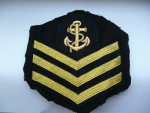
Also addressed by those of a lower rating as "Hooky".

Seen here with 3 "stripes" indicating 12 years of good conduct; or 12 years undetected crime, as we used to say.
View attachment 82538

I've always wondered why they use a foul anchor. Anyone wearing that badge who let the ship's anchor get like that would be in big trouble, as would the ship!
 
I've always wondered why they use a foul anchor. Anyone wearing that badge who let the ship's anchor get like that would be in big trouble, as would the ship!
The Oxford Companion to ships & the sea, edited by Peter Kemp, 1976, has the following explanation:

"The use of the foul, or fouled anchor, an abomination to seamen when it occurs in practice, as the seal of the highest office of maritime administration is purely on the grounds of its decorative effect, the rope cable around the shank of the anchor giving a pleasing finish to the stark design of an anchor on its own."

Fouled Anchors
 
Top