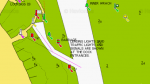
Yellow to port as you enter James Watt Dock

Yellow buoy, west or south cardinal - any of them would require a quick glance at a chart to make sure what is ahead. I remember the 1st time I went into JWD, single-handed of course, and even I managed to check what was on the chart. Here's another yin that wasn't armoured against ice and sank in the middle of the harbour after refloating.
WEB_Grounded-yacht-Greenock.-Credit-Craig-Scholte-2-630x354.jpg

WEB_The-sunken-yacht-at-Greenock.-Credit-Craig-Scholte.jpg

Reassuringly deep, though :rolleyes:
Donald
 
Yellow buoy, west or south cardinal - any of them would require a quick glance at a chart to make sure what is ahead. I remember the 1st time I went into JWD, single-handed of course, and even I managed to check what was on the chart. Here's another yin that wasn't armoured against ice and sank in the middle of the harbour after refloating.

Au contraire, surely the beauty of a Cardinal mark is that it is unambiguous. If forgetful or distracted, staying West of a West Cardinal and you should be fine. Even though also looking at a chart is clearly good practice, it is applying Darwinism rather harshly to suggest that navigation marks should be cryptic and meaningless. Perhaps the red and green buoys in the Clyde should be changed to alternate Blue and White to match the flag :)
And if multiple boats using their harbour are being damaged, and in at least one case sunk, on a hazard, surely it would be remiss of James Watt Dock not to seek to improve the marks, in conjunction with Clyde and NLB authorities.
 
Au contraire, surely the beauty of a Cardinal mark is that it is unambiguous. If forgetful or distracted, staying West of a West Cardinal and you should be fine. Even though also looking at a chart is clearly good practice, it is applying Darwinism rather harshly to suggest that navigation marks should be cryptic and meaningless. Perhaps the red and green buoys in the Clyde should be changed to alternate Blue and White to match the flag :)
And if multiple boats using their harbour are being damaged, and in at least one case sunk, on a hazard, surely it would be remiss of James Watt Dock not to seek to improve the marks, in conjunction with Clyde and NLB authorities.

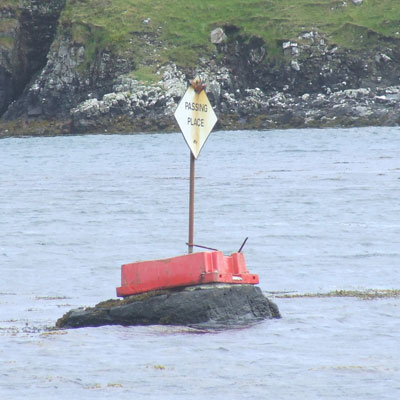
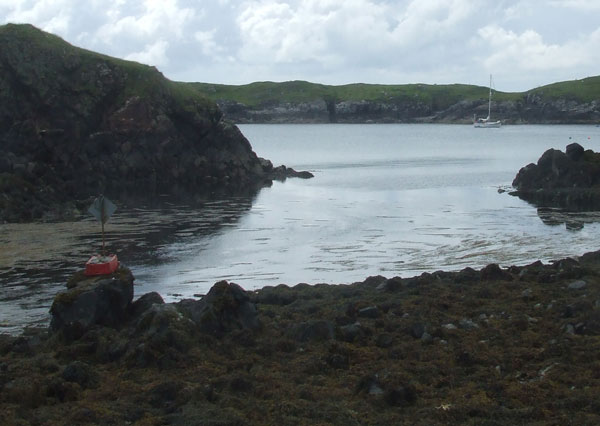
They could stick a pole in with a big firkin arrow & sign saying keep this side for JWD. I know it's not colregs compliant, but there are other examples, like the lighthouse near Puffin Island.
 
Au contraire, surely the beauty of a Cardinal mark is that it is unambiguous. If forgetful or distracted, staying West of a West Cardinal and you should be fine.

Aye, but there's the rub ..... stay west of a cardinal and you would never get into JWD. Make it a south cardinal and numpties would still go east of it.
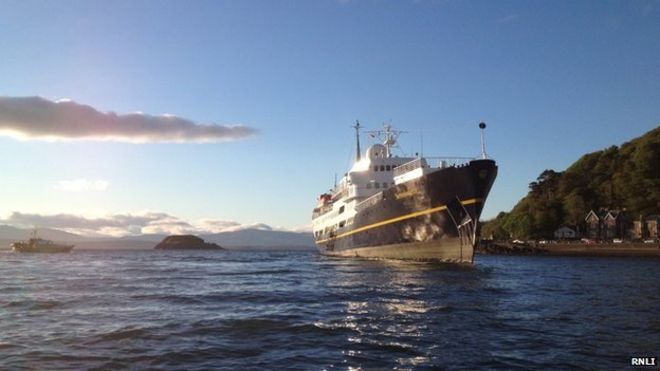
Oban Bay with its cardinals marking the Corran Ledge and the Scrat has collected a fine array of grounded vessels.

_67719695_cruiseship.jpg

The cruise ship Serenissima on the Corran Ledge.

Isle of Arran sailed from No.2 berth in Oban, bound for the island of Colonsay, a route on which the vessel was not normally engaged. After slipping, the vessel’s speed was increased and she headed towards Sgeir Rathaid reef, a hidden danger in Oban Bay 5 cables from the berth and marked by north and south cardinal marks. With the sun directly ahead, the master found it difficult to see through a dirty bridge window, and arranged for it to be cleaned. He then altered course to port with the intention of leaving the reef and a south cardinal buoy marking its southern extremity to starboard. Inexplicably, the turn was stopped early with the buoy still on the port bow. The master was alerted to the danger ahead by the second officer and, although full astern pitch was applied, Isle of Arran grounded momentarily on the reef. The vessel suffered substantial hull damage, but was able to return to her berth without assistance. There was no water ingress and no pollution.

... and there's a lot more!
 
Last edited:
Last edited:
See page 26 there's a red/green/red in the top left corner where the channels don't rejoin.

Yes but that's at the bifurcation of two channels.

The yellow on at JWM needs to be replaced with a buoy that shows the clear limit of a linear feature where there is only one side that is safe to pass.
A cardinal is the obvious choice.
A plain yellow less so.
 
Yes but that's at the bifurcation of two channels.

The yellow on at JWM needs to be replaced with a buoy that shows the clear limit of a linear feature where there is only one side that is safe to pass.
A cardinal is the obvious choice.
A plain yellow less so.
I think the problem as I understand it is that it is safe to pass either side of the linear feature, but not take a shortcut through it.
Donald
 
I was a denizen of JWDM for several years, and have heard of very few problems with the buoy - admittedly, one being my brother, despite clear "sailing directions" from me! However, he didn't hit anything as he realized early enough that "something wasn't right".

The buoyage in that area is mainly concerned with the ship channel leading up to Glasgow. The yellow buoy at JWDM is somewhat irrelevant to that, but it IS placed and maintained by Clydeport - NOT by JWDM. However, the point is that any alternative to a yellow buoy would be chosen with respect to the main ship channel rather than to the entrance to JWDM. The only real alternatives would be a green starboard buoy (as found near the Victoria docks) marking the southern extent of the primary channel, or a north cardinal. From the POV of users of JWDM, either would be even more confusing! Anything else would be confusing for a vessel heading up the channel to Glasgow, and that's the primary concern there.

The entrance is clearly marked on the charts, and the buoy marks the end of a fairly obvious danger - the spit concerned dries at low water, and is never far below the surface; indeed, I think there are one or two bits of rubbish that are always visible - but I'm not certain about that. Indeed, it was surface disturbance that alerted my brother, I think. Further, unless you're heading up the Glasgow, there isn't really any reason to consider passing east of the buoy - the direct route out into the channel is straight ahead, and you wouldn't be advised to turn sharply to Starboard, as you can't see up the ship channel until you're well clear of the entrance. Being run down by a commercial vessel heading out to sea could spoil your whole day! AIS isn't always reliable within the dock, as you're down within the dock walls, and ships in the channel may be masked. There's also the psychological issue that you'll already have ignored innumerable warnings within the dock, as the tugs that moor there will have sent your AIS into an electronic apoplexy.
 
Yes. You can. Either go up the main channel towards Dumbarton on the right hand side going upstream or straight into JWD. What you cannot do is take a shortcut across what was a linear breakwater which is covered at high tide.

Donald
 
Surely having smaller lateral buoys then the main channel ones would be fine? You don't get ships trying to get through the barrage in Cardiff and the chanels pretty much run next to eachother.

But just looking at the chart, let alone the drone footage it's pretty clear there's something to pay attention to. I imaging the boats getting caught up knew it was there but were just cutting the corner and got it wrong.

cardiff.png
 
Surely having smaller lateral buoys then the main channel ones would be fine? You don't get ships trying to get through the barrage in Cardiff and the chanels pretty much run next to eachother.

I suspect coming up with ideas is the easy part. The hard bit is probably persuading the elder brethren of the worshipful company of Clyde harbour comptrollers that anything needs to be done when it's only a few numpties in small craft in an obscure backwater of their very large patch that have any problem.
 
Top