Yammer 1gm10 not starting

Seadrifter

New Member
Joined
11 Sep 2025
Messages
14
Visit site
My problem started after an overnight outing, the next day I needed to use decompression valve to turn engine over and it would not start.

I have fuel delivering to cylinder as it is coming out the exhaust pipe.

I have bled all the system to be sure there is no air.

I have water leaking out of the air intake about two drops for every 10 -15 seconds of turning the engine over.

I am thinking fit is the injector that may dirty or not spraying.

Any help in this matter would be helpful.

Paul
 
RE: the next day I needed to use decompression valve to turn engine over and it would not start.

Did you need the decompressor because the battery was weak or because the compression was so strong?
Until now did you need the decompression to start the engine?

gary
 
I have two batteries, they are newer and new I was camping so I went to start the engine on the camping battery and it did not turn over, so I switch to the next battery 13v and it did not turn over, I turned the lever, and it still did not turn over, so I held
Lever up got my wife to hit the start button while I held lever it start to turn so I released the lever and the engine, did not start.
My problem started after an overnight outing, the next day I needed to use decompression valve to turn engine over and it would not start.

I have fuel delivering to cylinder as it is coming out the exhaust pipe.

I have bled all the system to be sure there is no air.

I have water leaking out of the air intake about two drops for every 10 -15 seconds of turning the engine over.

I am thinking fit is the injector that may dirty or not spraying.

Any help in this matter would be helpful.

Paul
I have read that since I have been turning over the engine so much, water can fill up
The exhaust system and create over flow into the engine through the exhaust valve.

I am thinking that this may be why I am seeing a very small amount of water come out of the air intake.

Paul
 
Sounds like its hydrolocked.

If this is correct, and you've got water in your cylinder it seems unlikely to start but if you can get it to turn over vigorously enough it seems quite likely to damage the engine, possibly bending the conrod.

Hardly any experience yet with this engine, but I'd think you need to disconnect and clear the exhaust first, if/in case thats where the water is coming from. then turn the engine over by hand with the decompressor operating to pump most of the water out of it, before attempting to start it.

An alternative path for water would be via corrosion perforation or head gasket failure from the water cooling circuit, but that's probably less likely.

Less drastic/expensive, I understand corrosion failure of the separation between the water injection jacket and the exhaust path in the exhaust elbow is pretty common on these engines, so it might be an idea to have a close look at that when clearing the exhaust of water, and/or at your earliest subsequent convenience.
 
Last edited:
So Paul. Not the battery!
Water in the cylinder is called water lock.
When the piston is at top dead centre on a high compression diesel engine there is very little space, so even a teaspoon of water can cause water locking.
It is rare but can't be ruled out.

You want to get onto this right away, as if you leave it for any time the rings will rust to the cylinder and create a bigger (more expensive) problem.

Luckily , (always look on the bright side of life) your little 10 GM is easy to work on.

In advance order a manifold gasket and a head gasket.

1. Remove the head. To do this you will need to remove everything connected to the head. (exhaust manifold, cooling water lines, fuel delivery line to the injector.) Rocker cover, rockers, push rods and then the head bolts.
2. Inspect , dry and clean the piston top and cylinder. REALLY clean!!
3. Replace head and ancillary parts. bleed fuel delivery line and away you go.

Not yet! You have to identify and rectify why the cooling water entered the cylinder in the first place.

"Ducked" has mentions some points here.

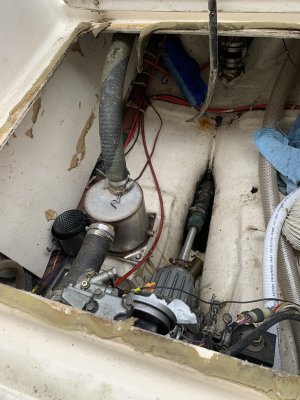
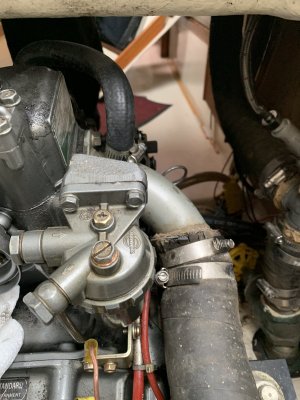
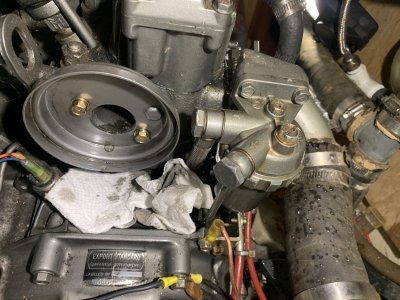
Can you post photos of your exhaust elbow and water to exhaust injection system?


All the best

gary
 
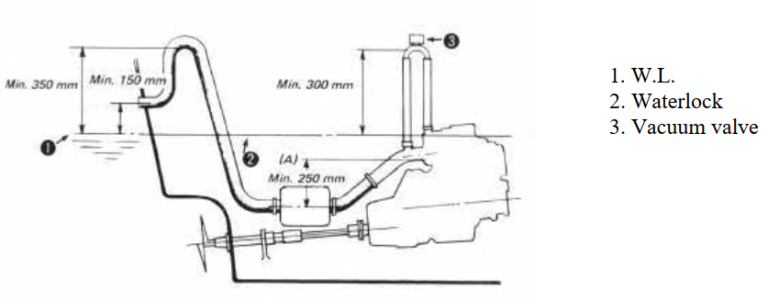
From the operation manual - you should have an anti siphon valve above the waterline.
1758277269874.png
If the engine is below the waterline the inlet water can travel through the engine cooling system and into the exhaust and back into the cylinder. The anti siphon valve will prevent this happening when the engine is not running. As I am a bit cautious I also turn off the inlet seacock when the engine is not in use.
 
So Paul. Not the battery!
Water in the cylinder is called water lock.
When the piston is at top dead centre on a high compression diesel engine there is very little space, so even a teaspoon of water can cause water locking.
It is rare but can't be ruled out.

You want to get onto this right away, as if you leave it for any time the rings will rust to the cylinder and create a bigger (more expensive) problem.

Luckily , (always look on the bright side of life) your little 10 GM is easy to work on.

In advance order a manifold gasket and a head gasket.

1. Remove the head. To do this you will need to remove everything connected to the head. (exhaust manifold, cooling water lines, fuel delivery line to the injector.) Rocker cover, rockers, push rods and then the head bolts.
2. Inspect , dry and clean the piston top and cylinder. REALLY clean!!
3. Replace head and ancillary parts. bleed fuel delivery line and away you go.

Not yet! You have to identify and rectify why the cooling water entered the cylinder in the first place.

"Ducked" has mentions some points here.

Can you post photos of your exhaust elbow and water to exhaust injection system?


All the best

gary
 

Attachments

  • IMG_1533.jpeg
    IMG_1533.jpeg
    1.6 MB · Views: 21
  • IMG_1532.jpeg
    IMG_1532.jpeg
    1.5 MB · Views: 18
Today I drained the water from the muffler, I noticed that there is more oil on dipstick than what should be present, I will drain the oil and oil filter and replace.
 
Today I drained the water from the muffler, I noticed that there is more oil on dipstick than what should be present, I will drain the oil and oil filter and replace.
I am thinking that I should remove injector clean it up. Test its ability to create a mist.
Paul
 
Today I drained the water from the muffler, I noticed that there is more oil on dipstick than what should be present, I will drain the oil and oil filter and replace.
This may mean that water has got into your sump; probably via the piston rings. If so, it will layer in the bottom of the sump and raise the oil level, but it will probably be below the bottom of the dipstick.

Look out for it when you change the oil.

It could also be fuel dilution caused by a faulty injector, but given that you have some evidence of water where it shouldn't be the former seems a more likely explanation
 
I am thinking that I should remove injector clean it up. Test its ability to create a mist.
Paul
The 'muffler' looks like a waterlock. It is there to collect any water in the exhaust system and stop it getting back into the engine. It will always contain some water.
After you have changed the oil and filter you need to check that you have good compression (difficult to turn over by hand) and the starter should turn it over quickly. I would leave the injector for now unless you are familiar with them as the high pressure jet can be dangerous. Best to get it checked at a specialist injector shop who will have all the correct test equipment.
You haven't said if you have an anti siphon valve before the pipe into the exhaust elbow. This could have been the source of your problem if it is absent.
 
You mentioned it won't turn over when starting and only does so if you use the decompression handle. Just to make sure, take a multimeter and check the voltage on the starter when turning over (or attempting to do so). If this drops significantly despite the new batteries there may just be a bad contact, start relay, loose/dirty battery clamps or the starter solenoid is bad. The 1gm10 can also be handcranked, did you try this? That would nicely rule out a mechanical issue.
 
Sounds like its hydrolocked.

If this is correct, and you've got water in your cylinder it seems unlikely to start but if you can get it to turn over vigorously enough it seems quite likely to damage the engine, possibly bending the conrod.

Hardly any experience yet with this engine, but I'd think you need to disconnect and clear the exhaust first, if/in case thats where the water is coming from. then turn the engine over by hand with the decompressor operating to pump most of the water out of it, before attempting to start it.

An alternative path for water would be via corrosion perforation or head gasket failure from the water cooling circuit, but that's probably less likely.

Less drastic/expensive, I understand corrosion failure of the separation between the water injection jacket and the exhaust path in the exhaust elbow is pretty common on these engines, so it might be an idea to have a close look at that when clearing the exhaust of water, and/or at your earliest subsequent convenience.
I drained the muffler. I have noticed that my oil level has gone up it is 1/4 inch from the top line. I am going to drain oil and change oil filter tomorrow.
 
The 'muffler' looks like a waterlock. It is there to collect any water in the exhaust system and stop it getting back into the engine. It will always contain some water.
After you have changed the oil and filter you need to check that you have good compression (difficult to turn over by hand) and the starter should turn it over quickly. I would leave the injector for now unless you are familiar with them as the high pressure jet can be dangerous. Best to get it checked at a specialist injector shop who will have all the correct test equipment.
You haven't said if you have an anti siphon valve before the pipe into the exhaust elbow. This could have been the source of your problem if it is absent.
One thing I notice is there is not much compression I can turn the engine over quite easily, after I drained the water tank in the muffler I read it was a good idea to turn the engine over a few times to empty the cylinder in t event there could be water, so I cranked it over a few times and water ejected out the water tank on the rotation. I thought the cranking would be much more difficult.
 
The 'muffler' looks like a waterlock. It is there to collect any water in the exhaust system and stop it getting back into the engine. It will always contain some water.
After you have changed the oil and filter you need to check that you have good compression (difficult to turn over by hand) and the starter should turn it over quickly. I would leave the injector for now unless you are familiar with them as the high pressure jet can be dangerous. Best to get it checked at a specialist injector shop who will have all the correct test equipment.
You haven't said if you have an anti siphon valve before the pipe into the exhaust elbow. This could have been the source of your problem if it is absent.
I do not believe I have an anti siphon valve, the pipe comes out of the engine into a pipe about 7/8” wide that goes into the muffler the photos I provided do not show this it is from factory. I do have a filter on the incoming water for the cooli g system. I am thinking I need a
Water catching filter on the incoming fuel line.
 
If it is water in the oil it will appear milky.

Smell the disptick/engine oil, if there is fuel in the oil it will smell of deisel.

This may help identify the fault/cause.
 
Last edited:
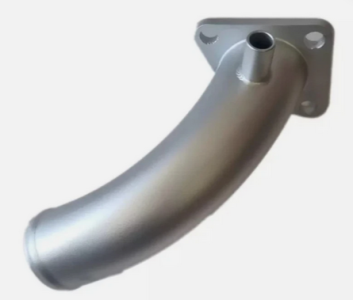
The water for the exhaust cooling goes into the small spigot on the top of the elbow. There is an inner sleeve that helps the water go into the exhaust and not back into the engine. It is easy to check that the inner sleeve has not been corroded and perforated which is a known failure point.
1758613957323.png
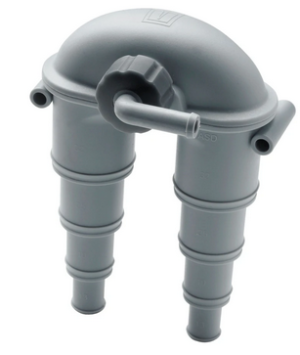
The anti siphon vent should be above the waterline and just before the cooling water goes into the exhaust. It will look like this.
1758614481294.png
Whilst it is a good idea to have a fuel filter with a clear bowl so you can see any water in the fuel.you should make sure you only put clean fuel into the tank.. The most likely cause of water in the fuel is a leaking seal on the deck filler allowing rainwater to get in. I doubt this is your starting problem.
The 1GM is very basic and if it has fuel, air, compression and turns over fast it will start.. Get these checked first and follow the suggestions above to find the source of the water in the cylinder and you will have a working engine again.
 
I think if the engine can be cranked by hand without using the decompression lever there is a significant internal problem
 
I had a yanmar 1gm. I remember having my tool box out more hours than I sailed. They are OK when new but as they age become more and more trouble. When it somehow started sucking oil to burn and I could not shut it down other than blocking the air intake I got rid of it, and the parts were so expensive I nearly had to remortgage the house. I remember complained to the dealer I had bought a chrome, extendable 3 speed fan from Argos, nice piece of kit for £19.99 and the dealer at Brightlingsea wanted £23 for a rubber impeller.
 
Last edited:
I changed the oil I could not detect any water in it the oil was black.

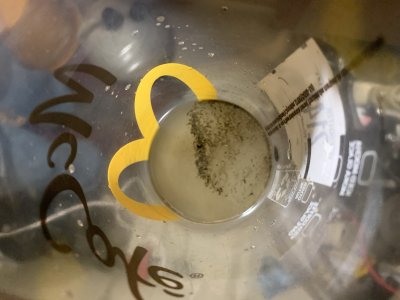
I took off the muffler and cranked it over and I believe that there must be a gasket that has blown. As I get lots of water coming out the exhaust port and a small amount of diesel fuel. I will post a video. I believe without delay I need to change the head gasket.

I also observed water coming out of the air intake.

I am going to let this dirty cup of liquid that came out the exhaust port settle and see if there will be a small amount of fuel on top of water
 

Attachments

  • IMG_1581.jpeg
    IMG_1581.jpeg
    1.7 MB · Views: 9
  • IMG_1576.jpeg
    IMG_1576.jpeg
    1.3 MB · Views: 8
Top