MapisM
Well-Known Member
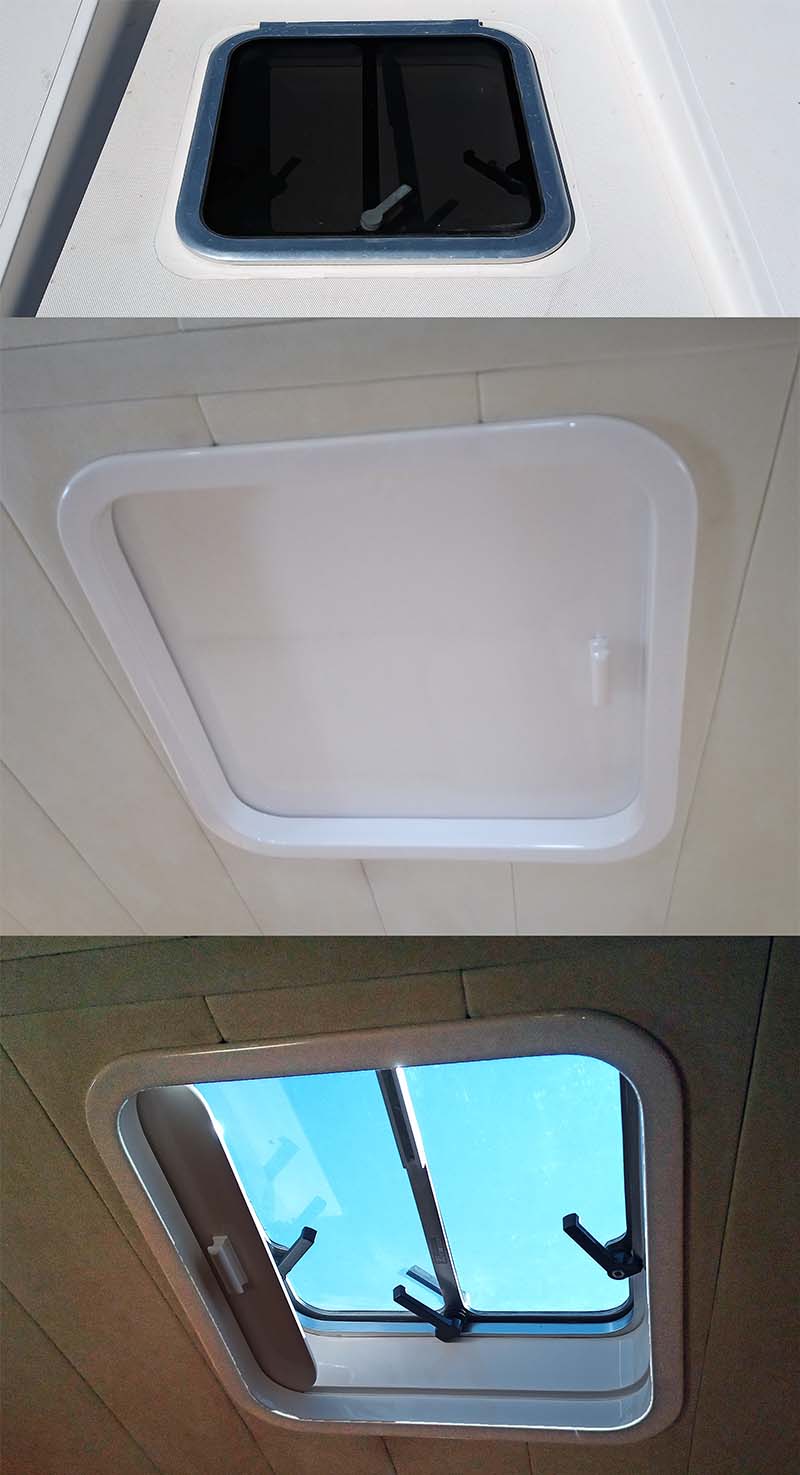
Can you guys think of any reason why the escape hatches normally used on the ceiling of bow cabins are made of transparent perspex?
Ok, it's often somewhat darkened/coloured, and so is mine - greyish, in fact.
But still transparent anyway, for reasons that I struggle to understand.
Now, bear with me.
A transparent hatch means that in order to not have light waking you up in the early morning, you must keep the internal sliding panel closed.
No big deal of course, but I'm noticing that (depending on the temperature differential), sometimes in the morning I find the internal structure of the hatch itself wet with condensation, possibly to the point of having some drops of water falling down.
This doesn't seem to happen if I leave the sliding panel under the hatch opened, I guess because air circulates better along the internal hatch surfaces.
Otoh, with the sliding panel left opened, as soon as the sun rises, the cabin is obviously filled with light.
This brings me to the point:
I'm wondering if it wouldn't be sufficient to wrap the external side of the perspex (maybe with a gelcoat-like colour film, but that's just a detail) to solve the problem, restricting light to enter also when the internal sliding panel is left open.
The reason for doing that on the external side is just for simplicity, since my hatch is very flat and regular externally, as opposed to the interior where it would be tricky to do a good job due to the handles and the internal frame.
Bottom line, do you think that an external wrapping could have an half decent durability in this application, and is there any specific film that you would suggest?
TIA!
Ok, it's often somewhat darkened/coloured, and so is mine - greyish, in fact.
But still transparent anyway, for reasons that I struggle to understand.
Now, bear with me.
A transparent hatch means that in order to not have light waking you up in the early morning, you must keep the internal sliding panel closed.
No big deal of course, but I'm noticing that (depending on the temperature differential), sometimes in the morning I find the internal structure of the hatch itself wet with condensation, possibly to the point of having some drops of water falling down.
This doesn't seem to happen if I leave the sliding panel under the hatch opened, I guess because air circulates better along the internal hatch surfaces.
Otoh, with the sliding panel left opened, as soon as the sun rises, the cabin is obviously filled with light.
This brings me to the point:
I'm wondering if it wouldn't be sufficient to wrap the external side of the perspex (maybe with a gelcoat-like colour film, but that's just a detail) to solve the problem, restricting light to enter also when the internal sliding panel is left open.
The reason for doing that on the external side is just for simplicity, since my hatch is very flat and regular externally, as opposed to the interior where it would be tricky to do a good job due to the handles and the internal frame.
Bottom line, do you think that an external wrapping could have an half decent durability in this application, and is there any specific film that you would suggest?
TIA!