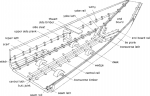
Would you?

I remember years ago reading about a Pakistani man living in Bradford who decided he wanted to return home by sea. He bought an old and decrepit wooden narrowboat and set off. He got to the Humber estuary and the Coastguards tried to dissuade him from going out to sea but he persisted, so they escorted him until the boat started to fall apart, and then took him off. No doubt administering a sharp and well-deserved telling-off as soon as they had him on board.

I think it was reported in the Bradford Telegraph & Argus but I have been unable to find the article.
 
Narrowboats have never historically crossed the North Sea. Indeed, with two notable exceptions (modern boats designed specifically to cope with open water) narrowboats are totally unsuitable as seagoing vessels and I'm not aware of any North Sea crossings by narrowboat

A handful of narrowboats did cross the channel as part of the Dunkirk evacuation fleet - these were GUCCo. motors that had been designed and built to trade down to Tilbury Docks and therefore had unusually high freeboard even when loaded

In (relatively) modern times, a handful of leisure narrowboats have crossed the channel successfully but it requires careful preparation, ideal weather and nerves of steel! One that i knew did it and it scared them so thoroughly that the boat came back on a lorry!

Crossing the Wash however, whilst not routine, has been regularly undertaken by narrowboats for many years with few incidents (istr one which ran aground due to poor navigation). Provided there's a suitable weather window and with expert advice regards navigation its nowhere near as adventurous as it looks!
 
I wouldn't. I understand they used to cross the N Sea, but two lashed together.

Not a lot of flotation in a narrowboat. Quick way to build a 60' catamaran though. Isn't that's a journey that wider beamed boats used to take a lot to miss the narrow locks around Northampton or somewhere?

It's a shame the canal system was never done properly in this country, like the big canals in Europe & Scandinavia you can take sailing boats or ships through. There's just one or two locks that cut the country in quarters due to narrow beams & shallow steps that exclude anything over about a 20-er (7' beam max).
 
About twenty-odd years ago I worked with a chap from the Birmingham area who took several across - having bought and renovated them he could sell them for much more in France - but he and his brother generally took them in pairs. They'd run two down to somewhere near the mouth of the Thames along with a couple of pre-cut/drilled steel beams, then on a a quiet/slight seas day, simply bolt them together like catamaran and motor across to I think Boulogne; I gather that whilst the motoring wasn't difficult, it did need an experienced hand on both narrow boat's helms/throttle to make it go smoothly.
 
Not a lot of flotation in a narrowboat. Quick way to build a 60' catamaran though. Isn't that's a journey that wider beamed boats used to take a lot to miss the narrow locks around Northampton or somewhere?

Not historically but in modern times wide beam boats have used the Wash to access the River Nene as the Northampton Arm from the Grand Union Canal to the river was built with 17 narrow locks

(And it was only built at all after the canal company was forced to do so it having been incorporated in the original Act of Parliament)

It's a shame the canal system was never done properly in this country, like the big canals in Europe & Scandinavia you can take sailing boats or ships through. There's just one or two locks that cut the country in quarters due to narrow beams & shallow steps that exclude anything over about a 20-er (7' beam max).

It's rather more than "one or two" locks*. And it's not just the locks themselves

Even the Grand Junction Canal from Brentford to Braunston, built with 14' wide locks and bridges, wasn't really a wide canal. It was actually built for pairs of narrowboats and thus the width of the channel through the pounds wasn't adequate for passing two loaded wide beam boats etc

It's not a case of it not being done "properly". The terrain, the demand and the finance all worked against the construction of large canals in the English Midlands.

* Separating the nominally wide Grand Union Canal, and thus the Thames, from the wide beam waterways to the North are ...

The whole of the Birmingham Canal Navigations (LOTS of locks!)

or

The Watford and Foxton locks on the GU Leicester section

The latter was always intended to be, eventually, wide beam - at least to the gauge of the Grand Junction mainline (see above)

At the Foxton end, the flight of ten narrow staircase locks was replaced by a short lived wide beam inclined plane but the planned widening of Watford locks at the Western end never happened. The inclined plane proved too costly to run and maintain
 
I'm not disputing any of that. I know a little money here and there is going into to restore old, semi lost canals, e.g. down in Sussex (Wey & Arun Canal). And widening the Northampton Arm would open up far greater areas of cruising. I remember looking into what was possible & it was frustrating, in comparison to some of the great canals in Europe, like the one's across Sweden or Russia to Finland that opens up large inland waters to sailing.

I thought constriction reductions might make good "grand projects" for a national project & actually spread new income around from tourist cruising but that some of the resistance actually came from the 'historical' crowd who wanted to preserve older, narrow locks.

I know the inclined plane lift you mention. The old photos are amazing. But look how well the Falkirk lift has worked connecting East & West coasts in Scotland. I know a couple from Norway that used it as a short cut to the Caribbean.

If you had a network that, in essence, dissected England in 4 with an East-West Y at the top, people would use it; Bristol to London, Littlehampton to the Humber (or Wash/Broads) & Merseyside. It would become a destination & encourage economic development along the routes.

I can't work out if I am a wishful romantic who hopes that one day the oil will run out & people will have to return to the sea if they want to travel, or a pragmatist who thinks we should be planning for it now while we still have some money to spend in infrastructure because it is going to happen.
 
Not historically but in modern times wide beam boats have used the Wash to access the River Nene as the Northampton Arm from the Grand Union Canal to the river was built with 17 narrow locks

(And it was only built at all after the canal company was forced to do so it having been incorporated in the original Act of Parliament)


It's rather more than "one or two" locks*. And it's not just the locks themselves

Even the Grand Junction Canal from Brentford to Braunston, built with 14' wide locks and bridges, wasn't really a wide canal. It was actually built for pairs of narrowboats and thus the width of the channel through the pounds wasn't adequate for passing two loaded wide beam boats etc

It's not a case of it not being done "properly". The terrain, the demand and the finance all worked against the construction of large canals in the English Midlands.

* Separating the nominally wide Grand Union Canal, and thus the Thames, from the wide beam waterways to the North are ...

The whole of the Birmingham Canal Navigations (LOTS of locks!)

or

The Watford and Foxton locks on the GU Leicester section

The latter was always intended to be, eventually, wide beam - at least to the gauge of the Grand Junction mainline (see above)

At the Foxton end, the flight of ten narrow staircase locks was replaced by a short lived wide beam inclined plane but the planned widening of Watford locks at the Western end never happened. The inclined plane proved too costly to run and maintain

Pater was employed all his working life on the canals, mostly for BCN before nationalisation then afterwards in Scotland.

In my archive somewhere I've a leatherbound presentation document of a project to be put to several of the old canal companies boards of something I think was called The Big Cross.

Basically it was to form a cross of larger canals to take much larger vessels with it's centre in Brum. The four points being (think I remember) Manchester in the NW crossing through Brum to the Thames in the SE then Bristol SW and Newcastle NE. Rationale to shift much larger large amounts of stuff in one go compared with the emerging competition from road transport.

Shame agreement couldn't be reached as it would be a great resource today - look at the stuff the Dutch shift by water.
 
The problem, as i alluded to, is that it isn't as simple as just widening a few flights of locks (or building parallel wide beam locks or lifts)

You also have to contend with a numerous other constrictions not least, for example, tunnels

Replacing or rebuilding the Foxton incline and widening or bypassing Watford locks wouldn't solve the problems of Crick and Blisworth tunnels both of which would have to be subject to one way working

This has already been a significant issue at Blisworth where, in peak season, there is simply far too much narrowboat traffic to make routine one way working feasible (the canal thereabouts is vastly busier than it ever was in the hey day of canal carrying). Major issues have already arisen with a relatively small number of wide beam boats wanting to use the tunnel, a significant increase in wide beam traffic would cause all sorts of problems

This goes to what i was saying above - it isn't simply that the locks are too narrow. The entire infrastructure of the Midlands canals is unsuited to wide beam traffic

The historic aspect cannot be ignored either but that's a separate and distinct arguement
 
The problem, as i alluded to, is that it isn't as simple as just widening a few flights of locks (or building parallel wide beam locks or lifts)

You also have to contend with a numerous other constrictions not least, for example, tunnels

Replacing or rebuilding the Foxton incline and widening or bypassing Watford locks wouldn't solve the problems of Crick and Blisworth tunnels both of which would have to be subject to one way working

This has already been a significant issue at Blisworth where, in peak season, there is simply far too much narrowboat traffic to make routine one way working feasible (the canal thereabouts is vastly busier than it ever was in the hey day of canal carrying). Major issues have already arisen with a relatively small number of wide beam boats wanting to use the tunnel, a significant increase in wide beam traffic would cause all sorts of problems

This goes to what i was saying above - it isn't simply that the locks are too narrow. The entire infrastructure of the Midlands canals is unsuited to wide beam traffic

The historic aspect cannot be ignored either but that's a separate and distinct arguement
The problem increasing the capacity of the waterways is a lack of available water.
 
I can never quite get to grips with the economics. Conjecture: a narrowboat carries 50 tons (2 x 1.5 x 15mts, say).20hp, at 4mph = 25h/100miles, three working shifts. 4litres fuel/hour, so 1litre/mile.
A lorry, 50 tons, with one man in one shift can do 250 miles for probably 10mpg, 110 litres/250m = less than a half litre/mile.
I rather wish this calculation was wrong.
 
I know the inclined plane lift you mention. The old photos are amazing. But look how well the Falkirk lift has worked connecting East & West coasts in Scotland. I know a couple from Norway that used it as a short cut to the Caribbean.
The Falkirk Wheel links the Forth and Clyde Canal with the Union Canal, which comes to a dead end in Edinburgh. It's also so underused that - last time I heard - they were planning to take one caisson out of use and convert it into a moving visitor centre.

The Forth and Clyde Canal is shallow, plagued with mechanical breakdowns and far less used than expected, possibly in part because they spent a fortune changing access at the east end from "bloody awkward" to just plain "awkward".
 
Pater was employed all his working life on the canals, mostly for BCN before nationalisation then afterwards in Scotland.

In my archive somewhere I've a leatherbound presentation document of a project to be put to several of the old canal companies boards of something I think was called The Big Cross.

Basically it was to form a cross of larger canals to take much larger vessels with it's centre in Brum. The four points being (think I remember) Manchester in the NW crossing through Brum to the Thames in the SE then Bristol SW and Newcastle NE. Rationale to shift much larger large amounts of stuff in one go compared with the emerging competition from road transport.

Shame agreement couldn't be reached as it would be a great resource today - look at the stuff the Dutch shift by water.

I've never heard of a proposal along exactly those lines* and I'd be interested in more info (and I'm absolutely certain currently active canal historians would be fascinated - my interests have moved on)

It sounds rathee like a speculative concept based on expanding the original Grand Cross concept developed by James Brindley which proposed linking the Thames, Severn, Humber and Mersey by canal. His vision was realised albeit in large parts by narrow canals (due to the aforementioned constraints of terrain, cost and demand)

* I wonder if this was a pre-war development of proposals led by Leslie Morton, at that time General Manager of the Grand Union Canal Carrying Company, to modernise and improve the canals

With government finance, the canal from Braunston to just south of Birmingham was upgraded to wide locks however the canal track wasn't improved to match and the government money dried up

Morton had a vision of a wide beam network along the lines of Brindley's original Grand Cross but i don't recall it including any suggestion of reaching as far North as the Tyne (which would be geographically challenging)

The reality, even in the 1930s, was that Morton was living in cloud cuckoo land. As I've posted on a number of occasions hereabouts, the harsh reality is that to be commercially viable today, a canal needs to be an order of magnitude bigger than the English canals. Simply going UK wide beam won't cut it and going big enough would be financially prohibitive
 
I can never quite get to grips with the economics. Conjecture: a narrowboat carries 50 tons (2 x 1.5 x 15mts, say).20hp, at 4mph = 25h/100miles, three working shifts. 4litres fuel/hour, so 1litre/mile.
A lorry, 50 tons, with one man in one shift can do 250 miles for probably 10mpg, 110 litres/250m = less than a half litre/mile.
I rather wish this calculation was wrong.

Your calculation is rather optimistic!

A narrowboat carries between 20 and 30 tons (assuming a well maintained canal). A pair (a motorboat and butty) can carry 50 tons (at best)

A working pair needs a minimum of two crew (three for preference) and it's the man hours calculation that scuppers the notion of genuine commercial carrying on the English canals
 
I wouldn't
I understand they used to cross the N Sea, but two lashed together.

If they were travelling in a pair, why didn't they do as suggested earlier in the thread and simply lash together or make some beams to create a powered catamaran.
I can't see the point in going in company so that they can watch each other turn turtle.
 
Top