Wiring refurb How to put it all togethet

thesaintlyone

Well-Known Member
Joined
12 Sep 2015
Messages
902
Visit site
On the Westerly Longbow 31, I have the following:
1 House Battery and 1 Starter Battery
They are connected to a Blue Sea Dual Circuit Battery Switch from which I have a positive lead from the house side going to a Blue Sea Bladed Fuse Box also attached to this are my Garmin Chartplotter and Dual USB/Cigarette Lighter Sockets.

Yesterday I connected the negative lead from the house battery to the bladed fuse block and everything worked fine.

I also have an Axon 12 Switch Circuit breaker panel to which I will have LED Cabin Lighting, LED Nav Lights.

I have a 100watt Solar Panel connected tdirectly o the house battery terminals via a solar charge controller

I also have on order a Victron VSR Battery Combiner 120a

So how do I connect it all up so the Blue Sea dual sea battery switch and vsr Combiner does what it should

Many thanks
 
On the Westerly Longbow 31, I have the following:
1 House Battery and 1 Starter Battery
They are connected to a Blue Sea Dual Circuit Battery Switch from which I have a positive lead from the house side going to a Blue Sea Bladed Fuse Box also attached to this are my Garmin Chartplotter and Dual USB/Cigarette Lighter Sockets.

Yesterday I connected the negative lead from the house battery to the bladed fuse block and everything worked fine.

I also have an Axon 12 Switch Circuit breaker panel to which I will have LED Cabin Lighting, LED Nav Lights.

I have a 100watt Solar Panel connected tdirectly o the house battery terminals via a solar charge controller

I also have on order a Victron VSR Battery Combiner 120a

So how do I connect it all up so the Blue Sea dual sea battery switch and vsr Combiner does what it should

Many thanks

Connect the charging sources to which ever battery you require them individually to charge as first priority ( Usually alternator to engine start battery. others incl solar, to the house battery). Wire the VSR to the two batteries.

Wire the house battery and the house circuits to one side of the dual circuit switch and the engine battery and feed to the starter to the other.

Don't forget fuses where appropriate

Post a wiring diagram of how you do it, or think you will do it., for comment, criticism or condemnation.
 
Last edited:
+1 to everything Vic said, plus a reminder that you need to make sure the cable from the domestic battery to the switch matches the engine battery cables, ditto the negative cables between all batteries.
 
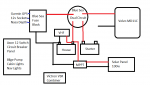
Here is my basic wiring diagram that I have so far there are some intentional gaps in the desigh

That looks like the general idea.

It would be a good idea to take the two battery negatives, and all the other negative connections, to a negative bus bar then when you decide to fit one of those mystical battery monitors its shunt just goes bnetwee the busbar and the house battery negative with no further messing about.
 
Here is my basic wiring diagram that I have so far there are some intentional gaps in the desigh

View attachment 70879

The different ways of connecting various loads to the house battery (fuse block, breaker panel, directly) looks a bit random to me. Why for instance the VHF directly?
Some people like to leave certain loads, like the bilge pump, connected before the main switch and might reserve the fuse block for these. If so, you could connect also the solar controller through this.
For things like USB chargers I prefer to have a switch, as there will be a small current draw even if noting is plugged in.
 
The different ways of connecting various loads to the house battery (fuse block, breaker panel, directly) looks a bit random to me. Why for instance the VHF directly?
Some people like to leave certain loads, like the bilge pump, connected before the main switch and might reserve the fuse block for these. If so, you could connect also the solar controller through this.
For things like USB chargers I prefer to have a switch, as there will be a small current draw even if noting is plugged in.

It used to be the recommended way of connecting a VHF.
 
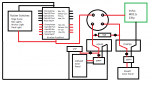
Ohana Rewire.png

So today I decided to move all cabin lights (LED) to the Blue Sea Fuse Block Along with Chartplotter, 12v usb/cig Sockets and depth sounderwhen its purchased.

Everything connected to the fuse block is working perfectly!!!!

And plan on installing the Nav Lights, Deck Light, Anchor Light and Bilge Pump onto the switch panel (Not yet connected)

I plan to install a 25watt Solar Panel for the starter battery keeping the 100watt for the house battery

The VHF is connected via a fuse direct to the house battery quite simply because thats how it is and it works

Above is what I think it should look like but please feel free to correct me if im wrong
 
Tis late, but a quick glance... basically looks good, only need to fuse one side of the VSR, unless the cables to it are vulnerable, the fuse is mostly to protect the VSR. Also, solar controller fuses should be as close to the batteries as possible, these are there to protect the wiring from the batteries.
 
I don't think a mppt controller will have much benefit on a 25w panel. Agree that it's not really required on a starter battery unless you use the engine very very infrequently.
 
OKi so no need to order a second solar panel. It was an additional purchase suggested by someone elsewhere. Have on order the Victron VSR 120a not sure if it is Dual sensing tho

Regards
 
Cool no need for the extra panel then. The fuses are closer to the battery than my crude effort in paint might suggest I have a blade fuse on the positive side.
 
Cool no need for the extra panel then. The fuses are closer to the battery than my crude effort in paint might suggest I have a blade fuse on the positive side.


:encouragement: I'd only fit one fuse to the VSR cabling, this protects the VSR from being overloaded, it can also protect the cables from the battery, but that's often not really needed as the VSR is usually mounted in a location where the cables cannot short, such as the battery box. I would also connect the VHF to a fuse in the fuse panel, that way it gets turned off when you turn the isolator off.
 
I think you should consider also fusing the main positive wires at the batteries, especially the house battery. Presently the wiring feeding the fuse block/switch panel is unprotected.
 
I think you should consider also fusing the main positive wires at the batteries, especially the house battery. Presently the wiring feeding the fuse block/switch panel is unprotected.

Good point. That domestic cable should be 10mm and be protected by a fuse, i'd use a midi fuse here.
 
Top