wind speeds and gusts

barca nova

Well-Known Member
Joined
30 Sep 2025
Messages
179
Visit site
I am an inveterate weather watcher and I noticed something surprising from a couple of the weather stations that I watch. The trace graphs of the last weeks wind speed show both gust and average wind and what surprised me was that unlike met office forecasts, these traces show a very good correlation between the two. In one case average wind speed plus 20% = gust speed for most measurements for a week. In the second case the correlation occurred at 30%.

The blue line is current wind speed average and the black line is gust speed. Gust scale on the right, average scale on left. Right scale is left plus 20%

I found this interesting because it doesnt tie in at all with the met office forecasts. Any met office types on here?
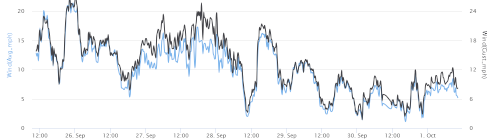
7 days wind.png
 
Wind gusts are heavily influenced by local topography, buildings etc and will vary according to the wind direction.

In the northern hemisphere, the wind also veers when it gusts due to the coriolis force (backs in southern hemisphere).
 
I suspect that the graph would look more dramatic if it showed peak wind speeds rather than what I suppose is an averaged gust speed, but even so, the relationship is closer than I would have supposed.
 
I suspect that the graph would look more dramatic if it showed peak wind speeds rather than what I suppose is an averaged gust speed, but even so, the relationship is closer than I would have supposed.

Would they average the gust velocity over any significant length of time? Would seem to defeat the whole point of measuring gusts.
 
Would they average the gust velocity over any significant length of time? Would seem to defeat the whole point of measuring gusts.
It isn't specified in the OP, and I have no idea what normal practice is, having never considered the matter before. Peak wind speed could be somewhat misleading, though I think that most of us having used it for bragging rights. My very rough guess is that the definition of a 'gust' is that it might be the highest average wind speed over a specific time, maybe one or five minutes.
 
There was a good thread on here last year about specifically Met Office forecasts. A number of people said the had noticed the met office forecasts consistently showing a much bigger gap between average wind and gusts eg 15 knots gusting 30. It was suggested the Met Office had changed their model for gusts. As a windsurfer as well as sailor I had already noticed this pattern and felt the local Met Office forecasts (eg for local areas like Hayling island or Portsmouth) were no longer useful for my purposes.
 
There was a good thread on here last year about specifically Met Office forecasts. A number of people said the had noticed the met office forecasts consistently showing a much bigger gap between average wind and gusts eg 15 knots gusting 30. It was suggested the Met Office had changed their model for gusts. As a windsurfer as well as sailor I had already noticed this pattern and felt the local Met Office forecasts (eg for local areas like Hayling island or Portsmouth) were no longer useful for my purposes.
That was me - and still seems to be the case. All this summer when sailing I checked 3 or 4 forecasts daily and the Met Office web page was still consistently massively pessimistic on gusts (mean wind speed fine).
Again the UKMO data going into Predict Wind was less extreme.
 
Meteo France categories are Gusts (avg +10/15kt), Strong gusts (avg+15/25kt), Violent gusts (>25kt above avg), definitely experienced them all several times :) "Violent" are quite rare, though every marine bulletin warns "Gusts can reach 40% above average wind".
 
I am an inveterate weather watcher and I noticed something surprising from a couple of the weather stations that I watch. The trace graphs of the last weeks wind speed show both gust and average wind and what surprised me was that unlike met office forecasts, these traces show a very good correlation between the two. In one case average wind speed plus 20% = gust speed for most measurements for a week. In the second case the correlation occurred at 30%.

The blue line is current wind speed average and the black line is gust speed. Gust scale on the right, average scale on left. Right scale is left plus 20%

I found this interesting because it doesnt tie in at all with the met office forecasts. Any met office types on here?
View attachment 200126
 
I very much doubt that there is a constant relationship (even if there is a typical one) between average wind speed and gust speed, not least because otherwise we would all know it (and probably have some ancient saying to remember it by), and airports wouldn't bother to report gust speeds to approaching/departing aircraft.

I read somewhere (on here perhaps?) years ago that winds in the mid-range, perhaps F5 - F6, were more likely to be gustier. I took that to mean were more likely have gusts significantly stronger than the average (which of course implies also lulls significantly weaker, or of greater duration, to produce the average) - i.e. that there were greater variations from the mean speed. (Though it could perhaps mean more frequent variations from the mean speed.)

I could sort of imagine that perhaps at low average speeds there isn't enough energy to produce great gusts above average, while at high wind velocities the whole is being swept along so forcefully variations are quickly buried in the general flow, but guessed that was probably erroneous or at least simplistic.

I suspect more likely 'gustiness', especially if it really is more likely to be greater at mid-speed ranges, is more likely to be a product of certain sorts of instability (=complexity?) in what is generating the wind.

Someone mentions topography causing gusts, but I think that is an additional cause of variability inshore. One still gets gusts far offshore.
 
Last edited:
As ever, it is easy to ask a question about weather but difficult to give a concise, comprehensive answer.

Wind is never steady. The atmosphere is continuously trying to even itself out but, as air moves the pressure pattern changes on all scales.

First, what is meant by a gust? Using WMO/Met Office definitions, reports of wind Values that we see in reports are average values over a 10 minute period finishing on the hour. So, looking at a chart showing wind, visibility, temperature etc, all the reports will be at the same time in UTC. A gust report is the highest value over a 3 second period within the same 10 minutes. The usual criterion for including gust values is for gusts >10 knots higher than the 10 minute wind. As an aside, for some purposes wind statistics refer to hourly means because these values are used on criteria for design of large structures.

Over or near land, any obstruction of the wind can cause a gust, as somebody said earlier. Surface friction being very variable over short distances will cause variations in the wind simply by slowing the wind by different amounts.

Strong gusts generally occur due to convection. The stronger the convection, the greater will be the mixing of air between the surface and higher up. Wind usually increases with height. That depends on the temperature structure which will change during thes dsy. Particularly near showers you will have experienced down-draughts. Cold blasts of air dragged down from heights well above the surface. I have seen gust values that were the same wind speeds as air over 3 km up. More typically, on a nice sunny day with small cumulus clouds, gust speeds wil be around the speeds 1km up. From all this, I hope that it is clear that the ratio of gust speeds to the average, 10 minute wind can vary greatly.

Coming to forecasts, computer models do not actually predict the surface level wind. The lowest level in a model is at a height where the pressure is 0.998 of the surface value. In other words models are terrain following. The wind values at the surface are derived from algorithms using pressure gradient, surface roughness and stability. Gust values are also derived using algorithms based on the same information.

Very briefly, and all I really needed to say, is that the gust to mean wind speed ratio varies greatly.

PS, inevitably in a post like this, my proof reading is poor. I hope I have got rid of the more obvious typos😇
 
Last edited:
The response time of the instrument must also be a factor. It may not be capable of responding to a short-lived gust.
I imagine that the little whirly things at the top of our masts respond a lot quicker than the larger industrial anemometers used by official agents, but in a way, they are also averaging out the readings.
 
Three seconds is a fairly pragmatic value. Modern instruments measure speed at 0.25 seconds intervals but the signal is very noisy. One second values are still noisy. 10 seconds is too long in terms of user experience. I guess that we sailors react to gusts shorter than 10 seconds but not as short as one second. It was such considerations which led to WMO agreeing 3 seconds as pragmatically sensible.

Cup.anemometers are sensitive enough to measure gusts although they do have problems in freezing rain. There are anemometers consisting of a heated tube mounted vertically with 4 slots at 90 degrees to each other. Measuring pressure differences across the slots gives wind speed and direction with no moving parts and a very low inertia.
 
One further thought. The two examples that I looked at were in very different topography - one on an exposed small island and the other at a harbour entrance. Its fairly obvious that the software producing the graphs alters the ratio og steady wind to gusts to fit the same visual scale, though the correlation is the same very high level. However, it seems to me that the "steady wind" is likely to be much nearer the forecast which covers a large area whilst gust speed will be more affected by local. topography eg buildings, hills etc For that reason met off ice forecasts of gust will be less reliable than that of the steady breeze. Does this make sense Frank?
 
Three seconds is a fairly pragmatic value. Modern instruments measure speed at 0.25 seconds intervals but the signal is very noisy. One second values are still noisy. 10 seconds is too long in terms of user experience. I guess that we sailors react to gusts shorter than 10 seconds but not as short as one second. It was such considerations which led to WMO agreeing 3 seconds as pragmatically sensible.

Cup.anemometers are sensitive enough to measure gusts although they do have problems in freezing rain. There are anemometers consisting of a heated tube mounted vertically with 4 slots at 90 degrees to each other. Measuring pressure differences across the slots gives wind speed and direction with no moving parts and a very low inertia.
On a previous boat I only carried a Ventimeter, nothing more than a tapered tube with a riser/indicator and a hole to let the wind in. It actually worked quite well, though I never got it to read over 30kn. I used to add 30% for a masthead equivalent.
 
Looked over the last week for both sites and including today Saturday so far. In both cases the wind is a lot stronger but the correlation is still there, However gusts are now steady wind plus 50%. Meantime the met office forecast for the area is giving gusts 100% greater. This seems to be a continuous issue,
 
Top