
Sea Change
Well-Known Member
Yep that looks like the right thing.Something like this any good https://www.cef.co.uk/catalogue/pro...Q4V32a-atCZp0pE983EHSEszv01kh_LF7eZqKEgLfv-Os
It makes class T look cheap though!

Yep that looks like the right thing.Something like this any good https://www.cef.co.uk/catalogue/pro...Q4V32a-atCZp0pE983EHSEszv01kh_LF7eZqKEgLfv-Os
There is a lot of debate about this - while we all know the IRC can be huge on LiFePO4 cells , by the time you add in busbars between cells, the terminal clamp, the wire, the fuse holder and the fuse, most agree that the IRC is much reduced. I would always use classT but several very reputable battery manufacturers say that ANL with a 5000A IRC rating are suitable and sell them with their products . (Note ANL have the higher rating than Mega fuses at 2000A)I have a friend whose system was installed by a professional UK company, they had used ANL as the main system fuse.
Your bete noir, Renogy sell them with their LiFePo4 batteries under their own brand (not of course that the fuses will be made by them)A friend had them fitted to a pair of 150Ah 24v batteries in New Zealand by a 'marine electrician' when he converted to lithium. I tried to advice him that they were not the correct fuses. He wouldn't believe me and trusted the marine electrician. The batteries are also of dubious quality. It's frightening that this system then gets signed off as professionally installed lithium for insurance purposes.

I spoke to a pair of domestic sparks yesterday who are off to install a full off grid system in a remote house and wanted a pair of "cheap inverters, 3000w" if I had any. A discussion ensued , no idea about LF inverters and the advantage for continuous use, no idea about the benefits of using a 24v or better still 48v system (especially as its all for conversion to 220v via the inverters) and no concept that one type of LifePo battery might be better than another ... never got as far as fuses. I know they work with domestic systems not DC etc but they didn't seem to have the basic concepts and are fully certified professional NICEIC electricians wiring a full off grid system to a house which the owner has left them to plan as well as install . GulpSome of the things i see and get asked to sort out are really scary and these cowboys are charging good money.
There is a lot of debate about this - while we all know the IRC can be huge on LiFePO4 cells , by the time you add in busbars between cells, the terminal clamp, the wire, the fuse holder and the fuse, most agree that the IRC is much reduced. I would always use classT but several very reputable battery manufacturers say that ANL with a 5000A IRC rating are suitable and sell them with their products . (Note ANL have the higher rating than Mega fuses at 2000A)
In testing with reasonable sized battery packs - 400-600 AH, the ANL fuses failed safe (ie blew and did not conduct current afterwards) every time .
As I said, I would not fit other than a class T (NH work but I prefer Class T and the prices have dropped a lot) but even a professional could be forgiven for using an ANL fuse on a smaller system when the manufacturers of the batteries may well have recommended them.
As I tend to tear in to those who do bad work I try also to be fair to those who may conscientiously follow manufacturers advice and frankly probably did no harm.
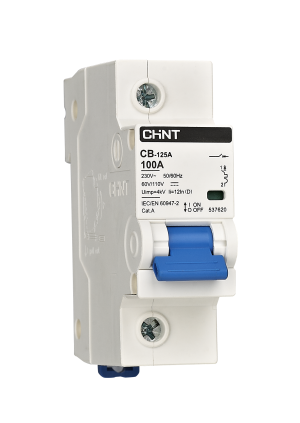
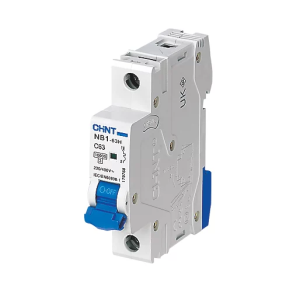

No mention of being DC rated in the data sheet though.Yep that looks like the right thing.
It makes class T look cheap though!

Absolutely correctNo mention of being DC rated in the data sheet though.

It is an example! loads around to choose fromAn entirely unbranded mccb from Frugo that’s way more expensive than a proper Class T… rather you than me.
 Note that it is a Moulded Case Circuit Breaker (MCCB) not Miniature Circuit Breaker (MCB).
There are indeed loads around, many look identical to the one you linked to, with various oddball names on them and some have slightly different spec's.It is an example! loads around to choose from


When I was looking at this I spoke to Eaton and they sent me this spec sheetI agree I don't think it's necessarily fair to say that lithium without a class T fuse is always bad. It's much more nuanced than that.
My biggest bugbear with 'ANL' fuses is the amount of junk versions on the market. I think that's what Will Prowse was trying to get at in his video.
For instance, this Renogy ANL fuse spec sheet tells you nothing useful at all: https://images.thdstatic.com/catalog/pdfImages/b1/b1dea9bd-1833-4382-8d7c-affcbfdbb164.pdf
I'll ignore the nonsensical 'Interrupt Capacity' column in the table. In my opinion this sort of shit has no place on a boat ever.
This Eaton ANL fuse datasheet has an AIC of 2700A @ 80VDC, still very low. Sure it's probably higher at 12V but Eaton weren't prepared to put that on the datasheet.
https://www.eaton.com/content/dam/e...ion/fuses/data-sheets/bus-ele-ds-2024-anl.pdf
In the machines that we manufacture that have big lfp batteries in them, we use a lot of Eaton AMX fuses: https://www.eaton.com/gb/en-gb/catalog/electronic-components/amx-and-amh-fuses.html
They are identical in size to a MIDI fuse, dirt cheap and rated for 8 kA @ 63 Vdc all the way up to 300A.
I thought about using these on my boat but decided I couldn't be bothered with the inevitable questioning. It's also not easy to get big wires on them without factory made busbars.
Generally speaking fuses are one of the few things that I genuinely think are worth paying the premium to have a known brand on them with a proper datasheet. You won't find any no name Chinese megafuses under the bonnet of your car...
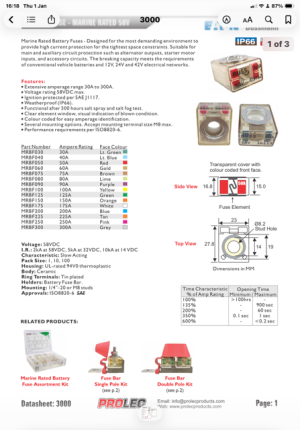
Nope, the spec just says:By the way, I recently bought a couple of Renogy Class T fuses which were a decent price, only to discover that they are only 10kA AIC. Not very impressed, I thought the AIC rating was part of the class T spec but clearly not.


