

You are using an out of date browser. It may not display this or other websites correctly.
You should upgrade or use an alternative browser.
You should upgrade or use an alternative browser.
Will Prowse Testing main battery fuses
- Thread starter simonfraser
- Start date

Boater Sam
Well-Known Member
Some pseudo "science" from someone with to much time on his hands just to create some pointless You Tube content.
If his welding cable was getting hot it was too thin and completely negated his "experiments" as it would be limiting current.
If his welding cable was getting hot it was too thin and completely negated his "experiments" as it would be limiting current.

PaulRainbow
Well-Known Member
The cable got hot because he was running it over current and the fuse didn't blow. The cable was the correct size for a 200A fuse, which is what he was using.Some pseudo "science" from someone with to much time on his hands just to create some pointless You Tube content.
If his welding cable was getting hot it was too thin and completely negated his "experiments" as it would be limiting current.
fredrussell
Well-Known Member
Interesting vid. Would have been interesting to test some of the ‘name brand’ fuses like Blue Seas and the like, which he seems keen on.
PaulRainbow
Well-Known Member
BlueSea make very little, if any fuses/breakers et. Mostly using stuff made by the likes of Busman, at very inflated prices.Interesting vid. Would have been interesting to test some of the ‘name brand’ fuses like Blue Seas and the like, which he seems keen on.
Trident
Well-Known Member
BlueSea or BEP are the names to use if not in the trade; as Paul says they don't make their own so if you have access to electrical wholesalers, Eaton Bussmann , Littlefuse etc are good names to look for and will be cheaper than the BlueSea or BEP in the chandlery but certainly pay more for a name than cheap on Amazon or Temu etc .
The same goes for cut off switches, circuit breakers etc - anything electrical really - I have replaced 200a and worse 650a battery cut off switches that owners "got off Amazon" that had completely melted inside with not a sign of damage outside (smell was a giveaway though) meaning they no longer broke the circuit . I fitted a water maker from a very expensive and reputable brand that was supplied with a press circuit breaker that fortunately melted during my commissioning process rather than when no one was looking - turned out when I called the importer that they "bought a job lot online" and were nor from the water maker factory (they did bin the rest and told me they would contact previous buyers to check ) .
With so many CE marks on goods that have had no testing and such lax checks on imports it's just not worth taking a risk to save a few quid
The same goes for cut off switches, circuit breakers etc - anything electrical really - I have replaced 200a and worse 650a battery cut off switches that owners "got off Amazon" that had completely melted inside with not a sign of damage outside (smell was a giveaway though) meaning they no longer broke the circuit . I fitted a water maker from a very expensive and reputable brand that was supplied with a press circuit breaker that fortunately melted during my commissioning process rather than when no one was looking - turned out when I called the importer that they "bought a job lot online" and were nor from the water maker factory (they did bin the rest and told me they would contact previous buyers to check ) .
With so many CE marks on goods that have had no testing and such lax checks on imports it's just not worth taking a risk to save a few quid

Ruffles
Well-Known Member
Typically a fuse will conduct for many seconds at 200%. They are guaranteed to works at the rated current, not blow. As the wire heats up its resistance may rise enough to limit the current anyway.
Before electronic fuses were available it was common to solder 20mm fuse holders to circuit boards. If you ran them near the rated current they would fall off as the solder melted
Before electronic fuses were available it was common to solder 20mm fuse holders to circuit boards. If you ran them near the rated current they would fall off as the solder melted

noelex
Well-Known Member
The video seems to confuse ANL and Mega fuses
PaulRainbow
Well-Known Member
Indeed, the Mega, AMG and Bojack fuses are all Mega fuses, AMG is just another name for a Mega fuse and Bojack is a (cheap) brand name. He also seems confused between types of fuses and brand names.The video seems to confuse ANL and Mega fuses
It's also a concern when he talks about BMS ratings when he's dealing with those cube fuses, i'd never, ever, use one of those with a Lithium battery.

Alex_Blackwood
Well-Known Member
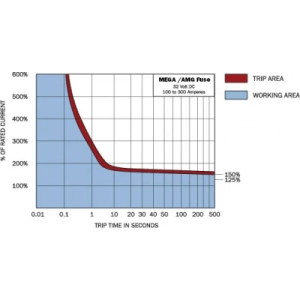
Mega fuse curve.Typically a fuse will conduct for many seconds at 200%. They are guaranteed to works at the rated current, not blow. As the wire heats up its resistance may rise enough to limit the current anyway.
Before electronic fuses were available it was common to solder 20mm fuse holders to circuit boards. If you ran them near the rated current they would fall off as the solder melted
PaulRainbow
Well-Known Member
Very similar to an ANL/Midi fuse.Mega fuse curve. View attachment 204215
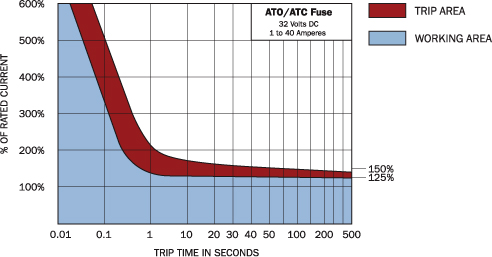
Blade fuse curve, very common on boats
stranded
Well-Known Member
Ooer. Does the “never ever” apply to a terminal mounted cube battery on the starter LA to the DC to DC charger to lithium?Indeed, the Mega, AMG and Bojack fuses are all Mega fuses, AMG is just another name for a Mega fuse and Bojack is a (cheap) brand name. He also seems confused between types of fuses and brand names.
It's also a concern when he talks about BMS ratings when he's dealing with those cube fuses, i'd never, ever, use one of those with a Lithium battery.
PaulRainbow
Well-Known Member
They are OK on LA terminals, but i wouldn't fit one to the battery terminal of a Lithium battery.Ooer. Does the “never ever” apply to a terminal mounted cube battery on the starter LA to the DC to DC charger to lithium?
stranded
Well-Known Member
Phew, thanks Paul. And Happy New Year!They are OK on LA terminals, but i wouldn't fit one to the battery terminal of a Lithium battery.

geem
Well-Known Member
A friend had them fitted to a pair of 150Ah 24v batteries in New Zealand by a 'marine electrician' when he converted to lithium. I tried to advice him that they were not the correct fuses. He wouldn't believe me and trusted the marine electrician. The batteries are also of dubious quality. It's frightening that this system then gets signed off as professionally installed lithium for insurance purposes.They are OK on LA terminals, but i wouldn't fit one to the battery terminal of a Lithium battery.

Sea Change
Well-Known Member
I have a friend whose system was installed by a professional UK company, they had used ANL as the main system fuse.A friend had them fitted to a pair of 150Ah 24v batteries in New Zealand by a 'marine electrician' when he converted to lithium. I tried to advice him that they were not the correct fuses. He wouldn't believe me and trusted the marine electrician. The batteries are also of dubious quality. It's frightening that this system then gets signed off as professionally installed lithium for insurance purposes.
PaulRainbow
Well-Known Member
Some of the things i see and get asked to sort out are really scary and these cowboys are charging good money.A friend had them fitted to a pair of 150Ah 24v batteries in New Zealand by a 'marine electrician' when he converted to lithium. I tried to advice him that they were not the correct fuses. He wouldn't believe me and trusted the marine electrician. The batteries are also of dubious quality. It's frightening that this system then gets signed off as professionally installed lithium for insurance purposes.
Sea Change
Well-Known Member
Those massive circuit breakers that he shows in the end of the video are interesting. I've been trying to figure out what they are and can't so far find anything suitable for my system (I'd need 200A+ and 20kA AIC; the biggest MCBs I have found with that AIC are only 63A).
I'm adding two extra batteries to my system and will take the opportunity to revamp a few things, e.g. I don't have isolators on each battery, and I'm only using MRBF on each battery, with a class T main fuse. I could possibly use correctly spec.d MCBs as a combined isolator/fuse on each battery. They are huge though.
I'm adding two extra batteries to my system and will take the opportunity to revamp a few things, e.g. I don't have isolators on each battery, and I'm only using MRBF on each battery, with a class T main fuse. I could possibly use correctly spec.d MCBs as a combined isolator/fuse on each battery. They are huge though.
geem
Well-Known Member
Have a look at BS88 fuses. They are like class T but way cheaper.Those massive circuit breakers that he shows in the end of the video are interesting. I've been trying to figure out what they are and can't so far find anything suitable for my system (I'd need 200A+ and 20kA AIC; the biggest MCBs I have found with that AIC are only 63A).
I'm adding two extra batteries to my system and will take the opportunity to revamp a few things, e.g. I don't have isolators on each battery, and I'm only using MRBF on each battery, with a class T main fuse. I could possibly use correctly spec.d MCBs as a combined isolator/fuse on each battery. They are huge though.
Alex_Blackwood
Well-Known Member
Something like this any good https://www.cef.co.uk/catalogue/pro...Q4V32a-atCZp0pE983EHSEszv01kh_LF7eZqKEgLfv-OsThose massive circuit breakers that he shows in the end of the video are interesting. I've been trying to figure out what they are and can't so far find anything suitable for my system (I'd need 200A+ and 20kA AIC; the biggest MCBs I have found with that AIC are only 63A).
I'm adding two extra batteries to my system and will take the opportunity to revamp a few things, e.g. I don't have isolators on each battery, and I'm only using MRBF on each battery, with a class T main fuse. I could possibly use correctly spec.d MCBs as a combined isolator/fuse on each battery. They are huge though.
Other threads that may be of interest

- Replies
- 1
- Views
- 50

- Replies
- 50
- Views
- 2K
