
Wichard quick release shackles on spinnaker halyards

merjan

Well-Known Member
Joined
21 Jun 2022
Messages
133
Visit site
I am wondering if anyone has any arguments against using Wichard’s Quick Release shackles like these
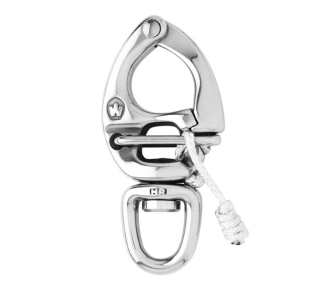
1751813723358.png
on spinnaker halyards.

Wichard say they’re suitable for this application but every boat I sailed on had either Tylaska-type shackles or the more conventional ones on halyards. I’ve come across these only on spinnaker sheets.
 
My spin halyards exit from the mast sheave and down through guides.
When hoisting the Code or Parasailor, both may swing into the mast area on the way up.
I would have though the chances of the small release 'toggle' or puller catching on something either during the hoist, when hoisted or when it should be coming down is not something that can be entirely ruled out.

There are others with MUCH more experience of hoisting coloured stuff but I wouldn't. Not sure what the advantage would be over a soft shackle.
 
The advantage of these is that you can attach them quickly with a single hand whilst using your other hand to hold onto something. No advantage over the Tylaska-type ones apart from I happen to have these.
 
The other advantage is Tylaskas require selling a kidney or two.

I go standard snap shackle for the halyards and those wichards for the sheets.
 
The disadvantage is that they tend to decide to release just when you don't want them to either under shock load or by catching on thing's.
 
I use a swivel permanently attached to the top of spinnaker(s) but attach the halyard to the swivel by a simple bow line. Spin gets a lot of use. It means each time the spin is attached top halyard the knot has a different length of tail so wear point of rope on sheaves is moved. Extending life of halyard. Spinnaker is always attached before departure mooring. It is stowed in anchor well. ol'will
 
I use a swivel permanently attached to the top of spinnaker(s) but attach the halyard to the swivel by a simple bow line. Spin gets a lot of use. It means each time the spin is attached top halyard the knot has a different length of tail so wear point of rope on sheaves is moved. Extending life of halyard. Spinnaker is always attached before departure mooring. It is stowed in anchor well. ol'will
A lot to be said for just tying stuff on with a knot rather than using hardware.
 
A lot to be said for just tying stuff on with a knot rather than using hardware.
We have a friend who is a successful racer of a 20 ft dinghy catamaran. He uses Dyneema for halyards and sheets, all of which he attaches to the sails, including spinnaker, by splicing. It takes him little longer than tying knots and has many advantages.
 
I am wondering if anyone has any arguments against using Wichard’s Quick Release shackles like these
View attachment 195797
on spinnaker halyards.

Wichard say they’re suitable for this application but every boat I sailed on had either Tylaska-type shackles or the more conventional ones on halyards. I’ve come across these only on spinnaker sheets.
Dad's old boat had these on the kite halyards. Occasionally the bit of string snagged something and just opened the shackle just as the sail hit full hoist. Which was suboptimal. We improved things by trimming the string down as much as possible....

The Tylaska type are better.
 
Dad's old boat had these on the kite halyards. Occasionally the bit of string snagged something and just opened the shackle just as the sail hit full hoist. Which was suboptimal. We improved things by trimming the string down as much as possible....

The Tylaska type are better.
Thank you - that's the kind of experience I was after. Of course Tylaska is the bees knees but happen to have the Wichards spare. I am convinced that they are risky for halyards, and I might use one of them for the tackline of the asymmetric instead.

It's a little off-topic but since the dyneema soft shackles have been mentioned many times: I am a big fan of them and have made several of them for use in various parts of the boat. However I don't think they are suitable for halyards that need to be attached/removed when sailing (frequently and quickly if you are racing). I also find them too fiddly not least because they need to be done or undone using two hands.
 
Tylaska are the best for releasing under load when desired.

they are probably the best choice for an asym tackline.
 
I use a soft shackle on the kite halyard and sheets - no problems at all getting it on and off quickly enough for safe use; were I racing I think a dog bone type soft shackle with a velcro safety strap - just pull the velcro "open" one handed and then the loops will come easily off the dog bone one handed. Total cost perhaps £15 -20
 
I use a soft shackle on the kite halyard and sheets - no problems at all getting it on and off quickly enough for safe use; were I racing I think a dog bone type soft shackle with a velcro safety strap - just pull the velcro "open" one handed and then the loops will come easily off the dog bone one handed. Total cost perhaps £15 -20
We use soft shackles on our change sheets. I definitely wouldn’t use them on halyards though. Too much risk of getting hung up on a split ring or similar at the top of the rig.

We also have the Dogbone type on the jib sheets, and that works very well.
 
We use soft shackles on our change sheets. I definitely wouldn’t use them on halyards though. Too much risk of getting hung up on a split ring or similar at the top of the rig.

We also have the Dogbone type on the jib sheets, and that works very well.
Mine is a mast head rig and at the front there is nothing a soft shackle can get caught on - it also normally flies with around 1m of halyard forward of the mast so again no real chance of the soft shackle touching anything... BUT, before I get too complacent have you seen this happen or is it just a concern? (I would also note that I always use two soft shackles side by side to be cautious as I have a catamaran and so have a 20 foot wide deck to work on so the extra time two take is fine, I'm not trying to hold on for dear life on a narrow point at 40 degrees :D
 
Mine is a mast head rig and at the front there is nothing a soft shackle can get caught on - it also normally flies with around 1m of halyard forward of the mast so again no real chance of the soft shackle touching anything... BUT, before I get too complacent have you seen this happen or is it just a concern? (I would also note that I always use two soft shackles side by side to be cautious as I have a catamaran and so have a 20 foot wide deck to work on so the extra time two take is fine, I'm not trying to hold on for dear life on a narrow point at 40 degrees :D
I've had halyards hang up when a split pin caught on the rope itself, so putting a soft shackle up there is not on my to-do list..

And honestly the suggestion that your halyard couldn't touch anything because when set it's clear is almost touchingly naive... Spinnaker halyards have an amazing ability to find themselves in all sorts of unplanned and unwanted places!

There is another issue too - which is that you'd need a way to stop the soft shackle being sucked into the sheave, as that is a very bad idea. With a normal shackle, or one of those whichard or Tylaska jobs, you can put a plastic bobble on to make sure that the metal shackle doesn't do damage to your sheave. However, clearly with a soft shackle you'd need some sort of stopper knot in the halyard in order to hold the bobble in place. Which is not a good idea as it weakens the rope.

I'm a massive fan of soft shackles, have dozens in use on the boat, but halyards are not a use I'll be putting them to.
 
I've had halyards hang up when a split pin caught on the rope itself, so putting a soft shackle up there is not on my to-do list..

And honestly the suggestion that your halyard couldn't touch anything because when set it's clear is almost touchingly naive... Spinnaker halyards have an amazing ability to find themselves in all sorts of unplanned and unwanted places!

There is another issue too - which is that you'd need a way to stop the soft shackle being sucked into the sheave, as that is a very bad idea. With a normal shackle, or one of those whichard or Tylaska jobs, you can put a plastic bobble on to make sure that the metal shackle doesn't do damage to your sheave. However, clearly with a soft shackle you'd need some sort of stopper knot in the halyard in order to hold the bobble in place. Which is not a good idea as it weakens the rope.

I'm a massive fan of soft shackles, have dozens in use on the boat, but halyards are not a use I'll be putting them to.
I guess I've been lucky - I've been using my asym about 100 days a year for 7 years now and about the same on my old boat for 6 years and never had the halyard go where I don't want it and would certainly never pull my halyard too far up that it goes in to a sheave - I have a dyneema sleeve in black (on a white halyard) for 1m above the end so I can see exactly when the black disappears in to the mast and that's the right height to fly the kite.
 
I guess I've been lucky - I've been using my asym about 100 days a year for 7 years now and about the same on my old boat for 6 years and never had the halyard go where I don't want it and would certainly never pull my halyard too far up that it goes in to a sheave - I have a dyneema sleeve in black (on a white halyard) for 1m above the end so I can see exactly when the black disappears in to the mast and that's the right height to fly the kite.
Yeah, if you're hoisting a kite slowly enough that you could spot when the black sleeve goes into the mast.... Then we're doing very different things. Our mastman is hoisting it as fast as humanly possible, and only stopping when the bobble hits the external guide.

In addition, that is the right height to fly a kite, with the halyard all the way made, no slack at all. All that allowing slack at the head of the sail does is allow oscillation, which gives less stability, more rolling, and wasted energy.
 
Top