Why not to use solid core T+E!

chris-s

Well-Known Member
Joined
24 Apr 2019
Messages
835
Visit site
Over Christmas I’ve been replacing the shore power wiring. We bought the boat last December and recognised it needed doing but have only just got around to it.
As it only gets used when ashore over winter it wasn’t a priority.
Of course, boats being boats, by the time you re-route cables ‘properly’ and tackle some other poorly routed cables whilst you are about it, as well as making-good all the shoddy connections and joins, you’re a week in and still not finished.

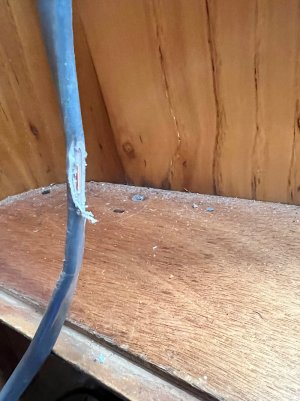
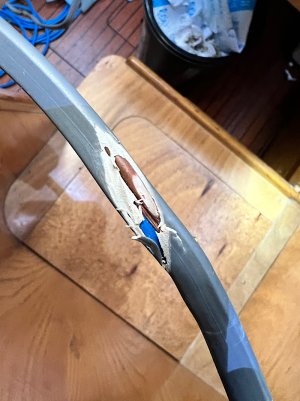
The previous owners lived aboard for several years and added quite a few sockets and some 240v lighting (which we removed last year). For some reason they wired it all using domestic solid core T+E, something that has no place on a boat. This combined with the lack of a suitably sized drill bit for passing thru wood work has turned up these two lovely finds so far…
B665DD0C-B50F-408A-82BB-A75B77526936.jpeg

1B1C7CF8-9455-42E3-ABE8-3262F3CC3C80.jpeg

I’ve yet to get to the T+E between the shore power inlet and fuse box.

I feel so much better now this is all being replaced and things routed neatly and tidily.
 
Over Christmas I’ve been replacing the shore power wiring. We bought the boat last December and recognised it needed doing but have only just got around to it.
As it only gets used when ashore over winter it wasn’t a priority.
Of course, boats being boats, by the time you re-route cables ‘properly’ and tackle some other poorly routed cables whilst you are about it, as well as making-good all the shoddy connections and joins, you’re a week in and still not finished.

The previous owners lived aboard for several years and added quite a few sockets and some 240v lighting (which we removed last year). For some reason they wired it all using domestic solid core T+E, something that has no place on a boat. This combined with the lack of a suitably sized drill bit for passing thru wood work has turned up these two lovely finds so far…

View attachment 169872

View attachment 169873

I’ve yet to get to the T+E between the shore power inlet and fuse box.

I feel so much better now this is all being replaced and things routed neatly and tidily.

Never trust, never assume. Looking forward to some more photos!
 
There's something seriously wrong with the boat if installed cables are jumping about enough to cause that amount of chafe.
It doesn't look like chafe, in the normal sense of the word, to me. Looks like the cables were dragged through inappropriate holes and the insulation damaged. Look how it's shaved back.
 
It doesn't look like chafe, in the normal sense of the word, to me. Looks like the cables were dragged through inappropriate holes and the insulation damaged. Look how it's shaved back.

Have to agree ... that is cable being pulled through ...

Domestic T&E is not recc'd - but in saying that - if properly supported and passing through rubber bulkhead grommets - it can work. Its like gas piping .. if supported to stop it flexing / vibrating up and down .. then fatigue cracks do not happen.... passing through proper grommets - chafe is avoided. Before someone jumps on me again as an ex Surveyor ... read the bold start to this paragraph.
 
It could be damage during insulation but I have damaged flexible wires like that due to hitting non protected cables by hitting the wire wit a drill . Same wit plastic conduit and . or plastic piping
 
We don't know what caused the damage to the cable, but it doesn't look to me like chafe in the normal sense. To me it looks as if someone with a drill had tried to increase the size of the hole in the bulkhead, by drilling right beside the existing cables. That was never going to be a good idea.
 
Have to agree ... that is cable being pulled through ...

Domestic T&E is not recc'd - but in saying that - if properly supported and passing through rubber bulkhead grommets - it can work. Its like gas piping .. if supported to stop it flexing / vibrating up and down .. then fatigue cracks do not happen.... passing through proper grommets - chafe is avoided. Before someone jumps on me again as an ex Surveyor ... read the bold start to this paragraph.
I think he means the drilled hole was inappropriate to the cable passed through resulting in the chafe of the insulation rather than the damage being caused by drilling.

It doesn't look like chafe, in the normal sense of the word, to me. Looks like the cables were dragged through inappropriate holes and the insulation damaged. Look how it's shaved back.
Unfortunately, I can give a classic example of how badly that sort of thing can go wrong. A laboratory at Rothera Research Station, the Bonner Laboratory, burnt down completely in 2001, thankfully without loss of life. The cause was eventually determined to have been a mains cable passing through the roof space. The cable was inadequately protected where it passed through a partition (I think a grommet had been omitted, but although I read the report at the time, my memory isn't that good!) and also had no slack in it because of poor installation practices. Minor vibration and movement - far less than anything to be expected on a yacht - eventually wore through the insulation; there was a short circuit and the rest is history. Fire-fighting in Antarctica is difficult (there's little or no liquid water!) and once the fire had a strong hold, the decision had to be taken to let it burn out - fortunately it was isolated from other buildings, so there was no risk of the fire spreading, and the risk to life of continuing attempts to fight the fire were deemed to be too great.

I thought the report of the investigation into the fire was online, but I can't find it.
 
Off topic .... but AP's Anatractica ...

I used to sail on Chemical Ships and one cargo was 95% Sulphuric Acid (actually not as bad as 75% !! ) ... but anyway - a requirement while loading / discharging was availability of water to dowse and dilute any spills ...

We arrived in Norway to load and it was January .... all snow and ice. The docks firefighting lines and FW supply lines were frozen ... so loading was not allowed. I was C/Off and sat there with Shore guy ... this was not good as someone has to pay !!
Then I struck on a suggestion ...

Outside was about 2ft of snow where not cleared ... so asked guy to get the snow piled up next to ship ... if anyone got acid - they could then dive into the snow ... totally daft idea but he went for it ...
Tractor came along ... shoved the snow into a nice pile ... and we loaded cargo.
 
Then there are those that say they prefer to buy a second hand boat, because the previous owner will have sorted any problems that comes with a a new boat :unsure: :rolleyes: 🤣 🤣

Most of the time, I'd say that's true, but there's a spectrum of owners, from craftsmen to bodgers, plus those who just throw money at their boats, though I'm unlikely to ever buy from them. T&E, though, would be a red flag because either they didn't know what they were doing and didn't bother to find out, or they were too cheap to spend a bit more for the right stuff. I don't want either person to have worked on my boat.
 
Actually, one might ask why is it wrong? Before we go further there is none on my boat. Everyone says it should not be used. So I do not.

However, if it is clipped to a bulkhead or the hull or passed through a duct ( as just about all my wire runs are) then it should be no more subject to harm than any other. No vibration etc. Being stiff it will stand up to reasonably small unsupported lengths if needs be. Then when it gets to a terminal the wire will be a substantial piece of copper. The earth can be terminated easily & the other wires will not be subject to damp running down the strands & blackening as one oft sees on stranded wire that has been subjected to damp. Particularly round nav lights etc. Of course it depend where it goes. One could not have it wired to a panel that has to be removed frequently as it would flex the wire & strain the connection. But perhaps a 13 amp socket ring main from the shore power would be different?
There will be no flexibility at the joint, but it will be a stiff wire , thus able to resist some side pressure. One can clamp fairly tight without damaging multy strands
So what is the reasoning behind not having it on the boat? Is it just an old wives tale bought about by poor installation. One reads about having tinned wires. But in all the years I have had boats i have never purposely used any- unless it has been supplied with an instrument. I usually leave some spare so if I have a problem at terminals I can trim back at least once , but it does not happen often. So I take that advice with a pinch of salt.
 
Last edited:
Off topic .... but AP's Anatractica ...

I used to sail on Chemical Ships and one cargo was 95% Sulphuric Acid (actually not as bad as 75% !! ) ... but anyway - a requirement while loading / discharging was availability of water to dowse and dilute any spills ...

We arrived in Norway to load and it was January .... all snow and ice. The docks firefighting lines and FW supply lines were frozen ... so loading was not allowed. I was C/Off and sat there with Shore guy ... this was not good as someone has to pay !!
Then I struck on a suggestion ...

Outside was about 2ft of snow where not cleared ... so asked guy to get the snow piled up next to ship ... if anyone got acid - they could then dive into the snow ... totally daft idea but he went for it ...
Tractor came along ... shoved the snow into a nice pile ... and we loaded cargo.
You NEVER, EVER add water to concentrated sulphuric acid! The dilution of sulfuric acid is STRONGLY exothermic, and the first drops of water boil, giving a VERY nasty steam explosion that throws concentrated acid all over. To dilute sulfuric acid, you ALWAYS add acid to water, so that the heat can be absorbed in a large exces of water. Even so, you do it slowly to allow the heat to dissipate.

Almost a knee-jerk reaction, it was drummed into us so well in school and university laboratories!
 
If I make changes or running new wires I always use flexible trunking as the protects the wiring and you can add extra wires easly. It ia not expensive from your local Screw fix /tool station
 
It doesn't look like chafe, in the normal sense of the word, to me. Looks like the cables were dragged through inappropriate holes and the insulation damaged. Look how it's shaved back.
Agree it is not chafing. However, I would suggest that it is too localised to be caused by pulling through, that would cause damage along the length of the cable. Looks like a cut from a knife blade or similar sharp object.
Irrespective of how it was caused it is not a reason not to use T & E. It is a lesson on how not to install cable!
 
Agree it is not chafing. However, I would suggest that it is too localised to be caused by pulling through, that would cause damage along the length of the cable. Looks like a cut from a knife blade or similar sharp object.
Irrespective of how it was caused it is not a reason not to use T & E. It is a lesson on how not to install cable!
Very true Alex.
 
Agree it is not chafing. However, I would suggest that it is too localised to be caused by pulling through, that would cause damage along the length of the cable. Looks like a cut from a knife blade or similar sharp object.
Irrespective of how it was caused it is not a reason not to use T & E. It is a lesson on how not to install cable!

101% (y) (y) (y) (y) (y)
 
Top