
Why has the market not embraced alloy anchors?

For a kedge rode we use several 20m lengths of Acera that have eye splices on each end. The line can also be used for stern tying to rocks/trees. The light floating line is very easy to swim to shore. Acera is an UHMWPE, as is Dyneema and with very similar properties, but it is cheaper. In fact it is less expensive strength for strength than nylon or polyester, so the cost need not be exorbitant.

The 20m lengths are connected with strop hitches. The lengths can be detached, but the main purpose is that the eye splice serves as an attachment point for the snubber at various distances. This adds stretch in a similar way to using a snubber with chain.

No solution is ideal, but Acera is more chafe resistant than other lines, and it is very light and easy to handle, especially compared to wet nylon/polyester. This helps quick deployment in an emergency particularly if the rode is rowed out in the tender. Acera is also physically less bulky and stores in a smaller coil.

Acera floats, which is great for stern lines, but a very small amount of weight is needed to sink the rode for most anchoring applications. This can be attached to one of the eye splices. The other drawback is that Acera is so strong that the required diameter for small yachts is only thin. Thin line is difficult pull by hand so a larger diameter will be needed for handling purposes. This increases the costs and reduces some of the advantages. For this reason the appeal of Acera kedge/stern lines is more for larger yachts.

The above system is quite new and some more practical experience is needed before it can be evaluated properly, but so far it has been a success. The new UHMWPE lines are very different to traditional lines, but especially with more recent lower prices there are a host of applications where these new alternatives are potentially better. Dyneema/Acera can also be used to replace stainless steel for some applications such as shackles and lifelines. I think it will take some time to determine the strength and weaknesses of these newer alternatives especially for kedge/stern lines, as there are very few yachts using this system.

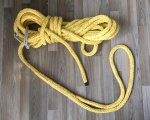
There are other new line materials that are worthy of considerion for different applications. For example, our new dock lines are Tipto-Twelve, which is much lighter and easier to handle than the heavy polyester/nylon lines that are required for our sized vessel. It is a bugger to splice, but my wife is a whizz with lines so the 12 strands barely slow her down.

A photo of the dock lines is below.
 

Attachments

  • C759859F-148B-46C3-89EC-DF7D48C0DA64.jpg
    C759859F-148B-46C3-89EC-DF7D48C0DA64.jpg
    524.1 KB · Views: 0
Floating shore lines of any sort should be used with markers, especially with deep drafted vessels. It is too easy for shallow drafted vessels to come inshore and catch a thin line.

Jonathan
 
For a kedge rode we use several 20m lengths of Acera that have eye splices on each end. The line can also be used for stern tying to rocks/trees. The light floating line is very easy to swim to shore. Acera is an UHMWPE, as is Dyneema and with very similar properties, but it is cheaper. In fact it is less expensive strength for strength than nylon or polyester, so the cost need not be exorbitant.

The 20m lengths are connected with strop hitches. The lengths can be detached, but the main purpose is that the eye splice serves as an attachment point for the snubber at various distances. This adds stretch in a similar way to using a snubber with chain.

No solution is ideal, but Acera is more chafe resistant than other lines, and it is very light and easy to handle, especially compared to wet nylon/polyester. This helps quick deployment in an emergency particularly if the rode is rowed out in the tender. Acera is also physically less bulky and stores in a smaller coil.

Acera floats, which is great for stern lines, but a very small amount of weight is needed to sink the rode for most anchoring applications. This can be attached to one of the eye splices. The other drawback is that Acera is so strong that the required diameter for small yachts is only thin. Thin line is difficult pull by hand so a larger diameter will be needed for handling purposes. This increases the costs and reduces some of the advantages. For this reason the appeal of Acera kedge/stern lines is more for larger yachts.

The above system is quite new and some more practical experience is needed before it can be evaluated properly, but so far it has been a success. The new UHMWPE lines are very different to traditional lines, but especially with more recent lower prices there are a host of applications where these new alternatives are potentially better. Dyneema/Acera can also be used to replace stainless steel for some applications such as shackles and lifelines. I think it will take some time to determine the strength and weaknesses of these newer alternatives especially for kedge/stern lines, as there are very few yachts using this system.
I was thinking of using dyneema with my kedge. I thought I might not need a snubber. If you has a decent length out, say 50m then the stretch of the whole line is 2m at break. This is the same as a 5m long nylon snubber, which is not much shorter than the snubber length I would use. What do you think?
 
I was thinking of using dyneema with my kedge. I thought I might not need a snubber. If you has a decent length out, say 50m then the stretch of the whole line is 2m at break. This is the same as a 5m long nylon snubber, which is not much shorter than the snubber length I would use. What do you think?

I am no rope expert, but Dyneema stretches very little so I think your numbers are correct. It depends on the grade, but around 3% at break is typical for the lower grades. 3% of 50m is 1.5m. However, this is at breaking load and I feel this will not provide adequate stretch at a working load in many anchoring situations. Similarly 5m of nylon is too short as a snubber for many severe anchoring situations.

However, kedge anchors have different requirements from the primary anchoring gear. One of the most important functions of a kedge anchor is in the event of an emergency situation, for example an unintentional grounding.

Normally stretch is a very important property of a good anchoring system. However, I wonder if in a kedge situation such as when trying to pull a boat off a sandbar, a large amount of stretch, is such a desirable property. I don’t have any answers. It would be great to have some feedback, or even better, some experimental results.

Dyneema allows the option of deploying the kedge with stretch (using a snubber) or with little stretch. If you have a large good quality kedge anchor in a good substrate with a powerful sheet (these are usually the most powerful winches on the boat), or anchor winch the low stretch option may be a better choice in the event of a grounding.

What do others think? Is a large amount of stretch, or low stretch desirable in this situation?
 
Last edited:
Noelex,

You are too modest

You have a video https://www.youtube.com/watch?v=-Q7-alugXMQ showing power setting of an anchor - with the, elastic and seems very short, snubber - stretching when you power set your anchor. surely if this educational film is correct (seem daft to me) it will work for kedging.

Both need the same end result - maximum tension to pull the yacht off the seabed or to set the anchor.

The other video in your series https://www.youtube.com/watch?v=LDC0g1GzdUc perfectly shows your anchor setting with the fluke at 16 degrees to the seabed - and you say (something like) perfectly set??

Jonathan
 
Last edited:
I know a number of experienced (I would rather not name-drop) cruisers that use Dyneema shore ties. There are no waves coming from the shore (reflections are possible--observe the situation) and the chain/catenary/snubber combination on the ground anchors provide constant tension.

----

I would like to offer a testing challenge. No sarcasm, dead serious. Scientists like to see others reproduce their work. The mantra is that Dyneema single braid is very chafe resistant, but I can think of many data points that contradict this. Most obvious is that it has been disallowed for use as lifeline for off-shore racing. The distinction seems to be side-to-side vs. end-to-end chafe. For good resistance over pulley and through LFRs you want fibers running end-to-end. It glides. For good side-to-side resistance, you want fibers going side-to-side. If you look at climbing ropes, the cover is tight and much of the fiber is side-to-side (the core is slightly twisted but parallel). I have run a number of tests of side-to-side abrasion under load over cinder block using a heavy pendulum to provide repeatability (and because it seemed to resemble yawing at anchor), and Dyneema has NOT done well. Webbing does better. Polyester does better and polyester coated with Maxijacket does many times better. Nylon climbing rope does better than most yacht braids because the jacket is tight and transverse. I've used polyester yacht braid for climbing anchors, and it does not wear nearly as well as similar (but different braid) arborist rope.

The reason is the weave. Single braid Dyneema is very loose. Individual fibers catch on the rocks/cinder block and snap. Unlike other braids, the failed bits do not protect the remaining line, and because they are slippery, they do not share the load well. The result is a rapid decline in strength. If the weave is tight (NER WR2 is a good example), Dyneema can wear like iron against most surfaces. But that is not what we are talking about.

Seriously. Create a test rig. Do some side-to-side chafe testing on rock under load. It will be an eye opener. Totally different than running through chocks or pulleys. I would NOT rely on it's legendary chafe resistance for shore ties or anchor rode without chafe protection where it meets rock.

BTW, climbers use Dyneema for rock anchors, but NEVER single braid. It is a tight webbing. I would NEVER use Amsteel or other single braid Dyneema for any climbing purpose. The weave is wrong.
 
I would like to offer a testing challenge. No sarcasm, dead serious. Scientists like to see others reproduce their work. The mantra is that Dyneema single braid is very chafe resistant, but I can think of many data points that contradict this.
That would be valuable. These fibres are relatively new and I don’t think the properties and suitable applications have been explored as well as they need to be.

There are significant differences between the brands. Dyneema has many loose fibres that I can imagine increases the vulnerability to chafe. Acera and Stealth Super-12 are quite different. The fibres are the same material (or very similar) but each strand is coated so it has no loose or fluffy fibres. As I have indicated, I am no rope expert but I have found this certainly reduces the chafe (compared to Dyneema) when used to connect the snubber to the chain. These materials would be worth including in the study.

Have you any view on the desirability of high stretch in rode of the kedge anchor in, for example, a grounding situation?

There is no doubt in normal anchoring high stretch is desirable. A gust hits the boat, the rode stretches, reducing the peak load on the anchor. The fact that the boat moves backwards several metres when the rode stretches, is of no consequence providing the anchor does not move, and the boat comes back to the same location.

However, if trying to drag the boat off a grounding it is much less desirable that the boat moves backwards several meters especially on a falling tide. A higher peak load on the anchor as a consequence of the lack of stretch in the rode may be a much better trade off.

There are other situations where low stretch in the anchor rode can be desirable such as a Med moor situation, where the stern is close to a quay.

In short, there is danger in thinking that high stretch in the anchor rode is always desirable. I feel this not always the true.
 
Last edited:
^^ Yes, the desirability of high stretch is not universal. I've helped boats kedge off, and polyester was better. On the other hand, I tried a Dyneema traveler line and found it too harsh. Like the springs and dampers on a car, there is a "right" amount for most jobs.

Even rock climbers use polyester lines for certain things (the equivalents of shore ties and kedging).
 
Th trouble is:

The fibres are not new. Dyneema has been available since the early 90's. Rothman's used Dyneema, fabricated by Bridon (though at that time it was thought to be very susceptible to UV - how views change!) We bought Dyneema from Bridon in the 90's - and some of it is still in use.

But it is 3 decades old and little work has been done in our field.

I believe a reason it is not recommended for use in lifelines was a failure on Comanche, a side to side failure. We actually use dyneema in our lifelines - because we have no side to side movement (as per Comanche). Protect it from side to side movement - it fine.

It horses for courses and understanding mechanisms. Too many are trying to find, or invent, uses for dyneema without understanding. Better to use proven textiles and leave the untested one until more repeatable work has been completed.

As you and Thinwater imply - plenty of work to do.

Jonathan
 
Th trouble is:

The fibres are not new. Dyneema has been available since the early 90's. Rothman's used Dyneema, fabricated by Bridon (though at that time it was thought to be very susceptible to UV - how views change!) We bought Dyneema from Bridon in the 90's - and some of it is still in use.

But it is 3 decades old and little work has been done in our field.

I believe a reason it is not recommended for use in lifelines was a failure on Comanche, a side to side failure. We actually use dyneema in our lifelines - because we have no side to side movement (as per Comanche). Protect it from side to side movement - it fine.

It horses for courses and understanding mechanisms. Too many are trying to find, or invent, uses for dyneema without understanding. Better to use proven textiles and leave the untested one until more repeatable work has been completed.

As you and Thinwater imply - plenty of work to do.

Jonathan

Actually, I think Comanche was a burn-through due to a rough jibe and spin sheets rubbing on a maxi. However, there have been others where it was sawing due to rail meat. And as I suggested, the side-to-side resistance of a different weave (NER WR2) can be more than 10 times greater.
 
When I'm thinking about the range of circumstances in which I'd need to use a kedge ( not a 'bower' or main ) anchor on a long, strong line such as Dyneema on a reel, the situation of deploying such an anchor should one run aground and need to take swift action is certainly one of them. That could be on a river mud-bank which has moved or grown.... e.g. upper Truro, Lynher and Tamar rivers, in my local area.... or a more hazardous entrance sand-bar such as those at Salcombe and Chichester harbours. I wouldn't want 'stretchy' in such circumstances.

Considering the difficulties experienced when one has had to take shelter and accept 'Hobson's choice' of a less-than-optimum berth, I've had to lie alongside old trawlers with rusty steel bulwarks in Newlyn and Castletownbere, alongside a very rough wall at both Fishguard and at Rosslare, and sit out rather severe steep swells in Ilfracombe - despite being tucked right into the best alongside position, as the big seas rolled right around the small harbour in a circle, effectively turning about through 180 degrees. Happily, the yacht club there was 20 metres away, and the RNLI shed just 100m......

There's another situation when the capacity to deploy a kedge on a non-stretchy line is desirable, and that's when one is likely to be pinned by wind and waves against a berth ( pontoon, stone wall, rusty trawler...) and so the kedge is positioned out to one side, so that one's boat is not being lifted and slammed against the berth, and there's a prospect of 'hauling off'.

One has to contend with both 'heave' and 'surge', for hours, as well as fierce abrasion and popped fenders. There's a role for carrying a ( folding? ) 'fender board' and a couple of used racing cart tyres....... or a couple of F1 tyres, if one has a larger boat!
 
Fender boards - now how many carry them?

We carry one, quite long - many of our piers have poles, tree trunks, and it is impossible to ensure fenders actually 'fend' - boards are the obvious answer. I confess we do not carry tyres.

J
 
When I'm thinking about the range of circumstances in which I'd need to use a kedge ( not a 'bower' or main ) anchor on a long, strong line such as Dyneema on a reel, the situation of deploying such an anchor should one run aground and need to take swift action is certainly one of them. That could be on a river mud-bank which has moved or grown.... e.g. upper Truro, Lynher and Tamar rivers, in my local area.... or a more hazardous entrance sand-bar such as those at Salcombe and Chichester harbours. I wouldn't want 'stretchy' in such circumstances....

[This question is dirrected at anyone, not just Zoidberg]

But how do you then pull on the Dyneema kedge rode?
* Hand-over-hand. No way.
* Windlass combination gypsy. Nope.
* Gripper hitch? None will grip. Rope grabs will damamge the line because of the loose weave.
* Lots of turns on a rope drum or cockpit winch? Maybe, but the self-tailer is not going to work.

To me, this is the greatest challenge. Dyneema is not easy to handle with standard gear. As shore lines it is fine; cleat it off and tension using the main rode. I'm sure you can do it, I just like to here how someone has pulled it at high load and how that worked out. The few times I have used a kedge, we used cockpit winches and a turning block as needed.
 
Why this focus on dyneema without a cover? We have dyneema halyards with a braided outer cover and we tension the halyard with maybe a couple of turns round a self tailing winch. We have dyneema sheets, same story.

Are we unusual, or 'old fashioned', lost touch with the latest 'must have' - does every one else only use 'straight' dyneema?

So what is wrong with the dyneema rode, for the kedge, with a conventional outer cover - it still has the low stretch and remains remarkably easy to handle.

There is the same focus on soft shackles - why this exclusive focus on dyneema? Many application that are being conjured up for the use of soft shackle (the one I really liked was to secure sheets to lifelines when at anchor or in the marina to keep decks clear) simply do not need exotic fibres.

Jonathan
 
Last edited:
Kedge anchors and primary anchors have different priorities in my view.

A good example is the Fortress anchor. This is a great kedge anchor. It has excellent holding power providing the direction of pull does not significantly change, and is the lightest weight (per potential holding power) of any anchor. However, in my opinion, it only works well in a limited range of softer substrates. I also think it is prone to breakout unexpectedly with a significant change in the direction of pull, and can drag very rapidly if it loses grip.

As a kedge, the very low weight of the Fortress is a significant advantage. It is easy to handle in the tender and can even be swum out (with a fender) if the need arises. A kedge anchor is rarely subject to significant change direction of pull and the speed of dragging is less important. The significant drawback of the Fortress as a kedge is the poor performance in hard and weedy substrates, but nothing is perfect.

A primary anchor has significantly different priorities. It is important the primary anchor can hold reliably if the direction of pull changes. Good performance in a wide range of substrates is important. Weight is less critical, at least if an electric windlass is used. Even if the vessel does not use an electric anchor winch, generally the weight in chain on the primary anchor rode is a more significant than the anchor weight.

There are hybrid anchors such as the aluminium Spade. Unfortunately, they tend to compromise both roles, especially as a primary anchor. The holding power and substrate versatility of the aluminium Spade is nowhere near as good as the steel Spade, and if used without chain as a kedge anchor the heavier weight compared to a Fortress is significant.

So ideally the primary and kedge anchors would be very different models. A Mantus, Rocna or steel Spade are typical premium primary anchors (although there are many other choices), and an aluminium Fortress or Guardian is used as kedge. The biggest dilemma concerns what happens if the primary anchor is lost. In an ideal world a spare primary anchor would be carried, but some boats accept, I think often reasonably, that the kedge anchor can be used with caution as a primary anchor until a replacement primary can be found. Much depends on the remoteness of the cruising grounds, time away from marinas, and the practicalities of retrieving a stuck primary anchor.
 
Why this focus on dyneema without a cover? We have dyneema halyards with a braided outer cover and we tension the halyard with maybe a couple of turns round a self tailing winch. We have dyneema sheets, same story.

Are we unusual, or 'old fashioned', lost touch with the latest 'must have' - does every one else only use 'straight' dyneema?

So what is wrong with the dyneema rode, for the kedge, with a conventional outer cover - it still has the low stretch and remains remarkably easy to handle.

There is the same focus on soft shackles - why this exclusive focus on dyneema? Many application that are being conjured up for the use of soft shackle (the one I really liked was to secure sheets to lifelines when at anchor or in the marina to keep decks clear) simply do not need exotic fibres.

Jonathan

Because single braid is cheap.

Of course, no one would use a loose single braid nylon or polyester for much. They exist (Tenex) but are not popular with sailors.
 
[This question is dirrected at anyone, not just Zoidberg]

But how do you then pull on the Dyneema kedge rode?
* Hand-over-hand. No way.
* Windlass combination gypsy. Nope.
* Gripper hitch? None will grip. Rope grabs will damamge the line because of the loose weave.
* Lots of turns on a rope drum or cockpit winch? Maybe, but the self-tailer is not going to work.

To me, this is the greatest challenge. Dyneema is not easy to handle with standard gear. As shore lines it is fine; cleat it off and tension using the main rode. I'm sure you can do it, I just like to here how someone has pulled it at high load and how that worked out. The few times I have used a kedge, we used cockpit winches and a turning block as needed.
I have used single braid dyneema successfully with a sheet winch and under considerable load. A few extra turns were needed to fill the drum and the jaws held fine. The rope was at the low end of the winch’s design range. This was as a halyard when used in place of a regular covered rope after it snapped. The clutch would not hold it BTW..
 
Last edited:
I am no rope expert, but Dyneema stretches very little so I think your numbers are correct. It depends on the grade, but around 3% at break is typical for the lower grades. 3% of 50m is 1.5m. However, this is at breaking load and I feel this will not provide adequate stretch at a working load in many anchoring situations. Similarly 5m of nylon is too short as a snubber for many severe anchoring situations.

However, kedge anchors have different requirements from the primary anchoring gear. One of the most important functions of a kedge anchor is in the event of an emergency situation, for example an unintentional grounding.

Normally stretch is a very important property of a good anchoring system. However, I wonder if in a kedge situation such as when trying to pull a boat off a sandbar, a large amount of stretch, is such a desirable property. I don’t have any answers. It would be great to have some feedback, or even better, some experimental results.

Dyneema allows the option of deploying the kedge with stretch (using a snubber) or with little stretch. If you have a large good quality kedge anchor in a good substrate with a powerful sheet (these are usually the most powerful winches on the boat), or anchor winch the low stretch option may be a better choice in the event of a grounding.

What do others think? Is a large amount of stretch, or low stretch desirable in this situation?
I think the need for shock absorption when using a kedge is low for the reasons you give.

Furthermore, if using the kedge as a second anchor at the stern there will be little need for snubbing on both anchors. Most shock loading is on the main rode and it comes from the changes in direction when sailing at anchor. If a kedge is used, the sailing at anchor mostly stops, so there is very little shock loading anywhere.

Shock loading from wave action, or boat wake still remains.
 
But how do you then pull on the Dyneema kedge rode? The few times I have used a kedge, we used cockpit winches and a turning block as needed.

That would be my initial approach, Drew. Part of the difficulty might lie in that Self-Tailing winches are 'sized' for a specific range of rope diameters - and we tend to forget that.
Another approach could be the use of rolling hitches, to attach a thicker diameter, less slippery, line to the Dyneema kedge rode, then use that 'suitable line' on the winch.
An adaptation of that is related to the 'swigging up' of a halyard..... tension the rode with multi-turns around your winch barrel.... then apply a force at ~90 degrees to that rode. Fairly simple mechanics gives a considerable 'mechanical advantage' and one gains a foot or more, which is heaved home at the winch. Not so easy if one is single-handed, I grant you! :rolleyes:

I use that simple technique to pull in the end of a boat, moored too loosely alongside, without risk of a hernia.

This is all very basic old-fashioned boat-handling stuff. It gets used every day I'm aboard/around...... like 'surging' a line to slow then stop a moving boat, others seem surprised by what is so very basic.
 
^^ A rolling hitch will not work on Single braid Dyneema.

I understand swigging (do it every day), but I'm not so sure that sound like fun on a highly loaded Dyneema line. That stuff is hard on the hands, even with gloves.

Yes, I have hauled Dyneema with a winch. But it is less fun. I guess I'm wondering if the weight and space savings is worth the compromises. IMHO, no. But it may be for another person.
 
Top