noelex
Well-Known Member
For a kedge rode we use several 20m lengths of Acera that have eye splices on each end. The line can also be used for stern tying to rocks/trees. The light floating line is very easy to swim to shore. Acera is an UHMWPE, as is Dyneema and with very similar properties, but it is cheaper. In fact it is less expensive strength for strength than nylon or polyester, so the cost need not be exorbitant.
The 20m lengths are connected with strop hitches. The lengths can be detached, but the main purpose is that the eye splice serves as an attachment point for the snubber at various distances. This adds stretch in a similar way to using a snubber with chain.
No solution is ideal, but Acera is more chafe resistant than other lines, and it is very light and easy to handle, especially compared to wet nylon/polyester. This helps quick deployment in an emergency particularly if the rode is rowed out in the tender. Acera is also physically less bulky and stores in a smaller coil.
Acera floats, which is great for stern lines, but a very small amount of weight is needed to sink the rode for most anchoring applications. This can be attached to one of the eye splices. The other drawback is that Acera is so strong that the required diameter for small yachts is only thin. Thin line is difficult pull by hand so a larger diameter will be needed for handling purposes. This increases the costs and reduces some of the advantages. For this reason the appeal of Acera kedge/stern lines is more for larger yachts.
The above system is quite new and some more practical experience is needed before it can be evaluated properly, but so far it has been a success. The new UHMWPE lines are very different to traditional lines, but especially with more recent lower prices there are a host of applications where these new alternatives are potentially better. Dyneema/Acera can also be used to replace stainless steel for some applications such as shackles and lifelines. I think it will take some time to determine the strength and weaknesses of these newer alternatives especially for kedge/stern lines, as there are very few yachts using this system.
There are other new line materials that are worthy of considerion for different applications. For example, our new dock lines are Tipto-Twelve, which is much lighter and easier to handle than the heavy polyester/nylon lines that are required for our sized vessel. It is a bugger to splice, but my wife is a whizz with lines so the 12 strands barely slow her down.
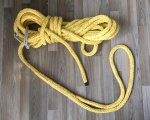
A photo of the dock lines is below.
The 20m lengths are connected with strop hitches. The lengths can be detached, but the main purpose is that the eye splice serves as an attachment point for the snubber at various distances. This adds stretch in a similar way to using a snubber with chain.
No solution is ideal, but Acera is more chafe resistant than other lines, and it is very light and easy to handle, especially compared to wet nylon/polyester. This helps quick deployment in an emergency particularly if the rode is rowed out in the tender. Acera is also physically less bulky and stores in a smaller coil.
Acera floats, which is great for stern lines, but a very small amount of weight is needed to sink the rode for most anchoring applications. This can be attached to one of the eye splices. The other drawback is that Acera is so strong that the required diameter for small yachts is only thin. Thin line is difficult pull by hand so a larger diameter will be needed for handling purposes. This increases the costs and reduces some of the advantages. For this reason the appeal of Acera kedge/stern lines is more for larger yachts.
The above system is quite new and some more practical experience is needed before it can be evaluated properly, but so far it has been a success. The new UHMWPE lines are very different to traditional lines, but especially with more recent lower prices there are a host of applications where these new alternatives are potentially better. Dyneema/Acera can also be used to replace stainless steel for some applications such as shackles and lifelines. I think it will take some time to determine the strength and weaknesses of these newer alternatives especially for kedge/stern lines, as there are very few yachts using this system.
There are other new line materials that are worthy of considerion for different applications. For example, our new dock lines are Tipto-Twelve, which is much lighter and easier to handle than the heavy polyester/nylon lines that are required for our sized vessel. It is a bugger to splice, but my wife is a whizz with lines so the 12 strands barely slow her down.
A photo of the dock lines is below.