Why do intercoolers on my MAN engines need cleaning every 2 years?

  • Thread starter Thread starter Deleted User YDKXO
  • Start date Start date
thats not correct. With a total raw water flow failure the downstream egt temp will rise a couple of hundred degrees C within literally a couple of seconds. Downstream egt sensors (along with a raw water pressure/flow alarm) are the only sensible way to get a fast alarm. If you wait to see the jacket water temp rise you've already got your plastic/rubber exhaust system nicely on fire and your holiday is over.

Ref MAN, engine manufacturers don't include downstream egt in their instrumentation because they don't make exhaust systems.

All Agreed ,but in the MAN set up ( which the OP has ) I was basing my post on UPSTREAM EGT .
Next time I,am on the boat I,ll find out if they measure raw water pressure -next week .
I guess if you have rubber / plastic then a down stream EGT is probably a good idea .
In my installation we have stainless steel risers going into a underwater box -full of sea water ,with a little pipe coming out to tell tales on the stern .Most of the exhaust exits underwater .
I understand Mario Amarti was one of the first in not the first to build boats in Euorope with underwater exhaust - way back in the early 80's .
I think with all this data as I said the engines hopefully will tell you when it's ready to be opened up
As opposed to strict 2 y by the book .

Also the OCD of the MAN manual it says " do not let the idle for more than 2 minutes - turn them off "
In real life in marinas ,at fuel pontoons ,at anchorages etc -that's not realistic .
Apparently they can -get this " over cool" so you must if are doing by the book do not them idle for more than 2 mins !
I have never seen anybody MAN or otherwise drift about with the engines off -cos they have exceeded the 2min rule -as per book .
 
All Agreed ,but in the MAN set up ( which the OP has ) I was basing my post on UPSTREAM EGT .
Next time I,am on the boat I,ll find out if they measure raw water pressure -next week .
I guess if you have rubber / plastic then a down stream EGT is probably a good idea .
In my installation we have stainless steel risers going into a underwater box -full of sea water ,with a little pipe coming out to tell tales on the stern .Most of the exhaust exits underwater .
I understand Mario Amarti was one of the first in not the first to build boats in Euorope with underwater exhaust - way back in the early 80's .
I think with all this data as I said the engines hopefully will tell you when it's ready to be opened up
As opposed to strict 2 y by the book .

Also the OCD of the MAN manual it says " do not let the idle for more than 2 minutes - turn them off "
In real life in marinas ,at fuel pontoons ,at anchorages etc -that's not realistic .
Apparently they can -get this " over cool" so you must if are doing by the book do not them idle for more than 2 mins !
I have never seen anybody MAN or otherwise drift about with the engines off -cos they have exceeded the 2min rule -as per book .

I lost interest in this thread when it started to drift into measuring exhaust water temperature, absolutely zilch to do with EGT.

EGT has two places for measurement #1 is Exhaust turbine out. Most manufacturers use 1/2 the dry pipe diameter downstream from turbocharger for thermocouple location.

The other measurement listed in a decent spec sheet is manifold temperature. Not practical to take manifold temperature so you have to calculate how much heat energy turbo is taking out of the exhaust. Therefore a good maximum number for a highly rated recreational engine would be say 500 Degrees C turbine out at rated speed which would work back to around 700 Degrees C manifold temp before tubo has recovered the waste heat energy.

EGT is a very accurate measurement of how hard the engine is working which it is a key peramiter. On a heavily weeded vessel with a fouled CAC you can see the EGT rise as fast as the rev counters as you approach WOT.

Had a long chat with pal who is engineering director for vessels providing wind farm support vessels for the North Sea who runs one of the largest fleets of MTU 2,000 Series motors. MTU 8V 2000 is a potent package in commercial applications, 18 liters around 2 tonnes, easy envelope to engineer due to V configuration and very high commercial rating at just under 1,000 Hp. It was confirmed that CAC and heat exchanger cleaning was not a mandatory requirement until the big 6,000 service due to a very effective but complex crankcase ventilation system.

In operation a close watch is kept on EGT due to cases of exhaust valve burning and MTU have come out with revised heads and new exhaust valve design. One sign of CAC fouling and elevated EGT's manifests itself in excessive sequential turbo switching, apparently always a bit of a nausea however becomes worse at elevated EGT's

Motors are very reliable up to about 4,000 hours when they start to experience turbo and CAC leaks and burned exhaust valves. Very few engines make the big 6,000 hour service without major a major intervention.

The 6,000 hour service is actually more of a mid life overhaul, heads turbochargers, injectors, CAC's can be ultrasonically cleaned however generally new units fitted, loads more stuff required for example new closed crankcase breather system. The MTU 6,000 hour work is referred to as the More Than U expected service with cost approaching 70% of a replacement motor.

The MTU 8V2000 is a superior envelope to the CAT C18 which has benefit of being a tad lighter however MTU has a far better commercial like for like rating as C18 is only 725hp, however C18' make 15,000 hours requiring odd injector or turbo along the way and some have seen 20,000 hours.

None of this is relevant to the leisure rated engines we are referring to however puts CAC servicing into perspective.

As to the issue of unrealistic MAN gobbledygook on engine idling, suspect some 'green' obsessed marketing person ticking an environmental box rather than any perceived technical issue.
 
Last edited:
I lost interest in this thread when it started to drift into measuring exhaust water temperature, absolutely zilch to do with EGT.

EGT has two places for measurement #1 is Exhaust turbine out. Most manufacturers use 1/2 the dry pipe diameter downstream from turbocharger for thermocouple location.

The other measurement listed in a decent spec sheet is manifold temperature. Not practical to take manifold temperature so you have to calculate how much heat energy turbo is taking out of the exhaust. Therefore a good maximum number for a highly rated recreational engine would be say 500 Degrees C turbine out at rated speed which would work back to around 700 Degrees C manifold temp before tubo has recovered the waste heat energy.

EGT is a very accurate measurement of how hard the engine is working which it is a key peramiter. On a heavily weeded vessel with a fouled CAC you can see the EGT rise as fast as the rev counters as you approach WOT.

Had a long chat with pal who is engineering director for vessels providing wind farm support vessels for the North Sea who runs one of the largest fleets of MTU 2,000 Series motors. MTU 8V 2000 is a potent package in commercial applications, 18 liters around 2 tonnes, easy envelope to engineer due to V configuration and very high commercial rating at just under 1,000 Hp. It was confirmed that CAC and heat exchanger cleaning was not a mandatory requirement until the big 6,000 service due to a very effective but complex crankcase ventilation system.

In operation a close watch is kept on EGT due to cases of exhaust valve burning and MTU have come out with revised heads and new exhaust valve design. One sign of CAC fouling and elevated EGT's manifests itself in excessive sequential turbo switching, apparently always a bit of a nausea however becomes worse at elevated EGT's

Motors are very reliable up to about 4,000 hours when they start to experience turbo and CAC leaks and burned exhaust valves. Very few engines make the big 6,000 hour service without major a major intervention.

The 6,000 hour service is actually more of a mid life overhaul, heads turbochargers, injectors, CAC's can be ultrasonically cleaned however generally new units fitted, loads more stuff required for example new closed crankcase breather system. The MTU 6,000 hour work is referred to as the More Than U expected service with cost approaching 70% of a replacement motor.

The MTU 8V2000 is a superior envelope to the CAT C18 which has benefit of being a tad lighter however MTU has a far better commercial like for like rating as C18 is only 725hp, however C18' make 15,000 hours requiring odd injector or turbo along the way and some have seen 20,000 hours.

None of this is relevant to the leisure rated engines we are referring to however puts CAC servicing into perspective.

As to the issue of unrealistic MAN gobbledygook on engine idling, suspect some 'green' obsessed marketing person ticking an environmental box rather than any perceived technical issue.

Thanks for taking the time to post that
I'm not sure if that makes me feel better or just depresses me.
But it does put things into perspective.

Interesting, on our MTU 8V CR2000s we do get excessive turbo switching at a particular load.
In the early days, before we identified the issue, the electronics would alarm during a few hours at this particular load.
The alarms were reported as a turbo speed alarm but maybe they were partially generated as a result of raised EGT.
The solution for us is simple - we don't run at that particular load and we don't then get the alarms.
 
Hurricane, the general (and correct) view of MTUs is that they are beautiful engines, oozing lots of nice design features, but have right across the board lower lifespans/shorter major service intervals for all the big items. I think their typical quoted fuel burn to assorted levels of rebuild is literally 50% of Cat's (adjusted for base consumption level of the engine). All this does is prove that buying a boat is a series of compromises. Look at Princess 82 - you kinda have to buy the MTU engine because if you put the C32s in the engine room there is no room for anything else. You could make the e/room bigger, but then the accom deck wouldn't be the stunner that it is. Compromises compromises!
 
Thanks for taking the time to post that
I'm not sure if that makes me feel better or just depresses me.
But it does put things into perspective.

Interesting, on our MTU 8V CR2000s we do get excessive turbo switching at a particular load.
In the early days, before we identified the issue, the electronics would alarm during a few hours at this particular load.
The alarms were reported as a turbo speed alarm but maybe they were partially generated as a result of raised EGT.
The solution for us is simple - we don't run at that particular load and we don't then get the alarms.

Apologies, did not meant to depress you Hurricane. In terms of packaging, power density, fuel consumption nothing comes close in this power node, I was discussing a commercial environment not pleasure.

The engineering director in question may have slightly jaundiced view as he detests the MTU approach to support. Technicians him seem to be brainwashed automatons, if they hit a snag NOTHING can be done without a call to Germany and the words 'never seen that failure before' ring a little hollow. By comparison techs from Finning have a far more 'can do' approach and are not averse to saying this or that is a rubbish bit of design we fix it by doing XYZ and do not live in constant fear of the Gestapo.

I have to say that sitting down with the MAN salesman at the boat show was a pleasure. Questions I had regarding all aspects of the engine design all answered to the last detail. I was particularly interested regarding the MTU triple wall exhaust manifold and the impact on fuel economy.
 
Apologies, did not meant to depress you Hurricane. In terms of packaging, power density, fuel consumption nothing comes close in this power node, I was discussing a commercial environment not pleasure.

The engineering director in question may have slightly jaundiced view as he detests the MTU approach to support. Technicians him seem to be brainwashed automatons, if they hit a snag NOTHING can be done without a call to Germany and the words 'never seen that failure before' ring a little hollow. By comparison techs from Finning have a far more 'can do' approach and are not averse to saying this or that is a rubbish bit of design we fix it by doing XYZ and do not live in constant fear of the Gestapo.

I have to say that sitting down with the MAN salesman at the boat show was a pleasure. Questions I had regarding all aspects of the engine design all answered to the last detail. I was particularly interested regarding the MTU triple wall exhaust manifold and the impact on fuel economy.

As with boat designs, it seems that engine designs are a sum of compromises between a seemingly infinite number of parameters.

With apologies to the OP for drifting, I'd like to ask LS, what is your overall favorite engine in terms of least design faults, reliability, power to weight, beauty of design, etc. Sorry if have answered this before, or this is an improper question, in which case I've missed it.
 
Last edited:
.......................Technicians him seem to be brainwashed automatons, if they hit a snag NOTHING can be done without a call to Germany and the words 'never seen that failure before' ring a little hollow...........

Must be a German thing, reminds me of the same text book reply every time from Porsche, only for a fix to appear without fanfare and slipped in during the next facelift, when asked what they did to resolve the issues, the answer was always a straight faced, "we didn't change anything!" Gotta love em!
 
...
The solution for us is simple - we don't run at that particular load and we don't then get the alarms.
Hurricane, did you really mean load, or rpm?
I understand that in a planing boat, once over the hump, the load normally increases constantly with the rpm, up to 100% or so at WOT.
Therefore, there's just one rpm level for any given load, and my question in this sense could appear pointless.
But since you always used the term "particular LOAD" in your description, I was wondering if you experienced the turbo switching at different rpm levels, depending on how loaded/fouled the boat is.
That is in fact the typical situation I can think of, where any given load can be reached at different rpm.
Just curious.
 
Hurricane, the general (and correct) view of MTUs is that they are beautiful engines, oozing lots of nice design features, but have right across the board lower lifespans/shorter major service intervals for all the big items. I think their typical quoted fuel burn to assorted levels of rebuild is literally 50% of Cat's (adjusted for base consumption level of the engine). All this does is prove that buying a boat is a series of compromises. Look at Princess 82 - you kinda have to buy the MTU engine because if you put the C32s in the engine room there is no room for anything else. You could make the e/room bigger, but then the accom deck wouldn't be the stunner that it is. Compromises compromises!

Oooo
You've hit a really soft spot.
The P82 is SWMBO and my dream upgrade.
It will never happen though.
Even more unlikely because that are a few significant things that would need sorting on the P82 to make it as useful as our current boat.
We spend a few hours on the P82 at Dusseldorf - we like a "homely feel" to our boats and that feel is difficult to find these days with all the square furniture etc.
Basically we are old fashioned in our views.
However, I would select MTU anyway - even if they weren't smaller - we have had such great service from the whole support chain.
 
Last edited:
Hurricane, did you really mean load, or rpm?
I understand that in a planing boat, once over the hump, the load normally increases constantly with the rpm, up to 100% or so at WOT.
Therefore, there's just one rpm level for any given load, and my question in this sense could appear pointless.
But since you always used the term "particular LOAD" in your description, I was wondering if you experienced the turbo switching at different rpm levels, depending on how loaded/fouled the boat is.
That is in fact the typical situation I can think of, where any given load can be reached at different rpm.
Just curious.

Well, I guess it is load.
Our V8 CR2000s are the twin turbos version (I seem to remember that the V12s upwards have three turbos)
The first turbo is always on.
Once actually on the plane and cruising, the second turbo seems to be required at about 21/22 knots.
At this "load" (21/22 knots) it seems that the second turbo will switch in and out quite often.
As I said above, after a few hours of this an alarm will be triggered.
We realised this in the first year of ownership.
Now, we either run at a displacement speed of 10 knots or at full cruising speed of 25 knots where the second turbo is definitely required.
Probably a bit of a layman's description - but thats what we do.
 
Aha, understood, thanks.
Either 10 or 25 sounds a bit of an extreme choice for a boat that (I suppose) should be on solid plane already at 18 kts or so, if not even less...
Then again, probably the MPG isn't that different between 18 and 25?
 
That's always going to be a problem in a boat-set on cruise rpm ( not a truck,tank mob crane -cos rpm is constantly changing ) with sequential forced induction .
Be it a line of turbo,s usually two ,or a compressor + turbo like smaller Volvo stuff .
They all have a set point whereby the second apparatus kicks in / drops out .
Wieght and fouling will lower that speed .
You just try to avoid it
 
As with boat designs, it seems that engine designs are a sum of compromises between a seemingly infinite number of parameters.

With apologies to the OP for drifting, I'd like to ask LS, what is your overall favorite engine in terms of least design faults, reliability, power to weight, beauty of design, etc. Sorry if have answered this before, or this is an improper question, in which case I've missed it.

Regardless of engine manufacturer PROVIDED motor is specified and installed 100% correctly which is certainly not always the case, best to apply housing market perimeters, location, location, location. However for a marine engine installation it is support, support, support.
 
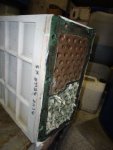
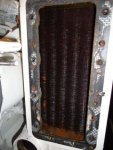
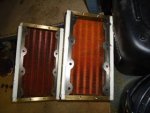
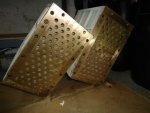
Bought our SS with MAN 800's from first owner 6 years old, only 180hrs, besides organising an immediate service also clean out of the coolers (as we couldn't find any paperwork to establish if they had been done previously) and were a bit wary of such little use. As can be seen from the photos, it was definately needed! Lack of use is the enemy of marine engines and whilst low engine hours are very attractive, more use less need to clean out....

The MAN MMDS system diagnostics have since been rock steady over the last 2 years.

Before:
Image 7.jpg
Image 30.jpg

After:
Image 62.jpg
Image 65.jpg
 
Bought our SS with MAN 800's from first owner 6 years old, only 180hrs, besides organising an immediate service also clean out of the coolers (as we couldn't find any paperwork to establish if they had been done previously) and were a bit wary of such little use. As can be seen from the photos, it was definately needed! Lack of use is the enemy of marine engines and whilst low engine hours are very attractive, more use less need to clean out....

The MAN MMDS system diagnostics have since been rock steady over the last 2 years.
Thanks, Pan, thats interesting. Did the MMDS give any indication that it was necessary to clean the coolers prior to doing the work or did you feel that performance was lacking? Do the engines perform better after cleaning?

I am in the same situation as you. I bought my boat last year and there was no paperwork or other info to suggest that either coolers or heat exchangers had ever been cleaned although I would be surprised if they weren't given that the rest of my boat was well looked after by a full time skipper. However, for my own peace of mind, I am having the coolers and heat exchangers cleaned on my engines and then I would probably not need to do them again during my ownership of the boat
 
No there was no adverse indication from the MMDS, except when the service engineers emailed me the read outs from the engine survey on their laptop from the management computers they showed previous owner had 3 occasions of overheat on one engine (it was suggested to me by seller that it was a faulty sensor, but I was a little suspicious!)when going thro' the boat paperwork prior to purchase, found service invoices, but no mention of coolers cleaning. After running thro' the MAN service schedules noted that these should have been done on a time basis rather than hours used.

Our delivery of the boat was about 300nm and the last thing we needed was an overheat on the voyage, so had the work done in Port Vauban immediately after purchase, the engineers emailed me numerous photos which showed that it really was necessary !! My view is regular use will keep the coolers relatively clear, but plan to do these every 3 years, expensive but better than a blown head gasket or worse. JFM's flushing system looks like an ideal solution, as what we saw was mostly salt deposits, probably with salt water left in the system for a long time.
 
Rydlime seems to clean the water side salt deposits ,as an interim or routine annual .Along with of course regular use .

Airside fouling
-I have been researching oil types for MAN engines and came across certain brands / types not recommended cos they enhance ,make worse fumes leading to airside fouling ., the crank case rebreathing recovery system is overwhelmed .

Apparently the correct spec MAN recommend oil(s) causes v little if any air side fouling .

Has anybody else heard anything along these lines ?
I,am new to MAN just gathering background info
 
Frankly for the minimal saving, I would only use the recommended oils by MAN. Our engines don't 'smoke' nor consume any oil, 'touch wood' , other than a faulty sensor, they haven't missed a beat over 2 years. Very pleased with them..:encouragement:
 
Top