When things go wrong ... mast problems ....

If you make the poles just long enough to nearly reach the stem head fitting you can attach the forestay/ furling spar to its apex and the main sheet between the apex and the stem head.

You can then lower it using the main-sheet tackle which has a more comfortable sized rope to handle than your 8mm poly-whatever. Assuming you have a jamming cleat on the mainsheet lower block you can utilize this if you need to pause midway

Good idea on the mainsheet ...

As to which I use as mast to A-frame ... have to check.

Arrange a support at the stern that will take the weight when the mast gets down to near horizontal ( bear in mind that the spreaders may well be near the point where you will arrange the support)

Be very sure about the integrity of the maststep/ tabernacle fixings to the deck because as yo get close to horizontal the shear loads on them become quite high.

Its been down quite a few times and I know the blade step is OK ... (if I had a tabernacle step with the side plates - I would have far easier job !).
 
Hi Vic your comments reminded me of an experience long ago. (these virus times seem like a good time for a yarn)
I was asked by an acquaintance to help him lower his mast for the first time on a 22ft trailer sailer. He kept it in a yard at the launching place so had not dropped the mast. He wanted to try the ocean and as I have mentioned we have 3 bridges to get under with about 20ft air draft. I went through with him the procedure and he picked me up near home on the way down river to the sea (and bridges) Yes the first drop was going to be while under way. All went Ok until the mast sat in the relatively low crutch.
It turned out unbeknown to us that the mast base had been screwed down to the deck with bronze screws. These had corroded over time. So when the mast weight rested on the crutch the mast was over balanced over the stern. The base ripped up off the deck. Fortunately it did not go too far before the tackle and A frame took up. But certainly a surprise to us. Needless to say it was back home and repair the damage. So yes you need a base able to take the shear loads and even possibly upward loads. Also another good reason to lower the mast only as far as necessary. ie tall crutch. ol'will
 
Confessions time ?

Mast bases ripping out ...... any others ?

I have two !

We had dropped the mast (this was 2011 Baltic cruise) .... and stopped at the town wall after the bridges to sort the raising .... but noted we had other problems meaning a return back upriver to home.
Now imagine - I have a mast that is still attached to its base and a significant amount sticking out astern of the boat ...

We need to come of the wall (we are facing outbound) ... and then turn 180 ....

Bow starts to come of wall nicely ... but in the rush to get back and sorted so we can catch up with schedule - I forget about that overhang .... that's when anchor light gets smashed ... VHF antenna bracket bent .... cap shroud attachment gets pulled ...

Back to base and luckily all can be sorted.

The second is on return from the cruise .... we have to raise the mast at home base. All is going fine until it all stops about 1/2way and I cannot see why ... so I give a few more 'pumps' of the windlass handle ... Oh Sh** ..... one cap shroud is caught and now damaged needing replacement ! (As a temporary - I made up my own galvanized replacement till the stainless arrived from Riga ... ).

Always interested to read others misfortunes ... if nothing else - they remind us to be careful ourselves to try not repeat !!
 
Confessions time ?

Mast bases ripping out ...... any others ?

I have two !

We had dropped the mast (this was 2011 Baltic cruise) .... and stopped at the town wall after the bridges to sort the raising .... but noted we had other problems meaning a return back upriver to home.
Now imagine - I have a mast that is still attached to its base and a significant amount sticking out astern of the boat ...

We need to come of the wall (we are facing outbound) ... and then turn 180 ....

Bow starts to come of wall nicely ... but in the rush to get back and sorted so we can catch up with schedule - I forget about that overhang .... that's when anchor light gets smashed ... VHF antenna bracket bent .... cap shroud attachment gets pulled ...

Back to base and luckily all can be sorted.

The second is on return from the cruise .... we have to raise the mast at home base. All is going fine until it all stops about 1/2way and I cannot see why ... so I give a few more 'pumps' of the windlass handle ... Oh Sh** ..... one cap shroud is caught and now damaged needing replacement ! (As a temporary - I made up my own galvanized replacement till the stainless arrived from Riga ... ).

Always interested to read others misfortunes ... if nothing else - they remind us to be careful ourselves to try not repeat !!

Oh yes ! Rigging wires can catch on almost anything........... cobwebs or even fresh air I reckon. Although I can lower and raise my mast using the A frame by myself I always have someone handy when raising it just in case a wire snags on something otherwise I ask them to stand well clear just in case things go badly wrong.
The other thing to watch out for is rigging screws "capsizing" and jamming on the inverted U bolts A little bit of extra muscle soon bends them. I attach the shrouds and the back stays before lifting the mast, That way when its reaches vertical it is well supported except for the forestay ( actually I dont normally disconnect the shrouds. If you were to look at my boat now you would find the back stays coiled in the back of the cockpit but the shrouds still attached to the deck fittings) To avaid the capsized rigging screw situation I stand them up with bits of light shock cord tied to the guard rails
 
Ok ... been some time since I worked on this but today finally decided how to do the 'foot' of my A frame steel poles.

I plan to use long bolts through chain plate U bolts to stop A frame moving but allowed to pivot. But I need to protect the GRP deck from the steel pole ends.

Here's the rig set up in workshop as a test :


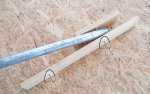
The wood blocks to allow pivot but protect the GRP deck :


Top end where rope tackles will be attached ..


Another view :


The only bit I'm unsude of is the angle the poles make to the boat sides may mean opening up the 'axle' holes in the wood blocks.
 
Last edited:
I welded a flat bar to each end ot the pole pivot drilled the hole in the flat bar and bent the flat bar so the holewas paralled to the chain plate when the angle ot eh poles come to a point.

I did the same at the other end so the axle / rod was across the boat making it easier to attach the block and forstay.

Hope this makes sense.

I made an A frame to fit on the front toe bar to allow ne to lift heavy loads with my front recovery winch
 
That studding will probably be ok, but does tend to be made of cheese metal. Got any old 3/8" coach bolts lying around?

I know the studding will bend ... I looked for coach bolts - but none were long enough.

I'm considering to put a piece of thin ply under the wood blocks so if pole end does touch deck - the ply will be a pad for pole end to gouge ..
 
I Know you may be set on dropping the mast but have you tried feeding the messenger line through a tube or hose and then forcing this tube up and over the sheave. This has the ability to release the bind. It worked for me in the past with some stiff plastic fuel line...I hammered it with a piece of metal pipe the same size which I pulled back and forth using a second halyard.
 
I Know you may be set on dropping the mast but have you tried feeding the messenger line through a tube or hose and then forcing this tube up and over the sheave. This has the ability to release the bind. It worked for me in the past with some stiff plastic fuel line...I hammered it with a piece of metal pipe the same size which I pulled back and forth using a second halyard.

Tried it when suggested before .... the lines are trapped hard !

It's given me excuse to make the frame anyway - I need a solution for the bridges so I can get to sea. I also want to service the masthead and sort out that daft wind indicator !!

I also have a halyard to re-run ... the Spinnaker which came away couple years ago - when trace line broke.
 
I accept I'm a novice generally - but I have raised and lowered the mast on my 19 and 20 footers twice (or more) a year for the last 10 years, so I'm aware of what can and and can't go wrong, but I have to say I wouldn't trust those poles... I accept we're only talking about a 22 or 23ft mast on mine but I use two pieces of 4 by 2 timber - joined at the top with an eye bolt and drilled at the bottom for lines that I attach to the forward chain plates... I have a taberbacle but I still have a couple of mates come and help - one to brace the mast laterally to stop swing, and one to keep an eye on the stays as it goes up and down so they don't catch anything, and to guide the mast into the crutch... the A frame is long enough for the apex to rest on the nose of the boat, I use my main sheet (6:1) for the lifting, and still need the guys to give it a start when lifting... I would be worried about those poles to lift my mast, and yours as I understand it is bigger, the tackle also looks a little under spec.. you know your boat better than me though, so feel free to ignore this - I may just be being a snowflake! :D
 
I accept I'm a novice generally - but I have raised and lowered the mast on my 19 and 20 footers twice (or more) a year for the last 10 years, so I'm aware of what can and and can't go wrong, but I have to say I wouldn't trust those poles... I accept we're only talking about a 22 or 23ft mast on mine but I use two pieces of 4 by 2 timber - joined at the top with an eye bolt and drilled at the bottom for lines that I attach to the forward chain plates... I have a taberbacle but I still have a couple of mates come and help - one to brace the mast laterally to stop swing, and one to keep an eye on the stays as it goes up and down so they don't catch anything, and to guide the mast into the crutch... the A frame is long enough for the apex to rest on the nose of the boat, I use my main sheet (6:1) for the lifting, and still need the guys to give it a start when lifting... I would be worried about those poles to lift my mast, and yours as I understand it is bigger, the tackle also looks a little under spec.. you know your boat better than me though, so feel free to ignore this - I may just be being a snowflake! :D

No worries .....

At this time - we are going to lower the mast ....

The steel poles are more than strong enough for this job ...... in fact I am considering setting up ground bases so I can lift my weekender boat with them ... (6 men can lift that).

A frames like derricks are stressed in compression and only fold when seriously undersized. Unlike a fixed vertical pole that takes a bending moment across its width and folds.

The use will be a minimum of two man operation ... me to work the tackle and my pal with the MoBo to start it and then to control the sideways bit as it descends.

The tackle has 8mm line that has a rating of 1400kg ... I may use the main sheets ... haven't decided yet.

The bit that is going to be interesting actually is the de-rigging of the A frame ... as the connecting stay mast to A frame is the forestay with furling gear. Once mast is down ... the A frame is going to be upright carrying the furling gear weight ...
Getting the A frame down and forestay / furling gear laid with the mast is going to be a careful job ...
Similarly when going to raise the mast .... need to refix forestay / furling gear to A frame and hoist up ....

What I am considering is having the genny halyard through the furling gear shackle but not made fast ... the halyard then being the connecting line to masthead ... this way - I can then use the excess halyard to lower the A-frame while still having forestay / furling gear under control. Basically the shackle will run on the halyard.
 
No worries .....

At this time - we are going to lower the mast ....

The steel poles are more than strong enough for this job ...... in fact I am considering setting up ground bases so I can lift my weekender boat with them ... (6 men can lift that).

A frames like derricks are stressed in compression and only fold when seriously undersized. Unlike a fixed vertical pole that takes a bending moment across its width and folds.

The use will be a minimum of two man operation ... me to work the tackle and my pal with the MoBo to start it and then to control the sideways bit as it descends.

The tackle has 8mm line that has a rating of 1400kg ... I may use the main sheets ... haven't decided yet.

The bit that is going to be interesting actually is the de-rigging of the A frame ... as the connecting stay mast to A frame is the forestay with furling gear. Once mast is down ... the A frame is going to be upright carrying the furling gear weight ...
Getting the A frame down and forestay / furling gear laid with the mast is going to be a careful job ...
Similarly when going to raise the mast .... need to refix forestay / furling gear to A frame and hoist up ....

What I am considering is having the genny halyard through the furling gear shackle but not made fast ... the halyard then being the connecting line to masthead ... this way - I can then use the excess halyard to lower the A-frame while still having forestay / furling gear under control. Basically the shackle will run on the halyard.
No argument.. reckon your plan is good.. The cross over/de-rig is always the interesting bit... not sure if it will work with your rig being bigger, but on mine I use the jib halyard like your thinking to do with the genny halyard as the connector to the A frame but I leave the furler completely loose.. for raising or dropping the mast I sit on the foredeck facing forward and just slide the furler over my shoulder... the guy controlling the lateral movement of the mast also helps with lifting/shifting it.. it means you can rig the forestay without disconnecting the A frame ... one more thing about using the mainsheet as the lifting tackle, the jammer is useful if you want to pause for any reason...
 
The studding here bends rather than snaps ....

The apex of the A frame - as can be seen has the studding in line with the mast not 90 deg to ... so there's no real stress on it. The blocks etc. will be fastened to the X of the poles basically pulling them together ... the studbar then only providing the 'link'.

The wood blocks at feet are 25mm thick solid wood and will have the 'axle' stud for pole pivot - but long enough to pass through the U bolt chainplates to lock the assembly down. The outer wood block is long and has a second bolt that passes through the more forward U bolt chainplate. This locks the fore - aft movement.

A-frame foot blocks.jpg
 
How about:
  • Horizontally lash one of the poles firmly to the base of the ladder.
  • Place ladder up against mast
  • Lash pole to something solid either side of deck (stanchion?) or a line forrard from each end of pole to bows.
  • For added safety lash ladder to mast at about head height.
  • Climb ladder to find that the problem still needs the mast dropping and go back to plan B.
 
How about:
  • Horizontally lash one of the poles firmly to the base of the ladder.
  • Place ladder up against mast
  • Lash pole to something solid either side of deck (stanchion?) or a line forrard from each end of pole to bows.
  • For added safety lash ladder to mast at about head height.
  • Climb ladder to find that the problem still needs the mast dropping and go back to plan B.

:D

Mast hasn't been down for about 8 years .... so I think its about time anyway !

If it works as well as others report of their A frames .. will make life for my getting to Baltic Sea much better ...
 
Top