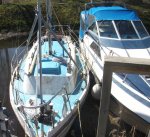
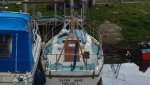
When things go wrong ... mast problems ....

Ok rigged on boat to check and adjust where needed.

Original idea was for pivot to be at the cap shroud U bolt ... but because I have old style cabin - the pole hits cabin side and cannot angle in enough

lP2Ih4u.jpg


sJ79AWT.jpg


So swap blocks round and have pivot at fwd babystay

fvMH1NB.jpg


Genny halyard is ideal and length is good just about to let me put A frame down after to unrig.

Here's all rigged ... will likely swap the rope and tackle for main sheets with the rope clutch.

sfDfvOQ.jpg


rvGBDb7.jpg


2rHiayk.jpg


Of course while forestay / furling is still rigged - the rope block fouls this - but once released - it should be clear ...

I think to run the genny halyard through the furling gear shackle on the slider - that will help control the furling gear while lowering / raising.
 
Interesting - when disconnecting boom from mast - it has a U to U fitting as the roller is through mast ... the U to U is made with a solid rod 'axle' and a split pin dropped down through the centre to fix. NO SPLIT PIN !!

I remember the original was an old brass job ... but it carries no weight .. the rod does all that. Must have just rotted and fallen out ! I have a choice of nylon or black metal bolt that fits the pin hole.... if I cannot find a replacement pin in the 'it will be handy later box'.
 
With regard to the top end of the A frame. Rather than the bolt through the 2 poles I would suggest a hole in the side of the tubes through which a shackle can be passed. One shackle each pole. The shackles then attach to a ring or large shackle attached to the tackle at the attachment of the forestay or halyard. Which ever you are using. It is often easier to manage a halyard if the forestay has a jib furler attached. But of course halyard needs to be well secured and sturdy.
Re the wood to protect the GRP deck. Of course would be better protection if you attached some ply wood across the bottom of the blocks for the pole to rest on. Then holes for the axles cab quite loose. ol'will Sorry just saw the photos after writing so what i suggest not relevant well done.
 
With regard to the top end of the A frame. Rather than the bolt through the 2 poles I would suggest a hole in the side of the tubes through which a shackle can be passed. One shackle each pole. The shackles then attach to a ring or large shackle attached to the tackle at the attachment of the forestay or halyard. Which ever you are using. It is often easier to manage a halyard if the forestay has a jib furler attached. But of course halyard needs to be well secured and sturdy.
Re the wood to protect the GRP deck. Of course would be better protection if you attached some ply wood across the bottom of the blocks for the pole to rest on. Then holes for the axles cab quite loose. ol'will Sorry just saw the photos after writing so what i suggest not relevant well done.

I thought about apex of A frame and stud across but then decided to be Boy Scout ... if you cross the poles as shown and then bolt through - the bolt never takes the weight - all it does it keep the two pole ends together.
If the halyard is not strong enough to take the mast - then will not matter where block and tackle is attached !!

Originally I was going to use the forestay but with the windlass etc. - I cannot get the A frame down low enough to connect - plus then I have too short a gap for the block / tackle. I need to tension the gear before releasing forestay ..... I don't like idea of using baby stays as the backstays etc. will remain close to final adjustment .....

Mainsheet block now fixed to stemhead fitting behind forestay - this will allow me to work on the stay to disconnect / connect.

6ULYxQb.jpg


The wood blocks are 25mm (1 inch) thick and the coach bolts are high enough so pole ends should never touch the deck .... but I do plan to slide a piece of thin ply under just in case. I have 2mm carton ply I can use.
 
Just to comment .... I understand that many others have used / created A-frames ... Gin poles etc. and been very successful. I borrow ideas from many - I watch YT / Vimeo etc. as well as see photos on forums like this. I owe an immense gratitude to all ...

My thread and the tests / rigs / modifications / ideas are all put here to help anyone else looking to do it. The pitfalls ... the areas to pay attention to ...

Yes I have a seamans background and also many years rigging rope walks / monkey climbs for Scouts ... so a reasonable understanding of the stresses and force directions in lifts. But each application has aspects that need someone who has already completed such a job to add input ... I am hoping that my knowledge of derricks / lift angles / compression and shear forces along with ideas / suggestions etc. from those who use a frames successfully provides a working safe solution.

Despite the feeling and watching many videos of similar where a single person operates mast up / down ... when my gear is used first time - there will be a strong helper guiding the mast down while I handle the A frame / tackle. Once that first time is completed - we will have more info as to any modifications / improvements etc. that could lead to one-man operation.

I do have another possibility - to create a fixed Gin single pole system doing away with the A design ... but more on that later ...
 
That's the unfortunate part of this .... because I cannot re-run halyards - I only have the one to use. So if it goes T's up ...... I'll be looking for a new mast !!

Batter a new mast that have to get you fixed.

Consider attaching some extra lines to your standing rigging with blocks on the chain plates you are not using.
Extra manpower could control these with a turn around a towbar and a car/s parked close but out of the firing line.

I made a lifting frame for my club some year ago which was 10-12 meters high using a A frame like you to lift it up pulling with my 4 x 4 and several club members.

Also if you place some patted tressels where the mast would fall all at the same hight this could reduce/prevent and damage to the mast it if fell.
 
The halyard is 12mm (old but good) ... I have a halyard for a job that I have never figured out - initially I thought it was a storm jib as its about 2/3 3/4 height of the mast but the fixing to the mast is a simple U plate .... just below above spreaders ..... will take the line that's there as a back-up ...

I basically reeved a line there to use for the spinnaker pole ..... I don't think it could carry a storm sail .. maybe.
 
Last edited:
I might have mentioned on this forum recently bu this works really well for me in using the forestay to lower the mast. (a lot lighter than yours). I ahd this little clamp for wire rope 2 plates with 2 slots side by side intended as a temporary cable clamp with screws pulling the 2 together. Pretty dodgy for the intended use. However by clamping around the forestay just above the splice I fitted a piece of SS rod into then other side. This has a loop on the bottom side for attaching tackle and a kink in the top end to stop it sliding through the clamp. The end effect is a loop to take a shackle which is next to but separate from the main eye of the forestay. It measns I can take the load on the tackle then disconnect the forestay from the bow fitting. In my case a high field lever. However as you used the halyard this trick is not necessary for you as the forestay is completely free for attach detach.
You should be fine as rigged but I would reiterate have a tall crutch support at the stern. Make it as high as possible but so you can lift the mast down lower or shuffle the mast forward after detach from base, before lifting down lower. As high as possible because this range of movement of the mast from 30 degrees fro horizontal to horizontal is where all the load on the gear will appear. Best wishes Nigel. I am sur eyou know all this already. Just be careful. ol'will
 
Every time I put mine up and take mine down, and contemplate the bad nights sleep I have had the night before, I try to remember that the sailors on Nelson's navy would have been doing this day in and day out and not even batting an eye lid... it doesn't help, but I always laugh afterwards (along with the sigh of relief).. :ROFLMAO:
 
Hi Will ... I have a Crutch ... the one on boat !! ... that puts the mast at decent angle above cabin top ... The only problem with it ... the design of the aft end of cockpit makes it difficult to lash the lower end of the crutch to secure. Its intended to drop mast this evening ... so before then - I will be looking again at how to fix the crutch more securely.

I notice that in USA - the Catalina guys (Catalina monohulls are actually the old Jaguar / Alacrity designs mod'd up) have a fancy telescopic single pole crutch ...
 
Every time I put mine up and take mine down, and contemplate the bad nights sleep I have had the night before, I try to remember that the sailors on Nelson's navy would have been doing this day in and day out and not even batting an eye lid... it doesn't help, but I always laugh afterwards (along with the sigh of relief).. :ROFLMAO:

Sheerlegs were a daily event literally for seaman ... launching lifting cutters / gear etc.
 
If you have a neighbouring boat, go up their mast and heel the two boats gently together, either with body weight of a line and winch, to access the top of your mast.
 
Tks VicS .... glad someone noticed !!

OK ... Crutch :

ready to drop mast (3).jpg

'Strange halyard line' led as back-up :

ready to drop mast (2).jpg

Jobs pencilled in for early evening today 0 but as you can see in the photos here ... looking like rain on its way !!
 
The only other boats with mast I could do :

If you have a neighbouring boat, go up their mast and heel the two boats gently together, either with body weight of a line and winch, to access the top of your mast.

Are the other side of the town bridges and that means mast DOWN anyway !!
 
Watch out for sideways movement of the mast during the initial lowing. Once the lowing has got to an angle of about 60 to the horizintal the A frame will start to control any sideways movement.
 
Top