What's the reason for requiring stern and masthead lights ?

Uh, no. The Colregs call them masthead lights, but they're often (incorrectly, if you like) called "steaming lights". The exact opposite of what you just said.

Pete

Yes, the Colregs call them masthead lights, but there is no requirement for them to be at the masthead, merely certain heights above the side lights. They are required when under power, (steaming) so why do the Colregs persist in this confusion?
 
That power driven vessel viewed from the bow is not correct. The white is an all round, so should be viewed from the bow.

For the sailing boat, you would not expect to see two white lights at the same time, as in the view from the beam. They do not have two be two different lights as already discussed on this thread, assuming the vessel is less than 12m.

I thought that. I have some flip cards which make the same mistake, AIUI the pictures should be as follows, right ?

Navigation_Lights_Motor_Sailing_edited.jpg


Navigation_Lights_Power_boat_under_12_meters_edited.jpg


Boo2
 
The ColRegs do seem to differentiate between a sailing vessel under power and a power vessel (under 12m).

Power vessels can display an all round white light but sailing vessels under power must show separate stern and steaming lights. There may be a good reason but the ColRegs don't give reasons.


Incorrect I am afraid !!

A sailing vessel under power IS a power driven vessel and should show the lights for a power driven vessel

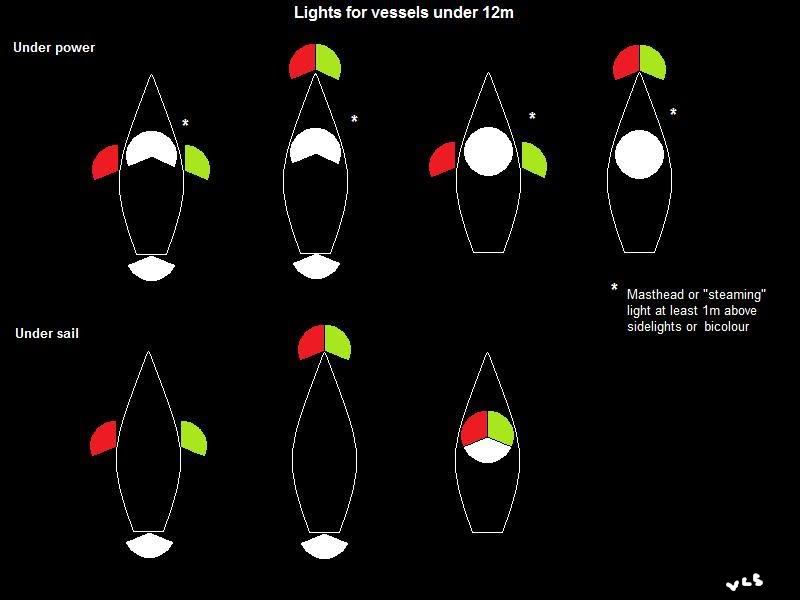
This diagram shows the legal combinations for the common lights for vessels under 12m
( all-round red and greens excluded as is the concession for certain vessels under 7m)


It is only vessels less than 12m that can combine stern light and masthead (aka steaming) light into one lantern

It is only vessels under 20m that can combine the side lights into one lantern.

The reason for the separate lanterns for stern and mashead ( steaming) lights, other than the concession for vessels under 12m, is as I expalined earlier :

It is because the regs define the stern light as "placed as nearly as practicable at the stern".
They also require that "When only one masthead light is prescribed for a power-driven vessel, this light shall be exhibited forward of amidships".

Now you cannot have a single light that satisfies both conditions!


See Rules 21 (c) and Annexe I 3 (d) In an up to date version of the rules ... not the old dog-eared book you have had since time began.
 
Last edited:
Yes, the Colregs call them masthead lights, but there is no requirement for them to be at the masthead,

I don't understand this.

If your all round white is anywhere but at the highest point it will no longer be 360 degree. Bits of boat will get in the way.

Masthead should be masthead, unless the white is split.
 
Quote:
Originally Posted by NormanS
Yes, the Colregs call them masthead lights, but there is no requirement for them to be at the masthead,
I don't understand this.

I don't understand this.

If your all round white is anywhere but at the highest point it will no longer be 360 degree. Bits of boat will get in the way.

Masthead should be masthead, unless the white is split.

“Masthead light” means a white light placed over the fore and aft centreline of the vessel showing
an unbroken light over an arc of the horizon of 225 degrees and so fixed as to show the light from
right ahead to 22.5 degrees abaft the beam on either side of the vessel.​

An all-round light is defined:

“All-round light” means a light showing an unbroken light over an arc of the horizon of
360 degrees​

Dont confuse the two!
 
Last edited:
>If your all round white is anywhere but at the highest point it will no longer be 360 degree. Bits of boat will get in the way.

Any light below the masthead is a steaming light with a 180 degree angle of light. It is only used when motoring not sailing, hence steaming light.
 
>If your all round white is anywhere but at the highest point it will no longer be 360 degree. Bits of boat will get in the way.

Any light below the masthead is a steaming light with a 180 degree angle of light. It is only used when motoring not sailing, hence steaming light.

225 degrees!

But "Steaming light" is not mentioned in the regs. Its just a popular term used in place of "masthead light", which is defined in the regs
 
Last edited:
>But "Steaming light" is not mentioned in the regs. Its just a popular term used in place of "masthead light", which is defined in the regs

If you look at the colregs picture for a yacht motoring it a has a white light mid mast, so I would say it is a requirement called a steaming light, I'm not sure what 'defined' means in this context.
 
>But "Steaming light" is not mentioned in the regs. Its just a popular term used in place of "masthead light", which is defined in the regs

If you look at the colregs picture for a yacht motoring it a has a white light mid mast, so I would say it is a requirement called a steaming light, I'm not sure what 'defined' means in this context.

Defined means as defined in the colregs.

The lights, as I have already said , are defined in rule 21:

(a) “Masthead light” means a white light placed over the fore and aft centreline of the vessel showing
an unbroken light over an arc of the horizon of 225 degrees and so fixed as to show the light from
right ahead to 22.5 degrees abaft the beam on either side of the vessel.

(b) “Sidelights” means a green light on the starboard side and a red light on the port side each
showing an unbroken light over an arc of the horizon of 112.5 degrees and so fixed as to show the
light from the right ahead to 22.5 degrees abaft the beam on its respective side. In a vessel of less
than 20 metres in length the sidelights may be combined in one lantern carried on the fore and aft
centreline of the vessel.
(c) “Sternlight” means a white light placed as nearly as practicable at the stern showing an unbroken
light over an arc of the horizon of 135 degrees and so fixed as to show the light 67.5 degrees from
right aft on each side of the vessel.

(d) “Towing light” means a yellow light having the same characteristics as the “sternlight” defined in
paragraph (c) of this Rule.
(e) “All-round light” means a light showing an unbroken light over an arc of the horizon of
360 degrees.

(f) “Flashing light” means a light flashing at regular intervals at a frequency of 120 flashes or more
per minute.​

There is, please note, no mention anywhere in the colregs of a "steaming light". It is just a popular term used to mean "masthead light" as defined above
 
Last edited:
Defined means as defined in the colregs.

The lights, as I have already said , are defined in rule 21:

(a) “Masthead light” means a white light placed over the fore and aft centreline of the vessel showing
an unbroken light over an arc of the horizon of 225 degrees and so fixed as to show the light from
right ahead to 22.5 degrees abaft the beam on either side of the vessel.

(b) “Sidelights” means a green light on the starboard side and a red light on the port side each
showing an unbroken light over an arc of the horizon of 112.5 degrees and so fixed as to show the
light from the right ahead to 22.5 degrees abaft the beam on its respective side. In a vessel of less
than 20 metres in length the sidelights may be combined in one lantern carried on the fore and aft
centreline of the vessel.
(c) “Sternlight” means a white light placed as nearly as practicable at the stern showing an unbroken
light over an arc of the horizon of 135 degrees and so fixed as to show the light 67.5 degrees from
right aft on each side of the vessel.

(d) “Towing light” means a yellow light having the same characteristics as the “sternlight” defined in
paragraph (c) of this Rule.
(e) “All-round light” means a light showing an unbroken light over an arc of the horizon of
360 degrees.

(f) “Flashing light” means a light flashing at regular intervals at a frequency of 120 flashes or more
per minute.​

There is, please note, no mention anywhere in the colregs of a "steaming light". It is just a popular term used to mean "masthead light" as defined above
I think the confusion over "masthead" light not being at the top of a modern sloop rigged boat, may be that when the rule was written (1840?) the (lower)main mast was only part of the mast with top mast and possibly top gallant mast above.
 
I think the confusion over "masthead" light not being at the top of a modern sloop rigged boat, may be that when the rule was written (1840?) the (lower)main mast was only part of the mast with top mast and possibly top gallant mast above.

I am looking at what I hope the latest version (1996?) of the colregs written in 1972, including amendments effective from 29 Nov 2003.

The 1972 regs replaced the 1960 ones. I have no knowledge of what was in the 1960 ones, never mind any that may or may not have dated from 1840.
( but I have seen a history somewhere. Wiki??)

If you read the current version you will see that the terms it uses are defined and there is very little reason for any confusion.
 
I am looking at what I hope the latest version (1996?) of the colregs written in 1972, including amendments effective from 29 Nov 2003.

The 1972 regs replaced the 1960 ones. I have no knowledge of what was in the 1960 ones, never mind any that may or may not have dated from 1840.
( but I have seen a history somewhere. Wiki??)

If you read the current version you will see that the terms it uses are defined and there is very little reason for any confusion.
I agree, there is no confusion in my mind, but abviously there is in many the minds of others judging from these latest posts, and many earlier threads. Wiki says UK introduced "masthead " light in 1840s before International conference agreement eventually in the 1890s.
 
>But "Steaming light" is not mentioned in the regs. Its just a popular term used in place of "masthead light", which is defined in the regs .

When under power the all round white at the top of the mast is an alternate position for boats under 12 meters, to the forward facing white part way up the mast and white stern light, it is not the only light position.

I mean, in the last 30 years every sailor I have met knew what a steaming light was, every boat builder fitted a steaming light, and all the chandlers would sell you a steaming light.

What is going to happen when we get to give way, and stand on vessel, if a simple thing like steaming light position is causing all this trouble.

Brian
 
I am looking at what I hope the latest version (1996?) of the colregs written in 1972, including amendments effective from 29 Nov 2003.

The 1972 regs replaced the 1960 ones. I have no knowledge of what was in the 1960 ones, never mind any that may or may not have dated from 1840.
( but I have seen a history somewhere. Wiki??)

If you read the current version you will see that the terms it uses are defined and there is very little reason for any confusion.

I would say there is every reason for confusion when the Colregs define a "Masthead" light as a light which is seldom at, and has no requirement to be at, the masthead.

See Rule 21, and Annex 1.
 
I would say there is every reason for confusion when the Colregs define a "Masthead" light as a light which is seldom at, and has no requirement to be at, the masthead.

See Rule 21, and Annex 1.
See my post at 30 with a diagram of the mast parts, mainmast below top mast below top gallant mast. Simple init.
 
See my post at 30 with a diagram of the mast parts, mainmast below top mast below top gallant mast. Simple init.

You may well be correct, and bang up to date in the 19th century.

I'm not disputing your hypothesis, just saying that the Colregs could do with being brought into the present century.:)
 
Top