Whats the largest boat you can lower a mast on?

carl170

Well-Known Member
Joined
13 Nov 2003
Messages
235
halcyon23.blogspot.co.uk
I am based on the Tyne, where we have a few bridges to go under. I have a Caprice with a folding Gunter rig, so I can easily lower and raise the mast as necessary.

Some of the other club members have bought and sold sailing boats over the years, mainly because they cannot get the mast to lower to get under some of the bridges. The swing bridge now costs £120 to open one way (they now take credit cards !).

A member recently bought a jaguar 21. We did a dry run lowering the mast when the boat was out of the water. The mast seemed to be about 30 feet long and overhung the boat by a frightening amount, as well an flexing beyond belief.

My caprice has a stainless steel tube extension from the tabernacle which forms a triangle shape and this can be lowered from the cockpit.

I was wondering what would be the biggest boat that would be able to raise and lower its mast comfortably, and if anyone has ever done modifications to their boat for this purpose. The main problems I have seen is that either the mast does not have a hinged tabernacle, or the mast is so long that the balance of the boat seems compromised.

Any suggestions or observations would be gratefully recieved!

Regards

Carl
 
I am based on the Tyne, where we have a few bridges to go under. I have a Caprice with a folding Gunter rig, so I can easily lower and raise the mast as necessary.

Some of the other club members have bought and sold sailing boats over the years, mainly because they cannot get the mast to lower to get under some of the bridges. The swing bridge now costs £120 to open one way (they now take credit cards !).

A member recently bought a jaguar 21. We did a dry run lowering the mast when the boat was out of the water. The mast seemed to be about 30 feet long and overhung the boat by a frightening amount, as well an flexing beyond belief.

My caprice has a stainless steel tube extension from the tabernacle which forms a triangle shape and this can be lowered from the cockpit.

I was wondering what would be the biggest boat that would be able to raise and lower its mast comfortably, and if anyone has ever done modifications to their boat for this purpose. The main problems I have seen is that either the mast does not have a hinged tabernacle, or the mast is so long that the balance of the boat seems compromised.

Any suggestions or observations would be gratefully recieved!

Regards

Carl

A Thames Barge :D
 
dropping the mast

Two weeks ago I tyook the slug - 18 ft 6inches - with a 17 foot mast up the river Nene

http://www.keepturningleft.co.uk/category/video-logs/

films 141 to 151


I had to drop the mast at least a dozen times a day while sailing the 42 miles upstream and 42 miles back

we did sail most of the way

I modified the rig and got rid of the boom

using a spinnaker boom on a loose fitted main

two part purchase on the forestay

and still made cock-ups

I hope to explore the Tyne next summer

tell me about the treats I have ahead of me

Dylan
 
Kindred Spirit is 24'6" and we raise and lower the mast ourselves, on the hard or afloat. However, that's a start and end of season job, and I wouldn't want to do it regularly without some effective modifications. Preventing sideways swinging on the way up or down would be the main one, and avoiding having to remove the sail would be good too.

Pete
 
I have to agree about the Thames Barge quip.

Traditional sailing boats on the Norfolk Broads have to deal with this issue aswell

You are seeking a modern solution to a problem solved hundreds of years ago

A Thames sailing barge, say 100ft length would have had a dedicated geared winch on board, to drop the mast backwards via the forestay, easy, and the same winch to raise it again, hard work !

I believe that barges rigged for this would be able to drop their top masts, and the forestay would be rigged to the top of the main mast. The shrouds would be mounted aft of the mast, so no adjustment would be required

Does this help to point you in the right direction?
 
I have to agree about the Thames Barge quip.

Traditional sailing boats on the Norfolk Broads have to deal with this issue aswell

Both of those are designed from the ground up to do it though. Especially the Broads boat, where the foot of the mast swings up through the focsle giving it a nice long lever to make a counterweight really work well.

The OP's Caprice isn't designed for it, so while something could definitely be arranged it's no good just pointing at traditional types and telling him to get on with it.

Pete
 
Mast lowering

Indeed on the Swan River (colony to the east of Capetown) virtually all larger sailing boats are rigged for mast lowering. Just a few reside at ocean front marinas.
At our club we have a Bene 39 and Farr 40 both happy to lower mast to transit bridges. I have been on 32ft and 28ftand another 25ft with heavy mast head rig masts while lowering for bridges. Being a slacker I go for steering while the owner does the grunt work. In each case the mast is lowered on the run as you approach the bridges. (3 together)
No one is saying it is fun a bit tense in fact but often done. One boat here "Walk on the Wild Side" must be 60ft long with huge fractional mast and we see them motoring down to the bridges of a Saturday morning for a day of racing and again they return the same afternoon late.
You simply get organised and used to it.
My own 21fter has a light mast so is a piece of cake. My main complaint is having to fit the o/b engine
for the transit as I usually leave it home. I use 2 spin poles on purpose fitted rings on the side decks. I have a mast support on the stern rail as high as possible (about 2 metres) and a 3 purchase tackle to the forestay. In my case with a fractional rig I just rely on man power to keep the mast steady in transit and try to do it quickly. There are vartious tricks to stabilise the mast sideways in transit but I don't bother.
In one weekend in March each year our club has a race outing to Rottnest. Saturday morning sees almost every yacht in the club about 25 marching one behind the other down to the bridges to lower their masts. And do it all again Sunday on return.
Plenty on the forum on mast lowering or PM me olewill
 
Last edited:
Sorry, maybe I should have worded this better. My own boat is fine and I can lower and raise the mast no problem. However, other people who have bought sailing boats have ended up selling them because the rig was just not suitable for raising/lowering.

I am looking specifically for brand/ type of boat that has a rig that would be suitable for adapting with an A frame etc.

The only boat I do know about is the Jaguar21 - the mast on that is too long and too flexible to be of any use to raise or lower easily.

We have a 30ft limit in our club too.

Thanks again and sorry for not being more specific.

Dylan - you are in for an experience up the Tyne. Perhaps you should start a new post nearer the time!

Regards

Carl
 
My Snappie 23 has an approx 27ft mast, which is fairly lightweight.
You need to make sure the cap shrouds are still connected to offer a bit of sideways support but, with the help of an A- frame (couple of bits of wood), it's not too awful to get down if you're prepared.
 
The only boat I do know about is the Jaguar21 - the mast on that is too long and too flexible to be of any use to raise or lower easily.

Carl

Hello Karl
I can't imagine any problem with the Jaguar 21 in the mast being too long and flexible. As I( said I have seen people regularly drop masts in the region of 80ft long)
The flexibility should not be a problem. What can be of concern (and may be what you mean) is the whole mast swaying from side to side. You need a mast support at the transom for the mast to drop into. You then keep some weight in the mast support and some on the lifting tackle.
The swaying while in transit can be a problem although I think the Jag 21 mast could be guided by a person standing on the cabin top.
A mast (mast head rig usually) that has cap shrouds that are mounted square to the mast ie not located aft of the mast can make it easy. You fit a piece of SS bar in place of the bottom of the shroud. ie chain plate up to a point in line with the mast pivot bolt. This is stayed forward so that as the mast comes down the pivot point for the cap shroud is exactly in line with mast pivot. The cap shroud stays tight all the way down.
However on a fractional rig it is not so easy as the cap shroud chain plates are usually well aft of abeam the mast so they go slack as soon as the mast begins to come down. One type of trailer sailer has purpose fitted stays from chain plate on the cabin top directly in line with the mast pivot and going up to the mast about 1/4 of the way up. This in addition to proper intermediate and cap shrouds is purely to guide the mast when it is in transit from up to down.
I have had some success with a cable clamp on the cap shroud about level with the mast step. I run a rope from this to a point forward with a pulley then back to a winch. (duplicated each side) This rope has to be adjusted as the mast comes down but will pull the cap shroud forward so that it can hold the mast from side excursions as it transits. As I said I don't usually bother.
Many mast steps can not cope with any sideways swing of the mast. Lugs set about 5 inches apart will snap off easily. Mine is quite narrow (half an inch) at the pivot point so can cope with a lot of excursion without damage.
http://www.ybw.com/forums/attachment.php?attachmentid=13727&stc=1&d=1316682021
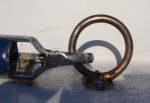
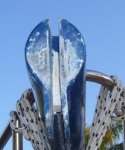
This is what I mean by a narrow pivot base on the mast step
http://www.ybw.com/forums/attachment.php?attachmentid=13726&stc=1&d=1316682021
This is a photo of the ring one each side to facilitate using spin pole to improve angle of pull on forestay.
Coincidentally tomorrow morning is relaunch time for boat currently at home. it will take a few minutes to get the mast from the cabin top base at the bow back into the mast step but actual raising is a piece of cake. All going well 30 mins from arrival to sail away. I hope. This will be something like 50 times I have done it. I don't think you should be concerned with lowering the mast on any boat you consider buying. But it is easier if it has a mast pivot or step to allow lowering. olewill
 

Attachments

  • Poleringscropped.jpg
    Poleringscropped.jpg
    20.8 KB · Views: 4
  • mastbase.jpg
    mastbase.jpg
    24.1 KB · Views: 4
mast drop film

while travelling on the Nene the mast was up and down like a yo yo

it did not always go smoothly

film 148 on this page if you want to see a mast being dropped - literally

http://www.keepturningleft.co.uk/category/video-logs/

I got caught by a gust of wind from the side

the slug has a simple hinge on the bottom of the mast

two part purchase on the forestay - and a smaller genoa to allow it to clear the full size bikes on the foredeck - of an 18 foot boat for goodness sake

Dylan
 
Hello Karl
I can't imagine any problem with the Jaguar 21 in the mast being too long and flexible. As I( said I have seen people regularly drop masts in the region of 80ft long)
The flexibility should not be a problem. What can be of concern (and may be what you mean) is the whole mast swaying from side to side. You need a mast support at the transom for the mast to drop into. You then keep some weight in the mast support and some on the lifting tackle.
The swaying while in transit can be a problem although I think the Jag 21 mast could be guided by a person standing on the cabin top.
A mast (mast head rig usually) that has cap shrouds that are mounted square to the mast ie not located aft of the mast can make it easy. You fit a piece of SS bar in place of the bottom of the shroud. ie chain plate up to a point in line with the mast pivot bolt. This is stayed forward so that as the mast comes down the pivot point for the cap shroud is exactly in line with mast pivot. The cap shroud stays tight all the way down.
However on a fractional rig it is not so easy as the cap shroud chain plates are usually well aft of abeam the mast so they go slack as soon as the mast begins to come down. One type of trailer sailer has purpose fitted stays from chain plate on the cabin top directly in line with the mast pivot and going up to the mast about 1/4 of the way up. This in addition to proper intermediate and cap shrouds is purely to guide the mast when it is in transit from up to down.
I have had some success with a cable clamp on the cap shroud about level with the mast step. I run a rope from this to a point forward with a pulley then back to a winch. (duplicated each side) This rope has to be adjusted as the mast comes down but will pull the cap shroud forward so that it can hold the mast from side excursions as it transits. As I said I don't usually bother.
Many mast steps can not cope with any sideways swing of the mast. Lugs set about 5 inches apart will snap off easily. Mine is quite narrow (half an inch) at the pivot point so can cope with a lot of excursion without damage.
http://www.ybw.com/forums/attachment.php?attachmentid=13727&stc=1&d=1316682021
This is what I mean by a narrow pivot base on the mast step
http://www.ybw.com/forums/attachment.php?attachmentid=13726&stc=1&d=1316682021
This is a photo of the ring one each side to facilitate using spin pole to improve angle of pull on forestay.
Coincidentally tomorrow morning is relaunch time for boat currently at home. it will take a few minutes to get the mast from the cabin top base at the bow back into the mast step but actual raising is a piece of cake. All going well 30 mins from arrival to sail away. I hope. This will be something like 50 times I have done it. I don't think you should be concerned with lowering the mast on any boat you consider buying. But it is easier if it has a mast pivot or step to allow lowering. olewill


William,

The mast on the Jag 21 was too flexible from the bow to stern direction. Maybe it is not the original mast, but it has a hell of a rake in it. The spreaders seem to anchor the first half of the mast and the backstay really hauls the top half back towards the stern.It seems very thin too (thinner maybe than the mast on my previous 18ft yacht.

Regards

Carl
 
I haven't thought this idea through fully,or done it ,but it seems to me that a forward amount of weight on a spigot at right angles to the vertical mast might work as a counterweight, provided the mast foot has a pivoting bolt. Get the balance right and raising or lowering could be a matter of routine similar to an 'A'frame with the forestay leading back via the bow roller to the cockpit winch, and a mast 'X' crutch, above head height, across the cockpit.
No need to release the shrouds, thus sideways movement restricted.
I'm guessing the a 56lb counterweight fixed at the outer end of the strut would give a reasonable balance to the mast of say 300lbs. The strut itself using a large clamping clip around the mast at say 2ft above the pivot,perhaps a modified spinnaker pole.

I'll go and have a lie down now!!

ianat182
 
I haven't thought this idea through fully,or done it ,but it seems to me that a forward amount of weight on a spigot at right angles to the vertical mast might work as a counterweight

It'll provide some effect, but the geometry is wrong really. At the same time as the mast is acquiring more leverage (approaching horizontal) the counterweight is losing it (becoming more vertical). In fact, as soon as the counterweight passes above the pivot (how early this happens depends on how high up the mast your strut is fixed) the resistance it provides becomes negative, it's actually helping pull the mast down!

If you're going to have a strut sticking forwards from the mast (and hopefully guyed with a halyard) then you're better off providing the downwards force with a tackle to the stemhead than with a weight.

Pete
 
Pete. Yes I understand that,my intention was more to make the balancing of the mast weight to assist the lowering process. An 'a'frame setup probably the way to go though.

Don't the Broads boats use a counterweight in a tabernacle arrangment,without removing sails etc?

Ian
 
Getting unhinged?

With ordinary deck stepped masts there is a considerable horizontal thrust at the step, which it is not really designed to withstand, a strong fixed tabernacle is much easier option but you usually only find this on ketches and motorsailers. When we had a Trapper 300 (26') we manhandled the mast up and down manually but even then we had some dodgy moments and we never tried it under way, it took four of us to manage it. We tried it once on our Sigma 33 but decided it was just too risky. If you are looking for enjoyable sailing and there is reasonable headroom for a shorter fixed mast a gaff rig might be the best answer.
I am still not convinced about those Aussie forty foot racers taking their rig up and down at will, it surely must require considerable manpower and sophisticated engineering, my mast is keel stepped but with 14 m above the deck on a 10m. boat it would overhang the stern by 9m.
 
prv, hi Pete

I take your point but thought the OP was looking at changing his boat, rather than modifying his existing.

I have taken down the mast of a 19ft boat with one other person, by hand.

I have remasted a 29ft boat, but that involved 5 people (to carry it), and using the masts of two adjacent boat as hoists, and a 31ft boat using a marina crane.

I do not know how long it takes to lower the mast of one of the larger trailer sailers, but wonder if that is where the OP should be looking

The very concept of raising and lowering the solid timber mast of a 100ft+ sailing barge, by a "man and a boy" fills me with awe!
 
Top