What type of perspex for a forward hatch?

Perspex is a trade name for acrylic sheet plastic.
You need to choose the thickness and colour then search for acrylic suppliers in your area.
What happens next is dependent on whether you are reglazing an existing hatch, making a hatch, just bolting to the deck etc.
I'm sure you'll be back with many more questions...
 
Any advice on the best sort of perspex to use? I sleep under it, so need to get it right!
Thanks,
Crisp
To add to what alahol2 just said. Acrylic can come in different grades, some deteriorate quicker than others in uv/sunlight but the Perspex brand is one of the better ones and when you buy the sheet the protective film on both sides that it comes with will be printed with the Perspex name. There are many suppliers but I have bought from Cut to Size Acrylic (Perspex) Sheet, Tube & Rod - Simply Plastics who gave good service.

Www.solocoastalsailing.co.uk
 
You can also use polycarbonate which is stronger, less prone to cosmetic crazing over time but is easily scratched. Acrylic is fine though, probably 8 or 9mm for the typical 550*550 (nominal) size forehatch.
 
Another case for more information.

Pictures (which will determine how the hatch is constructed (frame, no frame etc), actual size, Why do you need another hatch, is it crazed, crack developing etc.

With more information you would receive precise details.

Jonathan
 
Just replaced the lens in my forehatch with Lexan polycarbonate. Thanks for the car window tint idea - at the moment it is uncomfortably clear compared with the crazed, weathered acrylic that cracked across after 40 years.
 
If you want to buy your replacement material before removing the old one you will need to know the thickness. If the brand is not evident on the framing perhaps you could post a photo, or tell us the make and model of your boat and the hatch's dimensions and someone will be able to identify it and tell you the thickness of the material you need.
Alternatively of course, you could cut the plastic out of your hatch and cover it over with something weatherproof while you wait for the new one to arrive.
 
Another case for more information.

Pictures (which will determine how the hatch is constructed (frame, no frame etc), actual size, Why do you need another hatch, is it crazed, crack developing etc.

With more information you would receive precise details.

Jonathan
He is only asking what type of material to use for this type of application, no need to go in to detail about the whys and wherefores!
 
He is only asking what type of material to use for this type of application, no need to go in to detail about the whys and wherefores!

But, I often find the additional comments /advice one gets over and above the initial query can be very useful as it can bring to ones attention something one hadn’t thought about.
 
Polycarbonate (aka Lexan) is more forgiving, easier to work, much stronger (used for windscreens in planes and trains, car front/head lights etc.).
Comes in different colours/tint too.

I made a new windscreen for the flybridge. Cut with a jigsaw, detailed with a router to copy the original 1:1. Easy..

Sorry for the yankee style, but good info a bit into it:
 
Last edited:
Polycarbonate (aka Lexan) is more forgiving, easier to work, much stronger (used for windscreens in planes and trains, car front/head lights etc.).
Comes in different colours/tint too.

I made a new windscreen for the flybridge. Cut with a jigsaw, detailed with a router to copy the original 1:1. Easy..

Sorry for the yankee style, but good info a bit into it:
Nobody has so far mentioned that polycarbonate without UV protection should be avoided.

A previous owner of our boat fitted polycarb windows that had gone so badly ‘milky’ after a few years they were opaque. Our local plastics engineering place said it was typical of cheaper polycarb (technically sold for us indoors apparently - e.g. till/POS screens).

More expensive branded varieties have a UV protection layer.

We replaced the milky windows with 10mm tint acrylic (unbranded - but I can attest still frighteningly expensive - as I couldn’t source genuine Perspex anywhere without buying an entire sheet!). They look great and acrylic seemed easy to ‘work’ with standard tools.

Perspex brand is easily identified by the protective film.
 
  • Like
Reactions: Aja
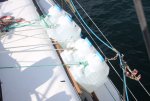
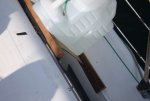
This is one of the windows we repaired. The windows are quite large and the problem is, or was, they were cracking. There was no pattern to the cracking - might simply have been heat. With windows this large you need two people to attach the new windows and we marked, with masking tape the insides of the windows, allowing for the overlap (that takes the sealant), of 100mm. This meant the person on the inside could direct the adhesive coated windows to the exact spot. The underlying gel coat was white and we found we needed to paint the overlap black, to match the sealant - or you could see gelcoat where the sealant was a bit thin. Windscreens in cars are similarly painted. We used no screws, other than to hold the temporary battens, the windows are simply attached with sealant. You can see the slight curve of the windows in the second picture.

We replaced the windows 3 years ago, almost to the day. They are all still fine. We removed, cleaned up and replaced one window a day. We used the acrylic from the old windows to makes scrapers to remove the old sealant. Simply grind a straight edge to a sharp edge, they will not damage the gelcoat (if you are fixing to gelcoat). They blunt easily make a number, and try to make them with comfortable handles.

You can see the batten we used with screw at each end (which we filled once the screw was removed) which allowed us to follow the moulding of the saloon roof. The water containers hold 20 litres each.

Our sealant is made in Brisbane and is specifically for glazing, sticking acrylic to gelcoat in the marine environment. AFAIK Sika and 3M make something similar.

We were advised to leave the battens and weights for 48 hours to allow the sealant to develop sufficient bond.

Our acrylic was 10mm and a larger curve would have needed making a mould and heat bending the acrylic (much more complex).


IMG_3089.jpeg

IMG_3088.jpeg

Its not a difficult task - but maybe more complex that you first think. You need to think through the various stages and plan ahead.

We toyed with polycarbonate but decided against it as we could not make a match with the good existing windows.

If you want to match an existing window then take a piece with you when you choose - there are a large number of shades, or densities of black tinting, including some with a blue tinge, We had the acrylic supplier cut the windows and slightly bull nose and polish the edges.

If your window/hatch has a frame then include an image of the frame and you will enjoy more focussed information specific to your needs.

Good luck

Jonathan
 
Hi all,
Many thanks for the advice.
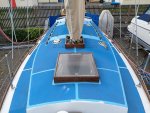
Apologies for not being more specific - it's a fairly straightforward design on my 50yr old Twister. The current perspex is unpleasantly yellowed and cloudy. Also the wooden frame and hinge need attention.
Best,
Crisp

20220925_110249_compress61.jpg
 
Looks like 10mm acrylic which you can buy on lone and some suppliers will not only cut to size but also drill and countersink the holes for you to your pattern. Bed down on butyl.

As you can see on my hatch of similar construction the fastenings go through the teak trim also on my to do list but not high up!

303654_750752e2de834047ed6d191933538c4d.jpg
 
Apologies for not being more specific - it's a fairly straightforward design on my 50yr old Twister. The current perspex is unpleasantly yellowed and cloudy.

If it's gone yellow and cloudy the chances are that the existing hatch is polycarbonate rather than acrylic. As acrylic ages it tends to get a 'crazed' appearance rather than turn milky.
As said, your best bet is probably to replace with decent quality acrylic.
 
Nobody has so far mentioned that polycarbonate without UV protection should be avoided.

A previous owner of our boat fitted polycarb windows that had gone so badly ‘milky’ after a few years they were opaque. Our local plastics engineering place said it was typical of cheaper polycarb (technically sold for us indoors apparently - e.g. till/POS screens).

More expensive branded varieties have a UV protection layer.

We replaced the milky windows with 10mm tint acrylic (unbranded - but I can attest still frighteningly expensive - as I couldn’t source genuine Perspex anywhere without buying an entire sheet!). They look great and acrylic seemed easy to ‘work’ with standard tools.

Perspex brand is easily identified by the protective film.
Agree. It is easy to identify an acrylic brand eg Perspex, that comes with a good uv resistance guarantee so you will have to search for a marked brand of polycarbonate sheet with an equivalent uv resistance guarantee.. Good uv resistant polycarbonate does not need a protective layer as demonstrated by car headlamps, the vast majority of which will be very clear at 20+ years without a protective layer.

Www.solocoastalsailing.co.uk
 
Top