[3889]
...
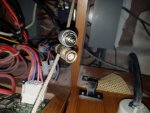
It's the gold one, what I consider a standard VHF connector is above it as scale reference. Flopping around behind my electrical panel it may be connected to a stubby antenna on the pushpit.



As above, the gold one is a standard BNC connector. The top one doesn't look like any standard type of connector!

Top one is a PL259. Lower one is BNC. The BNC may have gone to an AIS receiver if the other end is an antenna.
Thank you all. Bit of a mystery as, AFAIK, the boat has never had AIS. The top connector is for my VHF, a PL259.

BNC connectors are bog standard for connecting many types of antennae via coaxial cables. It's the usual one for television antennae, for example, and I'm pretty sure that the VHF on my boat uses BNC connectors at the tranceiver.
PL259 isn't a great connector for VHF. It's messes up the impedance of the line, isn't at all waterproof, and has variable connections to the coax. BNC is good, N type even better.
VHF radio manufacturers? Pah, what do they know!Is there a VHf radio on the market that doesn't have an SO239 socket for the antenna, to take a PL259? I don't know of one.
VHF radio manufacturers? Pah, what do they know!
Not sure I'd believe BNC or N were especially superior either.
They use them because they’re cheap and the PL259 is not too difficult to fit.

A lot of older VHF handhelds had bnc connectors built into their stub antennas. It could be that this is a connector to allow a h/h to be connected to a better aerial...?
Rob.
What VHF transceiver manufacturers know is that at VHF frequencies an SO239 (the socket part) and a PL259 (the plug) is just about adequate so long as it’s kept dry. They use them because they’re cheap and the PL259 is not too difficult to fit.
BNC (and the screw collared version TNC) are very much superior RF wise. N Connectors are even better. Forty plus years ago I was an RF engineer at the Royal Radar Establishment if you are wondering how I know any of this and sometimes I used to measure impedance mismatches in coaxial lines. (It’s a bit more complex than that but you get the gist)