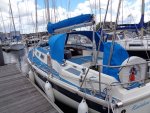
What tension on life-lines is desirable?

My stanchions are 3ft high so the top safety wire is very close to that.

I agree with you that a 600mm (2ft) stanchion is just high enough to trip you up and send you overboard. (I plan to install netting as well)

NylonSafetyNetting_300x300.png
You don't need netting unless you have a dog, cat or child onboard. We lace the bottom guardwire to the holes in the toerail to provide some protection to our dog. We only do it for ocean passages. She won't go on deck to go to the loo unless the .ines are laced on. We take it off when not sailing long distance as its not nice looking and serves no purpose.
 
You've got one big advantage over me: you've "been there, done that"

I have to rely on what I read.

Ship Railing Nets
Railing nets installed on ships of all kinds ensure that passengers or larger objects do not accidentally fall overboard. These special ship safety nets are mounted on the railings or bulwarks of boats, sailing ships or yachts as additional safety equipment.

https://cdn1.schutznetze24.de/templates/tpl_modified/img/logo/logo_head_en.png
 
Last edited:
Regard to line height ... lets be honest - vast majority of boats - top line is low enough to actually flip you a over t .... making higher on most boats would then look 'strange' .... I fitted to my Alacrity 19 ... not the single line height stanchions as usual - but dual line taller ... it looked totally out of place ... so much so - that I cut the stanchions to reduce the height.

I have never regarded the usual guardlines as really that effective ...... being too low except for a 'midget or child' ....

As regards making ends fast .... there's always the Pelican hook ... then it easy to make or remove the lines when recovering someone from water or boarding etc.
It has crossed my mind to cut my lines at midships ... add pelican hooks to create a midships boarding point - so no 'leg over' the lines.
 
Regard to line height ... lets be honest - vast majority of boats - top line is low enough to actually flip you a over t .... making higher on most boats would then look 'strange' .... I fitted to my Alacrity 19 ... not the single line height stanchions as usual - but dual line taller ... it looked totally out of place ... so much so - that I cut the stanchions to reduce the height.

I have never regarded the usual guardlines as really that effective ...... being too low except for a 'midget or child' ....

As regards making ends fast .... there's always the Pelican hook ... then it easy to make or remove the lines when recovering someone from water or boarding etc.
It has crossed my mind to cut my lines at midships ... add pelican hooks to create a midships boarding point - so no 'leg over' the lines.

Used pelican hooks on my last boat.

I replace the aft most stanchion with a custom stainless one, securely mounted, then used pelican hooks to make boarding "gates". The main section of guard-wire was secured at the bow with another pelican hook, easy to drop the wires to get the dinghy onboard etc.

If i was the OP i would used proper crimped/swaged fittings. On one end, one of these: Stainless Steel Wire Rope Swage Stud Threaded Terminals which should pass through the stanchion, so can be fitted by a local rigger, screw pelican hooks on after threading through.

On the other end, one of these: Steel Rigging Screws Jaw and Wire Rope Swage Studs UK

DSC00310.JPG
 
My stanchions are 3ft high so the top safety wire is very close to that.

I agree with you that a 600mm (2ft) stanchion is just high enough to trip you up and send you overboard. (I plan to install netting as well)

NylonSafetyNetting_300x300.png
I went over the side once when SH. I got back under the bottom wire with a struggle because my LJ inflated. If I had netting it would have left me in real trouble.
regarding tension of wires. Do they need to be bar tight to stop one going over the side? I think not. If they give a few inches it seems to me it should not matter, so long as they do not break. Or is there some other theory re tension? I have no problem when going forward with them flexing a little because I do not put my weight on them. It tends to be more as a "balance" issue to give me a guide rather than actual support.
 
I went over the side once when SH. I got back under the bottom wire with a struggle because my LJ inflated. If I had netting it would have left me in real trouble.
regarding tension of wires. Do they need to be bar tight to stop one going over the side? I think not. If they give a few inches it seems to me it should not matter, so long as they do not break. Or is there some other theory re tension? I have no problem when going forward with them flexing a little because I do not put my weight on them. It tends to be more as a "balance" issue to give me a guide rather than actual support.
The offshore regs seem to expect them to deflect a little. Maybe that’s for a good reason. For one, if you’re going to bounce off them, it might be best for them to decelerate you rather than stop with a bang, so to speak. The slacker lines might hurt less.
 
The offshore regs seem to expect them to deflect a little. Maybe that’s for a good reason. For one, if you’re going to bounce off them, it might be best for them to decelerate you rather than stop with a bang, so to speak. The slacker lines might hurt less.
Don't forget that the wire is continuous from pulpit to pushpit. 50mm deflection in 9m or so of wire is not much at all.... By eye the top wire should be tight.

There is more allowed in the lower wire as the offshore regs are about racing, and it is much more comfortable to hike on a wire that has some give on it. The limit is there because it's an advantage to have them very loose and get your body further out....
 
Don't forget that the wire is continuous from pulpit to pushpit. 50mm deflection in 9m or so of wire is not much at all.... By eye the top wire should be tight.

There is more allowed in the lower wire as the offshore regs are about racing, and it is much more comfortable to hike on a wire that has some give on it. The limit is there because it's an advantage to have them very loose and get your body further out....
That's a good point: 2 inch deflection is not a lot in 28ft (9m).

Since I have gangways mid-ship I can make that 1 inch deflection in 14ft. I like the idea of a fairly tort safety lines to grab in the event of in-balance.:oops:
 
To Crimp eyes to Guardlines ..... there used to be a DIY crimper composed of two flat metal bars with slots ground in to suit different 'ferrules' .... basically the two bars were squeezed together by two nut / bolts ....

Easy enough to create own line ends if still sold ? Most Chandlers used to sell them.

On board ship when Cadet Officer - I had the job of making sure crimped lanyards were secure for various deck items. The crimper was like a large set of 'pipe grips' ..... bit expensive I reckon and maybe not really suited here.

But the flat bar type ... cheap and handy.

Tension ....

If the lines are slack - it allows a falling body to gather further energy - which may be enough to break the line. But reasonably tight without strain prevents that - and also is not strained already before stress applied.

Its why I avoid the use of turnbuckle etc. and use a lanyard.
 
... If the lines are slack - it allows a falling body to gather further energy - which may be enough to break the line. But reasonably tight without strain prevents that - and also is not strained already before stress applied. ...

The more obtuse the angle the wire makes as it passes through the stanchion, the greater the reduction in WLL. Hence the tighter the wire the greater the risk there is of failure if it gets struck by a falling body. Slack lines reduces the obtuse angle and would improve the WLL. I have no idea if the OSR rules take this into account or if they only consider the point Flaming makes.
 
The more obtuse the angle the wire makes as it passes through the stanchion, the greater the reduction in WLL. Hence the tighter the wire the greater the risk there is of failure if it gets struck by a falling body. Slack lines reduces the obtuse angle and would improve the WLL. I have no idea if the OSR rules take this into account or if they only consider the point Flaming makes.

Sorry have to disagree .........

4 yrs of Nautical Science College and all the hours studying stress for wires / moorings / lifting etc ...

Nah ... sorry.
 
Something I haven't mentioned previously.

I am launching the yacht at Two Rocks but then have to motor the yacht 40km in open seas to get the yacht rigged. I don't want the yacht to go to sea without proper safety lines.

When I read:
"Hand crimping is the least expensive “do-it-yourself” option but not our first choice. Hand crimping often leaves a bulky joint and can be susceptible to pulling free under load. We often see poorly/under-crimped connections which are definitely not safe"
I decided to use duplex cable cramps. I suppose if I find them unsatisfactory I can get the yacht riggers to do the crimps professionally.
 
You've got one big advantage over me: you've "been there, done that"

I have to rely on what I read.

Ship Railing Nets
Railing nets installed on ships of all kinds ensure that passengers or larger objects do not accidentally fall overboard. These special ship safety nets are mounted on the railings or bulwarks of boats, sailing ships or yachts as additional safety equipment.

https://cdn1.schutznetze24.de/templates/tpl_modified/img/logo/logo_head_en.png
When we cruise in the Caribbean you can tell instantly when a boat has kids onboard. There is netting. It can be a pain. Tying up you boat with long spring lines. The net will be in the way. I would suggest you don't fit them unless you find you need them. It is very hard to get them fitted and .looking good. It takes hours to thread them to the guardwires. They are not something long distance cruisers routinely fit unless they have a specific issue like kids, dogs of cat. Save yourself a lot of trouble and try without first
 
Top