What size life raft do I need?

Pavalijo

Well-Known Member
Joined
18 Jan 2013
Messages
425
Visit site
Ocean Safety have my 21 year old 6 person life raft for inspection (just out of test, came with new boat). They are going to advise whether it is worth servicing given its age.

I was looking on Ebay to see whether there is anything worth buying and saw an ad for a 4 (Edit - 6) person liferaft. As usual there was the reason for sale - in this case it was because - "my wife and I bought this for our boat and have been advised to use a 4 man not 6!"

Our yacht is 38' with a 3 cabins plus saloon. We will have 6 on board from time to time but mostly 2 or 4. We will be sailing mostly Clyde area with occasional foray outside the Mull of Kintyre. In a few years we will be off to the Med and maybe onto Caribbean. I suspect we will have 4 on board for the longer passages but who knows.

I had just assumed that a 6 person raft was the right size, but why would somebody sell a 2006 Seago raft for the reasons given above? :confused:
 
Last edited:
If it was me I would wait until you go to the Med/Carribean and have no raft in the mean time. If you have a good search of the forums (go to Google and type "liferaft site:ybw.com/forums") the general consensus seems to be that they are more trouble and money than they are worth, and the statistics from rescues seem to show they are more harmful than good.

All that said though, if you feel you must have one get the 6 man. Regardless of the reasons why a 4 might be better your worst nightmare would be choosing who doesn't get to go on the raft! I suspect that the main reason is money for servicing.

I forget where but you can rent liferafts cheaply, we got an 8 man for about £100 for a couple of weeks so it's worth doing this for specific big trips rather than buying into the servicing regime. Remember that even if you buy on Ebay it will need servicing, and the person selling it is probably doing so because a new raft is not much different in cost.
 
On the assumption you have your figures muxed ip and it is a 6-man that is for sale - the perceived wisdom is that few people in a bigger raft is much less comfortable in rough weather than a fully loaded yin. I have even seen it suggested that 5 people in a 4-man raft is better than in a 6-man.
If you believe it is worthwhile carrying a liferaft then surely buying one from a reputable source in pristine condition makes sense rather than taking a chance with a half-life expired ebay reject.
 
I understood that the under filled life rafts were much easier to flip and also harder to right the less people you have. I hope it never comes to trying.
 
The raft on my boat is 20+ years old. I had it serviced when I bought my boat in 2011 and it was some 12 years since it had last been checked. Universal Safety at Universal Marina on the Hamble advised it would likely be good for another 10, and were quite happy to give it a 3 year service interval.

However, when I asked about a new raft they were unequivocal that the new raft I would buy today for around £7-800 would be no where near the quality of the raft I already had, which cost me £300 for the service, and they were dubious such a raft would last the same 10 years. Like so many things today the major emphasis is on keeping cost of initial production low, rather than something that will last a reasonable period.

They did offer me a similar quality 10 year old secondhand raft for less than £500 should mine have failed the inspection, and that would be my preference.

The risk of buying a raft from EBAY is that it passes the inspection, and you need to allow an extra £300 if it does, or £20 for its disposal (plus what you paid for it !) if it doesn't.
 
On the assumption you have your figures muxed ip and it is a 6-man that is for sale -

Well spotted - yes it is a 6 person for sale! I was really looking on Ebay as a long shot. There is a "brand new" Ocean Safety 4 man raft on Ebay now with current bid at £650 (no reason given for sale, unusually). I had intended to buy from Ocean Safety subject to further research. I don't understand the economics of keeping a liferaft after it gets beyond the 3 year service cycle, given the price of a service and the cost of buying new, and agree that time expired Ebay purchase is a false economy.

Many thanks for the replies. I did wonder if the reason related to flipping with a light payload. Equally don't fancy staying aboard as skipper or clinging to the outside - so I think when I do buy it will be a 6 person raft, and then I'll never have to find out whether I would act in the fashion of an Italian cruise ship skipper!

Maybe will give some thought to what I could take aboard as ballast if we do go offshore short handed.

I like the advice that says don't bother until we go offshore (and presumably keep the dinghy and pump readily accessible). Having just bought the boat, even though well maintained by the previous owner there are plenty of other items calling on my hard earned cash! :(
 
The cheaper rafts on the market are pretty rubbish. There have been a few industry tests and the cheap ones have failed to inflate and are generally poorly manufacturered. If you want a decent raft, buy one from Viking. About double the price of a cheap raft but made to last. The other option, as has already been stated is to hire. For about £300 + vat a year you can hire a 6 man. No need to worry about servicing; they simply send you a new one every year.
 
However, when I asked about a new raft they were unequivocal that the new raft I would buy today for around £7-800 would be no where near the quality of the raft I already had, which cost me £300 for the service, and they were dubious such a raft would last the same 10 years. Like so many things today the major emphasis is on keeping cost of initial production low, rather than something that will last a reasonable period.

They did offer me a similar quality 10 year old secondhand raft for less than £500 should mine have failed the inspection, and that would be my preference.

Good point thanks - Ocean safety's first thought was that at 21 years old it might be time to replace it, but that it is a good quality raft and they will advise when inspected. I did wonder why they said there would be a trade-in discount - maybe I need to quiz them carefully when they report back, if not positive!
 
I like the advice that says don't bother until we go offshore (and presumably keep the dinghy and pump readily accessible). Having just bought the boat, even though well maintained by the previous owner there are plenty of other items calling on my hard earned cash! :(

If you read the reports most of them suggest that your best bet for survival is to stay on your big boat which will likely float for a long time even if low in the water. On a 38 footer though you should be able to keep it inflated on the coachroof, stern or similar.
Having said that, on a similar discussion previously the general consensus was that although it would be sensible not to buy one there were very few people who would actually remove one from a boat due in part to superstition!
 
An over-filled raft is better than an under-filled one.

It's more stable and less likely to get flipped. It's also warmer.

I would say that if you usually have 2-4 people on-board, then get a 4-man. You could squeeze 6 in if you needed to.

Oh yes, and spend the money on a Viking raft.
 
Liferafts are usually rated to be able to be 100% overloaded. Although if you ever do a sea survival course, you will see how cozy a 4 person with 8 in it would be!

If you have a six person liferaft and only four of you, on an ocean crossing, have some fresh water containers on the deck that you can load it up with. Add the normal grab bags of stuff and hopefully you will be fine.

The old adage of, "Stepping up into the life raft off the boat as it sinks" still holds true.
 
Life rafts generally have a 50% overload capacity. I have been one of 20 in a 10 man life raft, a popular configuration during sea drills post the Falklands conflict! An overloaded life raft is a very unpleasant place to be. The main concern is sea sickness. It just takes one to start and next thing you know you are up to your ears in carrots as everyone joins in. All aviation life rafts have a 50% overload capacity and they are cosy in that configuration. The yachtie life raft seem smaller compared to their industrial contemporaries, I would not want to overload one by 100%.

The idea of stepping up into your liferaft is often quoted. Have a look on you tube of fishing vessels sinking, fortunately there are not many yachts going down. The speed and unpredictability is frightening. I would make the decision to abandon early. Stay next to the vessel if need be as it is more conspicuous to the rescue services, but at a safe distance ready to cut the cord.

Life raft choice boils down to your sailing area - survival time v rescue time and of course budget.

We generally sail 4 up, I am replacing the existing 4 man for a 6 man.
 
The cheaper rafts on the market are pretty rubbish. There have been a few industry tests and the cheap ones have failed to inflate and are generally poorly manufacturered. If you want a decent raft, buy one from Viking. A.

Do you have any evidence of this because your view differs from the last PBO test that was run.

Pete
 
The cheaper rafts on the market are pretty rubbish. There have been a few industry tests and the cheap ones have failed to inflate and are generally poorly manufacturered. If you want a decent raft, buy one from Viking. About double the price of a cheap raft but made to last. The other option, as has already been stated is to hire. For about £300 + vat a year you can hire a 6 man. No need to worry about servicing; they simply send you a new one every year.

Agree with Pete7. There is no evidence of this that I have seen. Indeed reports have shown rather the opposite, that is failures of so called premium rafts to inflate. This may well be because such rafts still dominate the numbers in use and the number that are actually activated is small and the number that fail is therefore also very small.

There are of course differences between cheaper and more expensive rafts, but these are often in detail design, ease of use and equipment.

If you have copies of the "industry tests" that support what you claim I am sure many would be interested to see them.
 
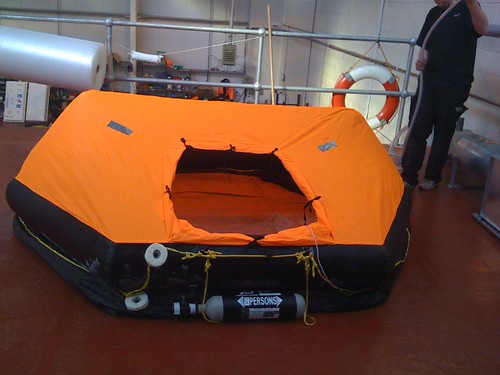
This is an 8 Person, Plastimo Cruiser liferaft. Note the man standing next to it to gauge the scale.

8712674151_49b8a451af.jpg


I would go for the 6 person liferaft if it has ballast pockets in compliance with ISO9650 or equivalent. The ballast pockets make the liferaft stable when unloaded or partially loaded. The comments john_morris_uk makes regarding space for stuff I would argue is just as important in more challenging coastal type sailing as opposed to day sailing coastal type sailing. Today the grab bag is quite ubiquitous and knowledge about surviving more common such that we are likely to take stuff with us into a liferaft these days. Four people in a 6 man is comfortable, 6 people in a 6 man is uncomfortable from my experience of liferafts on survival courses.
 
The idea of stepping up into your liferaft is often quoted. Have a look on you tube of fishing vessels sinking, fortunately there are not many yachts going down. The speed and unpredictability is frightening. I would make the decision to abandon early. Stay next to the vessel if need be as it is more conspicuous to the rescue services, but at a safe distance ready to cut the cord.

There are quite often MCA reports linked to on here, and the overwhelming conclusion is to stay on the boat. Fishing vessels are nothing like yachts - the engine is a massive weight and the boat itself has very negative buoyancy. A yacht on the other hand has a comparatively small engine and is not nearly as heavy while having many more cubby holes to trap air. I agree that if the yacht is definitely going under then abandon but the majority of evidence linked to on threads like this in the past has shown that yachts rarely sink and crew would be better off wet inside the boat than bouncing in the sea in a floating tent.
 
Life rafts generally have a 50% overload capacity. I have been one of 20 in a 10 man life raft, a popular configuration during sea drills post the Falklands conflict! An overloaded life raft is a very unpleasant place to be. The main concern is sea sickness. It just takes one to start and next thing you know you are up to your ears in carrots as everyone joins in. All aviation life rafts have a 50% overload capacity and they are cosy in that configuration. The yachtie life raft seem smaller compared to their industrial contemporaries, I would not want to overload one by 100%.

The idea of stepping up into your liferaft is often quoted. Have a look on you tube of fishing vessels sinking, fortunately there are not many yachts going down. The speed and unpredictability is frightening. I would make the decision to abandon early. Stay next to the vessel if need be as it is more conspicuous to the rescue services, but at a safe distance ready to cut the cord.
.

I was quoting what I was told on my last sea-survival course.

I note that Aviation life rafts are rated at 50% overload, but the point I was making is that overloading a life-raft is VERY uncomfortable...

There is evidence that yachts can sink quite slowly. Its easy to imagine the thing going down very fast, but I am not sure that's always the case. Anyway, the point about stepping up is more to try and get people not to abandon too early. Plenty of abandoned yachts are found after storms still floating but having been abandoned with the crew thinking they'd be better off in the liferaft.
 
There are quite often MCA reports linked to on here, and the overwhelming conclusion is to stay on the boat. Fishing vessels are nothing like yachts - the engine is a massive weight and the boat itself has very negative buoyancy. A yacht on the other hand has a comparatively small engine and is not nearly as heavy while having many more cubby holes to trap air. I agree that if the yacht is definitely going under then abandon but the majority of evidence linked to on threads like this in the past has shown that yachts rarely sink and crew would be better off wet inside the boat than bouncing in the sea in a floating tent.

Yes, fishing boats behave in a very different manner to yachts. Founderings are often capsizes as a result of snagging gear on the bottom, overwhelmed in extreme weather or as in the latest one structural failure. This results in almost instant sinking and a high mounted Hydrostatic release raft makes some sense.

The very few yachts that founder usually do so slowly, or as a result of a collision which is probably catastrophic. Don't recall any liferaft deployment from a yacht where a hydrostatic release was used, although arguably one or two where it might have been useful (Ouzo for example, although the report did not suggest it). In most cases the raft was deliberately deployed while the boat was still afloat with varying degrees of success.
 
There are quite often MCA reports linked to on here, and the overwhelming conclusion is to stay on the boat. Fishing vessels are nothing like yachts - the engine is a massive weight and the boat itself has very negative buoyancy. A yacht on the other hand has a comparatively small engine and is not nearly as heavy while having many more cubby holes to trap air. I agree that if the yacht is definitely going under then abandon but the majority of evidence linked to on threads like this in the past has shown that yachts rarely sink and crew would be better off wet inside the boat than bouncing in the sea in a floating tent.

I have a 200kg engine and 3000kg ballast in the keel, unless you have a reserve of buoyancy like the etaps etc or you can stem the flow.. .. gravity will win every time.

A semi submerged yacht on a calm sea is one thing..... waves breaking over the vessel is another.


https://www.youtube.com/watch?v=GPfwodwRTRQ&feature=youtube_gdata_player
 
Last edited:
Top