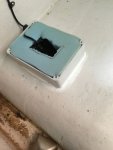
what silicone to use for fixing a transducer in hull??

I would use Butyl tape - you can remove items easily if necessary, whereas if using a 'silicon' it can be difficult. All my skin fittings are sealed with Butyl tape and never have any problems.
 
If it's something like a log that you need to undo and redo regularly, then use an adhesive sealant like Sika.
It is possible to twist some skin-fittings out of the hull when doing up the log, which is unpleasant. So use something with a bit of grip.
 
thanks for replys----it will be in the bilge which has always got some water in even when out on the trailer
 
You dont say what transducer,echo sounder,or log,in hull does that mean mounting an echo sounder transducer inside the hull or drilling through the hull?
 
sorry everyone----i didn t make it clear----it is a garmin fishfinder ----the transducer should be mounted outside the hull but i believe it might work if pressed into a large blob of silicone inside the hull-----i just know if i hang it off the stern as recommended i will damage it launching and recovering to trailer
 
Some of these do work in-hull, but you may get reduced range (i.e. depth).

One way to check is to temporarily set and see if you get any readings (and at what depths) - and then stick in place. Silicone, Sika or 3M would be equally good. Just make sure there are no air bubbles trapped.

P.S. Some serious fishing people opt to purchase the Airmar P60 (I think) or P1000, which are made for in-hull installation.
 
I bought a cheap fish finder with transom mount transducer. Just to try it out I stuck it a bed of vaseline inside the glass/ply hull of my boat. It worked perfectly so i left it there. Its been there 9 years and never looked like moving. I made a little plywood box to put over so it doesn't get knocked.
Now i am looking at replacing it with something more upmarket. Glad i didn't silicone it in. Can only imagine what a horrible removal job that would be.
 
Last edited:
Cheap bath seal-type silicon works perfectly. I deliberately didn't clean the (old boat) area to give me a fair chance of peeling it out if I need to remove it.

(Bear in mind that it's unlikely to work where there's a liner moulding - due to inevitably imperfect bonding).
 
Last edited:
thanks for replys----it will be in the bilge which has always got some water in even when out on the trailer
Thread drift, I know, but water in the bilge when on the trailer points to rainwater ingress through leaking deck fittings. It's time to find the leaking fitting and reseal it, or initiate a programme of removing and refitting all deck fittings. There are some excellent searchable threads on this forum containing good information with regard to efficiently sealing them.
I would second the use of butyl tape, having discovered the disadvantages of trying to remove fittings, both through-hull and through-deck, that have been sealed with adhesive sealer.
 
sorry everyone----i didn t make it clear----it is a garmin fishfinder ----the transducer should be mounted outside the hull but i believe it might work if pressed into a large blob of silicone inside the hull-----i just know if i hang it off the stern as recommended i will damage it launching and recovering to trailer

I have fitted a Humminbird 'trailing' transducer inside using silicon. It works fine for downscanning but won't do sidescan - well it will do quite well one side but the keel structure impedes the other side. I knew that was going to happen but I just wanted the downscan. I put a big layer of about 15mm to press gently to exclude any air - needs care to do that, it won't work if an air bubble is left in place - and I then inclined the 'silicon cushion' to ensure the transducer was vertical. And then left it for 24 hours.

Don't use Sikaflex. It is an adhesive. Once cured it can only mechanically removed (i.e. ground out). Just ensure the bottom of the boat is clean.
 
sorry everyone----i didn t make it clear----it is a garmin fishfinder ----the transducer should be mounted outside the hull but i believe it might work if pressed into a large blob of silicone inside the hull-----i just know if i hang it off the stern as recommended i will damage it launching and recovering to trailer

Ah - I thought you were talking about a through-hull mount, and was going to strongly recommend not using silicone. But for sticking a transom type transducer down in the bilge, silicone seems a pretty good choice. It’ll stick down as firm as you need, but still peel off if it has to be replaced in future.

I don’t think it really matters what type you use. Just make sure there’s no air bubbles in the blob, or under the transducer face as you squidge it in.

Pete
 
in my kayak the transducer is embedded in sika 291i . I roughed up the hull with 80 grit, cleaned with solvent. Made a 1/2" deep box from sticky foam .
Took the nozzle off to give a broad bead and kept squeezing with continuous contact to ensure the box was filled with NO air bubbles included.
light sand and solvent clean to transducer head. Push one end in at approx 45 degrees to the desired depth then slowly rotate the head down into the sika. This ensures are air is excluded. Set the head level both ways and add enough weight / support to keep it firmly in place for 24 hrs .
Mine has been in 5 years and still solid and it does get wet in there.

Regards clive
 
NASA Marine specifically recommend a particular silicone for their through hull electromagnetic speed transducer. Don't have the exact spec on hand.

They recommend ordinary silicone sealant, as polyurethane sealants/adhesives (such as the 3M 4200 and Sikaflex already recommended) can degrade the inferior plastic which Nasa use.

It's possible that the transducer the OP wants to fit might also be damaged by polyurethanes, as it's not intended to be glued inside a hull. So to be safe I'd use ordinary silicone sealant, or epoxy as suggested by PaulRainbow (although that might be difficult to remove cleanly if the transducer doesn't work in-hull).
 
sorry everyone----i didn t make it clear----it is a garmin fishfinder ----the transducer should be mounted outside the hull but i believe it might work if pressed into a large blob of silicone inside the hull-----i just know if i hang it off the stern as recommended i will damage it launching and recovering to trailer
Done exactly as others say and with this brand inside the hull of a Hardy 25. These are not thin skinned boats. Tape a section of toilet roll core or whatever tube is the right diameter to the hull, fill with silicon, no bubbles, insert transducer and fix somehow so it is parallel to the water until it all sets. Worked perfectly.
 
Top