What is your lifejacket policy?

Possibly different for a sailing yacht that spends a lot of its time tipped over at strange angles.
Not only does our boat never tip over at a strange angle, it’s also a bloody long way to the edge unless you’re handling the downwind sails. I clip on for that bit. We still wear lifejackets mostly. Its not the leaning over, but the action needed. Everyone but the helm just sits there on a mobo. Sailing requires jumping about a fair bit.
 
Everyone aboard has a life jacket allocated and if they are guests they are shown how to wear and operate it. The rule is that when underway then inside the wheelhouse / saloon they are optional but should be close by but if going on the deck and flybridge they must be worn - not a matter of choice, just a sensible policy that applies to all.

It amazes me how many people don’t wear them, particularly some yachties who are arguably at greater risk.

For those that think being inland and / or in calm waters means that they are unnecessary then just have a look at the almost routine fatalities on the Broads.
To me, it seemed to be the mobo's who first wore LJ's while sitting down in the cockpit. Was this because a lot more of them had formal training ?
More raggies are wearing them and I'm wearing mine a lot more, but I find that on a sailing boat that there are a lot of cleats, etc all wanting to "grab" the LJ and trip you up.
 
Not only does our boat never tip over at a strange angle, it’s also a bloody long way to the edge unless you’re handling the downwind sails. I clip on for that bit. We still wear lifejackets mostly. Its not the leaning over, but the action needed. Everyone but the helm just sits there on a mobo. Sailing requires jumping about a fair bit.

Moboing requires jumping around a bit on approach or departure from a Marina or mooring.
Also when anchoring.

Otherwise, not so much.
 
Well , for the peeps , don't agree with MAIB and the RNLI and the guys who give you training on the water, but they would not train you without one , I say good luck know wot ameen ARI
 
Moboing requires jumping around a bit on approach or departure from a Marina or mooring.
Also when anchoring.

Otherwise, not so much.
You lot don’t all jump up and run to the other side of the boat when you turn though. When we are racing, we sit on the amas, so that’s a 8m sprint/scramble🤣. When I had a smaller tri, even the helm did that, we had a telescopic tiller extension for steering from out there. If I can find one long enough, I’d do that on the Df920. Great view, you can see round the forestay, rather than have your crew call the shots.
 
All the comments suggesting giving a lifejacket to someone then letting them decide if they wear it or not makes me wonder who really is in command of the vessel.

Not everyone will be as familiar with the boat, the weather, the risks etc as you.

Everyone wears them on my boat until we're docked or anchored.

It all depends on risk assessment. If you have to make a conscious decision each time, then you have to make an assessment of the conditions each time. If it is a habit, then you tend not to assess the conditions. My take is that making an informed decision about an action is better than creating a habit - this was taught to me by a police driving instructor on an advanced driving course. If you indicate out of habit, then you tend not to assess the situation around you properly before making a manoeuvre, and it's the assessment that needs to be the habit, not the indicating.

We sail in waters where there are no tides, it's often mirror calm, with no wind or waves, and the sea is like a warm bath. My kids jump in wearing shorts and t-shirts to practice man overboard - I will not force people to wear lifejackets in these conditions. The last thing I want is someone deciding to jump in for a swim wearing one, or ending up in the water while horsing around, or even getting the pull-chord snagged and inflating the thing. That's an out-of-service self-inflating life jacket until I can fit a new CO2 cartridge and salt tablet. (We do carry spares).

I have also had people on board who sh!t themselves as soon as the boat heels more than 3° ... they are the ones who can choose to wear a lifejacket when I'm not wearing mine - basically if they feel unsafe and wearing a lifejacket makes them feel safer, then I'm not going to stop them.

If mine goes on however, everyone wears one on deck and in the cockpit.

Always worn at night and always tethered at night.

I think this is a reasonable compromise in a cruising ground where the temperatures are usually high 30s and normal sailing attire is shorts and t-shirts.
 
For us, if you are on the flybridge or on deck we wear them. Thats on a 30ft cruiser. We have a ski boat on the river as well and unless you are a child, or going in the water, we don't wear them at all.
 
In my 20 ft sports cuddy I always wear a lifejacket and kill cord.

I also have a VHF clipped to the lifejacket and an PLB in my jacket pocket ( with strong Velcro fastening).

Plenty of opportunities for me to be thrown around the cockpit at high speeds.

I've never been ejected from any boat I've owned but the potential is there.

Calshot on a summer's day can be interesting with multiple large wakes, ferries, etc all combining to create unpredictable seas, so the risk is there.

I agree that the most likely time I'll fall in is when coming alongside or recovering my anchor ⚓.
 
If you are on a fly bridge boat where I sail and the boat sinks, just stay on the boat, you won't even get your feet wet..
Actually even if it's not a fly bridge boat, just stand on the cabin roof you won't get wet..
The Norfolk broads are shallow, most of the rivers and deep water channels are around 6 ft deep.
The broads themselves are around 4 ft deep with soft mud beneath.

Life jackets? I only insist on the dog wearing one..
Getting a soggy doggy out of the water is difficult, a doggy life jacket has a handle on the back.
 
Well , for the peeps , don't agree with MAIB and the RNLI and the guys who give you training on the water, but they would not train you without one , I say good luck know wot ameen ARI
On the PB2 course using a Merry Fisher 725 we had to wear the lifejackets all the time.

On the day skipper course on the Targa 35 we only wore foul weather gear and lifejackets when out on the deck or on the flybridge, inside the cabin/wheelhouse it was jerseys and jeans.
 
If you are on a fly bridge boat where I sail and the boat sinks, just stay on the boat, you won't even get your feet wet..
Actually even if it's not a fly bridge boat, just stand on the cabin roof you won't get wet..
The Norfolk broads are shallow, most of the rivers and deep water channels are around 6 ft deep.
The broads themselves are around 4 ft deep with soft mud beneath.

Life jackets? I only insist on the dog wearing one..
Getting a soggy doggy out of the water is difficult, a doggy life jacket has a handle on the back.
Not sure less risk in shallow water, its takes about 6" to drown and if you or worse a child hits their head on the way down, being unconscious makes matters worse.
Realising somebody has gone over, reacting to the event, turning round, locating the casualty then recovering them could result in serious injury.
Not sure just how long before deprivation of oxygen results in serious injury, possibly just minutes ?
There is reason lockeepers wear auto inflating L/Js.
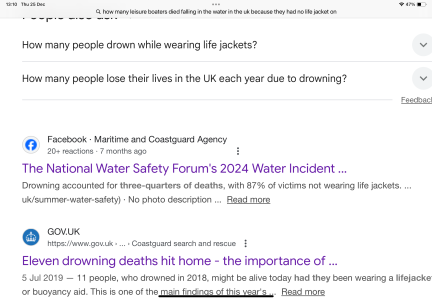
"Where do most drownings occur in the UK?
Inland waterways, rather than coastal, are the most common locations for drowning deaths to occur in the UK. These locations include rivers, canals, lakes, reservoirs and quarries. In fact, persons drowning in rivers are the leading cause of water-related deaths inland with 73, followed by lakes with 24."

5 mins to lose consciousness , 10 mins brain damage.


Info easily found from various reputable sources, none via AI


Now understand why the dog swims ashore unscathed but their owner has drowned ?
 
Last edited:
Yes we'll don jackets when the going gets sketchy but whatever happend to this old chestnut? "one hand for yourself and one for the ship". Wearing a jacket doesnt make me feel any safer but will help those who have to retrive my body. My safety relies in my ability to make sure I dont go over in the first place, and that begins with constant assessment of my nautical environment.
 
Top