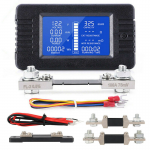
What battery meter to go for.

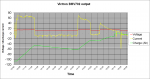
I had the NASA on my previous boat which was fine, it gave a good sizeable display of Voltage and Current, don't trust the SOC, same for all types. I now have a Victron BMV702 and it is great, display is rubbish but I can view and monitor on my PC which is useful. The graph below is MS excel and show data from a 6 hour period of logging date at something like 1 minute intervals. Alternator is a Presolite 100A and connected to a Sterling AB130. I find that these graphs provide a lot of insight. When the battery are low (380AH total) and down 110AH the alternator loads up to a sustained 60A+, later charge cycles from the alternator show an exponential decay in current, due to the batteries being closer to full charge. Perhaps to much info for most, but I like to know what is going on!

The ripple on the current is the fridge cycling.

Happy to provide more info.

1608663910457.png
 
I had the NASA on my previous boat which was fine, it gave a good sizeable display of Voltage and Current, don't trust the SOC, same for all types. I now have a Victron BMV702 and it is great, display is rubbish but I can view and monitor on my PC which is useful. The graph below is MS excel and show data from a 6 hour period of logging date at something like 1 minute intervals. Alternator is a Presolite 100A and connected to a Sterling AB130. I find that these graphs provide a lot of insight. When the battery are low (380AH total) and down 110AH the alternator loads up to a sustained 60A+, later charge cycles from the alternator show an exponential decay in current, due to the batteries being closer to full charge. Perhaps to much info for most, but I like to know what is going on!

That's a good demonstration of the fact that big alternators don't necessarily result in big charging current! The alternator will only produce as much current as the batteries can accept. I reckon that one of the most cost-effective improvements we can make to our boat 12v systems is to add more battery capacity.
 
Indeed
I have spent some time optimising the charging efficiency, 35mm cable and the Sterling AB130 which is very clever. The BMV shows approx 65 amps for 1 hour with little dacay despite the alternator heating up and losing efficiency. A new vent fan has been fitted to cool the rear of the alternator has helped . Like all charging circuits, its the whole system that has to be addressed and as Pete says just fitting bigger alternator will not result in faster charging,
Sorry for thread drift:-(
 
I had the NASA on my previous boat which was fine, it gave a good sizeable display of Voltage and Current, don't trust the SOC, same for all types. I now have a Victron BMV702 and it is great, display is rubbish but I can view and monitor on my PC which is useful. The graph below is MS excel and show data from a 6 hour period of logging date at something like 1 minute intervals. Alternator is a Presolite 100A and connected to a Sterling AB130. I find that these graphs provide a lot of insight. When the battery are low (380AH total) and down 110AH the alternator loads up to a sustained 60A+, later charge cycles from the alternator show an exponential decay in current, due to the batteries being closer to full charge. Perhaps to much info for most, but I like to know what is going on!

The ripple on the current is the fridge cycling.

Happy to provide more info.


View attachment 105432
I found these graphs interesting.
Could I ask, please:
1) What is the event just before 16:19, when the Ah curve seems to jump up some 10 Ah in a very short time?
2) What is the instrument saying about SOC at 16:19 and onwards?
3) What is your own estimate of real SOC at that time?

Thanks
 
I found these graphs interesting.
Could I ask, please:
1) What is the event just before 16:19, when the Ah curve seems to jump up some 10 Ah in a very short time?
2) What is the instrument saying about SOC at 16:19 and onwards?
3) What is your own estimate of real SOC at that time?

Thanks
At 16:19 the engine went to tickover, when this happens the alternator ceases to charge, until the revs increase. At 16:19, the electric anchor winch lowered the anchor in David Balfours Bay near Iona. I am not sure why the SoC jumped 10AH, but I tend not to trust this too much. I have seen these jumps before as the charge approached 100%.

These Excel charts are great, just need them to update realtime, a challenge to pass the time during lockdown here!
Angus
 
At 16:19 the engine went to tickover, when this happens the alternator ceases to charge, until the revs increase. At 16:19, the electric anchor winch lowered the anchor in David Balfours Bay near Iona. I am not sure why the SoC jumped 10AH, but I tend not to trust this too much. I have seen these jumps before as the charge approached 100%.

Thank you. I was wondering if the system considered the batteries 100 percent charged at 16:19, as the Ah-curve at that time reached the zero-level.
In reality, I think such a quick return to 100 percent charged could be doubted. More likely that several hours of motoring would be needed (at low charging rate as the batteries would not accept very much).

To the OP: If the Ah-counting functionality of the typical battery monitoring system is not required (perhaps because it cannot be fully trusted anyway), then an alternative approach could be to put together your own system from components like the ones in this photo.
The amp meter comes with a matching shunt included. The toggle switch could be wired so that the volt meter would measure either house battery or start battery voltage.
In my own set up I have two shunts, so not only the voltage but also the charging current into the start battery can be monitored.
Unlike the typical battery monitoring system, these can be installed in the positive side of the wiring, which might in some cases be more convenient.
NB the toggle switch is ON-OFF–ON, because the power draw of these meters is a little too high (15 mA) to leave them on 24/7.
amp%20%26%20v%20meters.jpg
 
Can I ask where people with current measuring systems mount their shunts?
The obvious place (to me) is right by the battery but that would require quite long sense wires by the time they have routed from the batteries round the heads and to the control panel. I realise the sense wires don't carry significant current, so is distance not an issue? Do you twist the pair to reduce any interference or does it just work?
 
Can I ask where people with current measuring systems mount their shunts?
The obvious place (to me) is right by the battery but that would require quite long sense wires by the time they have routed from the batteries round the heads and to the control panel. I realise the sense wires don't carry significant current, so is distance not an issue? Do you twist the pair to reduce any interference or does it just work?

I mounted mine close to the domestic bank. As you say, the sense wires carry minimal current, so they can be quite long. A twisted pair will reduce interference.
 
On mine the shunt does the processing and the cable to the monitor is data.

Same with mine; we both have the Simarine Pico monitor. Simarine say that if you need to extend the data cable, you should use 2 twisted pairs. Simple monitors which just measure the voltage across the shunt should also use a twisted pair to minimise electrical interference.
 
Anyone with a Pico use the NMEA2000 gateway? Do you need the display to show NMEA 2K or can you just connect the shunt to the gateway? I've emailed but waiting for a reply.

I don't have the NMEA2000 gateway on my Pico. As far as I can see, it has limited functionality. You will need a Pico display, as the associated SiCOM port comes with it.
 
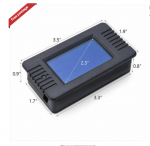
I had a BEP monitor on the last boat, worked but no better than the 99p cig lighter v meter I could see from anywhere in the cabin. My 'new' boat has lovely analogue v meters which I will retain but I fitted this for £15.00 Digital Monitor LCD Watt Meter DC Ammeter RC Battery Power Volt Amp Analyzer. UK | eBayView attachment 105471
Is it handy? What are the dimensions, please? I can't find them given on either the eBay ad you link nor on any of the similar ones.
 
Thanks everyone for commenting on this thread. I've learnt much though need to read around the subjects and terms quite often. I'll have something fitted by launch time.
 
Top