What battery meter to go for.

I have a friend who is a retired commercial electrician on big ships. He rewired his Westerly Storm and put in some cheap voltmeters. He reckons that the battery monitors are not very accurate due to battery state and losses and all you need to know are the voltages of each battery. I did like wise and bought a voltmeter for less than a £8 off e bay and wired it in so that it reads the battery voltages off each battery via my 1/2/both switch.
On my new to me boat I have bought a voltage monitor for £5 and will be repeating the process. I can tell the rate of charge for each battery and its voltage at rest. For the price of some of the monitors I can buy a pair of new batteries. I am not against battery monitors but i don't want to know rate of power etc going out and how much is left. Just my own experience.
 
Looks like it's very similar to the Victron SmartShunt 500A but the latter will monitor both batteries.

I have a simple voltmeter at present and it's barely adequate. I will probably install the SmartShunt this year.

The SmartShunt will only monitor one bank of batteries, but it show voltage of a second battery. The BMV series still have a lot to offer. They have an alarm and a relay that can both be user set, the relay in mine triggers a 240v relay that switches the mains charger on at a set voltage, as an example. You can still view data via Bluetooth by connecting the Victron Bluetooth dongle. Additionally, Victron make a USB cable that allows the monitor to be viewed on a PC. I have USB cables connected from the battery monitor and solar controller, to the onboard PC.
 
Looks like it's very similar to the Victron SmartShunt 500A but the latter will monitor both batteries.

I have a simple voltmeter at present and it's barely adequate. I will probably install the SmartShunt this year.

Will be installing a Victron SmartShunt next week.

Had a Nasa BM1 on the previous boat.
No real issues, but towards the end, I started to question it's reliability.
 
My situation is very similar to yours. I chose a Merlin Smartgauge but have not yet fitted it. It gives a reading for engine and domestic bank and doesn’t involve a shunt

I have had a NASA BM2 and a Smartguage on my LA bank for about 8 years. I would never buy a Smartgauge again. It might work OK in telling you when you need to charge your batteries, but it hasn’t got a clue when they might be full. The reading will reach 100%, but I think even the manual tells you not to believe it, (somewhere towards the end of the manual IIRC).

Having bought a Victron BMV712 to monitor my Li bank, this is the one I would recommend every time. If money is short, the NASA BM1 or 2 does the job, apart from the SOC is completely unreliable. Tail current is the only way to tell if your batteries are full.
 
I find that he also wrote the response, that "a sentimentalist is a man who sees an absurd value in everything and doesn’t know the market price of any single thing.”
 
I find that he also wrote the response, that "a sentimentalist is a man who sees an absurd value in everything and doesn’t know the market price of any single thing.”

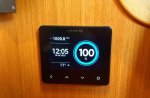
Well, I'm not a sentimentalist, but I do appreciate good design and functionality in products. The Pico isn't cheap, but its touch-screen display is very clear and the system has astonishing versatility.

pico.jpg
 
Victron kit is great quality, but the display isn't great. The Simarine Pico has such a lush display.

Can't argue that the Victron display could be bigger/better, but i view mine on the onboard PC, so it's not an issue. That said, when you look at more comprehensive Victron installations, some other systems pale into insignificance. Mind you, the cost goes up significantly too :(
 
Well, I'm not a sentimentalist, but I do appreciate good design and functionality in products. The Pico isn't cheap, but its touch-screen display is very clear and the system has astonishing versatility.

View attachment 105299

I agree it looks very nice, and didn't say it's not worth it.

It looks like Simarine provides value when you buy into the whole system - the Pico has a page, for example for showing how full the tanks are, and they also sell a module with 4 independent shunts so you can separate out how many amps the fridge is consuming and how much the solar panels are providing. So it seems to be trying to solve a larger problem than that of just monitoring the battery

I think Simarine is incompatible with the NMEA 2000 tank senders which allow volume of remaining fuel or water to be displayed on the plotter, and one can measure how much the fridge is using with a single shunt and by turning everything else off. So I would be a little reluctant to buy into Simarine's proprietary system, though I can see why one would.
 
If you want to keep things simple but use a panel voltmeter which displays two decimal places,ie 12.75v rather than 12.7volts then you can see if the batteries are charging or discharging.Use a three position switch,on,off,on
So you can select either battery.
If I want to know amps draw I just use a multimeter.
That's what I do, I have two 12 and a 24 volt banks.
 
The Victron SmartShunt is about £120 and it will monitor one bank, with just voltage for a second. It can be hard wired to some Victron equipment, or just Bluetooth to your phone, tablet or PC with the free Victron app' Victron Connect. A very cost effective solution for those who already have onboard tablets or PCs. A new Android tablet can be had for £50 (or maybe less), which still represents great value when you consider you have battery monitoring on a 7" display (or 10" for very little more money) and you can use the tablet for other purposes. For instance, a 10" Lenovo tablet with inbuilt GPS is just £80, makes an ideal backup plotter as well as the battery monitor display.


For those wanting more than just battery monitoring, Victron have some very nice kit, including some recently launched monitoring solutions.

The Cerbo GX has more inputs than you can shake a stick at Cerbo GX - Victron Energy

Add a Smart Shunt and it'll fully monitor one bank of batteries and show the voltage of another. Tank sensors can be added too. It can control and customise all manner of equipment and can output data to Android, iOS, Windows or dedicated Victron displays such as the GX touch 50. You can connect inverters, inverter/chargers, solar controllers etc etc It's also N2K compatible and will display on some models of Garmin, Raymarine and Simrad MFDs.
 
I fitted a pico 2 years ago. It's lush. Of course if your budget is limited you could just fit two DC volt meters (one for each batter) for pennies.

Screenshot 2020-12-21 at 17.03.54.jpg
 
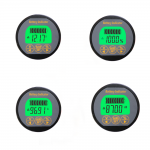
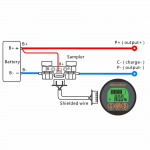
I've a couple of these monitors fitted, one for each battery bank. They seem to be cheap copies of the expensive Victron but have the same functionality except for Bluetooth and an alarm.
Just program in the battery capacity when you know the battery is fully charged, then all the data is by reference to this. The % capacity is then calculated by a shunted ammeter and a time chip. They'll only work correctly if your batteries are good and their REAL capacity inputted hasn't deteriorated with age/usage. I keep mine in sight and swap battery banks when nearing 60% capacity.

Battery Monitor 4in1 DC 80V 350A SOC AH VOLT AMP Capacity Tester State of Charge | eBay


1608566766600.png1608566766600.png1608566914876.png1608566914876.png
 
Last edited:
The SmartShunt will only monitor one bank of batteries, but it show voltage of a second battery. The BMV series still have a lot to offer. They have an alarm and a relay that can both be user set, the relay in mine triggers a 240v relay that switches the mains charger on at a set voltage, as an example. You can still view data via Bluetooth by connecting the Victron Bluetooth dongle. Additionally, Victron make a USB cable that allows the monitor to be viewed on a PC. I have USB cables connected from the battery monitor and solar controller, to the onboard PC.

That's very interesting indeed. In principle could you use this alarm to trigger a LVD on either the DC or AC side of an inverter?
 
Sorry for the jargon. Low Voltage Disconnect. It would be an additional layer of protection for a lithium system.

No problem. It's a very low current relay, so it's best suited to triggering another relay, such as my 240v relay to turn the mains charger on. There are ways it could be used to disconnect the domestic loads from the batteries, such as a normally closed latching relay on the positive supply, but there are better ways to do that, such as a heavy duty voltage sensing relay, Victron (amongst others) make such a device:

Victron Energy Smart Battery Protect 12/24V 220A - BPR122022000 – Battery Megastore
 
Top