What a shame

Bought a small Hunter in 1979 for the same amount that I would have paid for a Mediterranean holiday. Two upgrades for the same amount as holidays and I still have the value in the current boat, 45 years later, whereas the 3 holidays would have been over as soon as I returned so money 'lost'. I worked out (somewhere above) that the running cost over the 45 years has been no more than a single cup of Costa Coffee per day.

Potential to have a serviceable boat of the type being considered in this thread for much less than a Mediterranean holiday

Admittedly young people are time limited and now more likely to have paddleboards or dinghies, but seeing some moving over to cruising boats or want them as overnight accommodation..

Yacht company locally advertises recycling and putting rest in the big incinerator for a reasonable price when the time comes. Good that the incinerator takes it.
 
Last edited:
I've been told the harboyr is contaminated. Actually, I was told it was "radioactive", which I'd guess isnt true, but perhaps dioxin, which can have a long half life.

Very nice harbour over the other side at Charleston in Fife, but derelict, and full of apparently mostly abandoned boats. Story is landowner wants to fill it in and develop as an upmarket housing estate, but its listed, so wasn't given planning permission, so its been closed and they are waiting for it to become dangerous. Not an entirely unfamiliar story.
capsize_qt.jpg
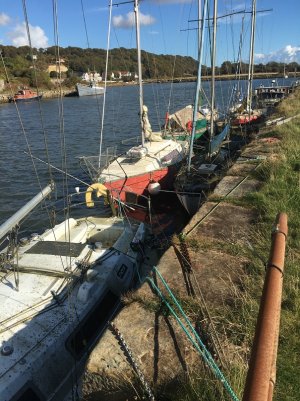
The houses behind the capsize give a clue to the "vision" for the site. Not all sunk, though

Some of them were sinking
soggycornerQtr.jpg

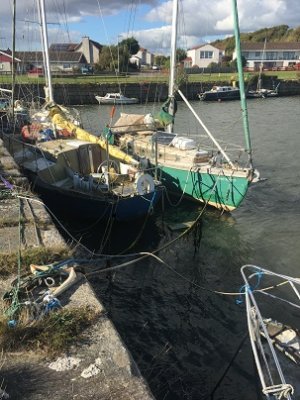
And some of them seemed to be floating fine
notsunk20.jpg

2blue10.jpg

clipperbow10.jpg
I did wonder if one of the (preferably unsunk) ones might be acquired for a fiver, but didn't think I'd have anywhere to put it, though I've since learned that the club my subsequently acquired Trident (looked worse but was ashore) is at, over the other side, had at least one 50 quid refugee from here.

Probably something like 30-40 boats there (though I didn't count them) mostly above water at the beginning of October, so it would probably be difficult to find mooring for all of them locally even if anyone wanted to.

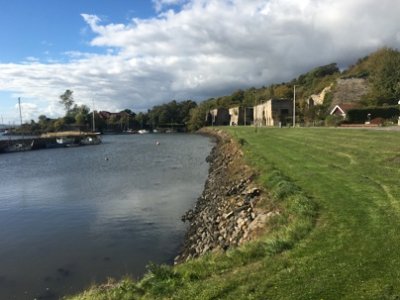
Big, attractive historical harbour with good shelter. Such a shame. But money talks, and possession is 9/10 of the law.
longshore10.jpg

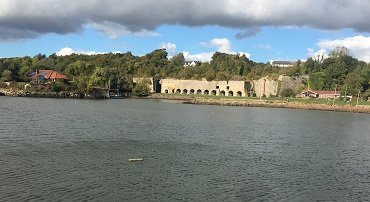
The arches are limekilns, though the nearby village of Limekilns, which has an active sailing club, doesn't seem to have any left

bigharbour10.jpg
I miss spelt it above Its Charlestown, not Charleston.
 
Last edited:
Problem with old grp is that it is often contaminated with antifouls such as Tbt (still around on many long abandoned boats) Also unreacted peroxide catalyst (oxidising agent) that stays in the laminate, grind the grp up & this makes the filler powder prone to spontaneous combustion.
The energy costs in grinding the stuff up are significant & this makes filler more expensive by far than new virgin stuff.
Plants have been set up to deal with waste grp but they depend on a steady supply of feedstock & new waste from industrial laminators is preferable as it doesnt have the contamination issues of antifouls etc.
Boats have always been a surprisingly small part of the composites industry approx 10% so in the grand scheme of things recycling boats isnt really economic hence landfill often being prefered.
The problem is that as well as potential contaminants, ground-up GRP has no commercial value. There's nothing in it worth the expense of recovery and the market for using it as a filler is tiny - the potential contaminants make it unsuitable for most products. The only possible use I've heard of is as feedstock for making cement - but even there, the composition is too variable for it to be easy to use. There is a very minor use in making non-slip gratings for pontoons! Also, the transport cost of taking a derelict hull to a processing facility makes it even less commercially viable.

In fact, the only remotely viable option I can see would be for the hulls to be recycled as working yachts! But the costs of doing that are such that no one would buy the product, as it would be a poor second-best to the many new-builds and would cost comparable amounts if brought up to current standards.. Even if the hull only requires minimal cosmetic work, that's still only about a third of the cost of building a working yacht.
 
Incinerating might be best option then. All you're left with at the end is the glass content I believe.

There's an energy recovery plant at Marchwood, Southampton water. Could be ideal, sail up there and bid your boat farewell.

Talk of re-opening the branch railway line, so could be even more convenient!
 
There's an Aries and boom going........I heard through grapevine that he'd take £500 for each or £800 for both..... I didn't think that was a bad price considering the brother in law got it all for nothing off the boat which has now been dragged away to be left somewhere I know doubt
 
Incinerating might be best option then. All you're left with at the end is the glass content I believe.

There's an energy recovery plant at Marchwood, Southampton water. Could be ideal, sail up there and bid your boat farewell.

Talk of re-opening the branch railway line, so could be even more convenient!
Even incineration is tricky - unless done under controlled conditions, you can end up with very dangerous emissions., including cyanides. So incineration should only be done under controlled conditions in an industrial incinerator. Such facilities are few and far between because most communities object to having them nearby! The energy content of GRP might be too low for an energy recovery plant; most of it by weight is glass.
 
Ipswich energy from waste plant on the old cement works seems to work as well as can be - no smoke or smell - clever systems to minimise pollutants in emissions as much as can and says it stops if emission levels exceeded, New houses built right next to it, so it is possible. Appears better than the smell from the Colchester landfill. Guessing local boat recycler who mentions energy from waste would be taking remnants there and it is accepted. Quantity of a boat will be very small in comparison with general waste, but I suppose it depends on how much is burned off and how much still needs to go to landfill, whether it is worth the effort and consequent air pollution.

(Was surprised houses were built there rather than a plastics recycling facility, to save the plastic for recycling having to be shipped half way around the world, but that is another topic.)

Seperately - Perhaps an RIBA competition for re-use of boat hulls - fish ponds, storm water storage, garden features, garden office?
 
Last edited:
Bought a small Hunter in 1979 for the same amount that I would have paid for a Mediterranean holiday. Two upgrades for the same amount as holidays and I still have the value in the current boat, 45 years later, whereas the 3 holidays would have been over as soon as I returned so money 'lost'. I worked out (somewhere above) that the running cost over the 45 years has been no more than a single cup of Costa Coffee per day.

Potential to have a boat of the type being considered in this thread for much less than a Mediterranean holiday

Admittedly young people are time limited and now more likely to have paddleboards or dinghies, but seeing some moving over to cruising boats.

Yacht company locally advertises recycling and putting rest in the big incinerator for a reasonable price when the time comes. Good that the incinerator takes it.
Keeping a boat in good order is a very satisfying thing to do, but there is no way that anyone could take on a boat of the type being discussed in this thread for less than a med charter. Restoring boats (if you have the time and perseverance) is it's own reward but expensive even if you don't cost your own time or pay anyone else to do any work.

I would also say that those who buy a fixer-upper (not a going concern) and actually complete the intended work & launch are in a minority. I've come back to yards 10 years later and seen the same boats and people...now that really is dead money.

On the other hand 4 mates can charter a decent sized yacht for a couple of weeks in Greece for £500 each! Even for family peak time holidays I've found a couple of weeks charter the same overall price as keeping a smallish boat in the UK.
 
The professional recyclers don't seem to be particularly expensive considering what is involved, so that must be the way to go when the time finally comes. See Post #52.

Perhaps a club with a boat to dispose would be better to hold a fund raising event to raise the disposal cost and give it a good send off.
can the parts that get stripped, scrap from keel etc generate enough on ebay to cover the disposal cost?
(I would have thought most clubs and yards keep tabs on what is in their boat parks and turn out each year if fees not paid, but maybe not, as in #175 - creeks without an active harbour authority may be different.)
Even well run yards its a headache - I think a yard I knew were advised that before selling a boat that hadn't paid any fees for 5 years and hadn't been visited for 7, they had been advised to get Sheriffs Officers (like Bailiffs) to serve notice on the owner. The money he got back from the sale barely cleared the legal costs - he did remark it would have been better for everyone if it had just been nicked!
Seems like cut up hull material could sometimes be re-used for things like reinforcement in way of chainplates, laminated into a mast compression beam, ring frames or pads to take bulkhead tabbing, rigging deadeyes (?) etc or in extremis, ground up as filler, though you'd need an industrial facility to do that safely on any scale.
Not a lot of a boat is flat parallel solid GRP though. I think its been suggested that chipped it can be used like hardcore when laying roads - but I can see people worrying about TBT etc.
Mostly it seems to go just to landfill.
the actual volume of GRP from a boat isn't a huge amount of landfill.
 
I would also say that those who buy a fixer-upper (not a going concern) and actually complete the intended work & launch are in a minority. I've come back to yards 10 years later and seen the same boats and people...now that really is dead money.
there's one in a yard near me thats on at least its third owner in a dozen years and has never been in the water in that time. The yard fees alone would have bought quite a nice boat in sailable condition!
 
" I've come back to yards 10 years later and seen the same boats and people."
Having completed a really fairly substantial refit and upgrade of a once-tired older boat, and seen that yard over a long time, I think there's an illusion here. The ones who will never finish are still there, but more people came in, refitted and left in comparatively fewer spaces over that time. In my yard there are boats nobody visits, there are boats that are active eternal projects (at least two I'm not sure are dead money, since the work seems to be the fun for their owners... fine, I can see the enjoyment actually) and then a fairly decent number of projects that have completed and sailed away, but as successive users of the same small number of spaces. So at any one time it looks as though eternal projects are dominant, but measured over a couple of years (I went back to upgrade) they were not.

I wonder if the change of emphasis from owning to Med chartering goes hand in hand with a change in amount and distribution of time off, as well as the rise of the cheap flight. I'm not absolutely sure, but I think in the 70s-80s most better-off professional full time employees got less paid leave than they do now. That must have made "lots of weekends on the UK coast" more attractive vs "long trips in the Med". If you have loads of paid holiday it makes more sense to take a couple of two week blocks for charters and you still have plenty left over. (I am a very lucky fellow and I do have that, but the nature of my work stops me taking it in big lumps, so coastal weekending with my own boat I can leave all my own stuff on is right for me.) I appreciate this is only a factor for people in pretty advantaged positions, but that was probably similar then too.
 
View attachment 189209
The houses behind the capsize give a clue to the "vision" for the site. Not all sunk, though

Some of them were sinking
View attachment 189210

And some of them seemed to be floating fine
View attachment 189211

View attachment 189212

View attachment 189213
I did wonder if one of the (preferably unsunk) ones might be acquired for a fiver, but didn't think I'd have anywhere to put it, though I've since learned that the club my subsequently acquired Trident (looked worse but was ashore) is at, over the other side, had at least one 50 quid refugee from here.

Probably something like 30-40 boats there (though I didn't count them) mostly above water at the beginning of October, so it would probably be difficult to find mooring for all of them locally even if anyone wanted to.

Big, attractive historical harbour with good shelter. Such a shame. But money talks, and possession is 9/10 of the law.
View attachment 189214

The arches are limekilns, though the nearby village of Limekilns, which has an active sailing club, doesn't seem to have any left

View attachment 189215
I miss spelt it above Its Charlestown, not Charleston.
The grey boat in the background in some pictures looks an interesting vessel, MFV by the looks.
 
I was told , and it may even be true, that a certain amount of glass in the incinerator is needed to produce a useful slag rather than useless ashes
 
The grey boat in the background in some pictures looks an interesting vessel, MFV by the looks.
In fairly good nick IIRC, at least compared to the 2-3 sunk ones (the capsized yacht is up against the deck house of one of them)
Was an interesting visit, a bit depressing but seasoned with a frisson of (at the time) barely conscious acquisitiveness.

I found the number of liferafts surprising, suggesting some of these had been places and had spent significant money doing it.

Or alternatively, I suppose, suggesting that the keepers had thought they were especially likely to sink doing it
 
About 10 years ago our local boatyard changed hands, At the time i remember one of the staff saying that 30% of the boats in the yard were abandoned, thats a lot of income lost. New owner replaced them with caravans & houseboats, much more lucrative!
Walking through our club this morning I reckon 30% of the boats are at end of their economical lives, as long as the owners keep paying its ok but in a club with an ageing membership people keep dropping off their perch or lately its newer members just disapearing after a few years leaving us with another hulk.
We got rid of one a couple of years ago, bought by a right bunch of chancers, its now sunk off thorpe bay, One for Southend council if they can be bothered, reality is it will break up & end up on the beach!
 
Rochefort 'Port de Plaisance' is just up the road and there is a 'park ferme' for boats. Usually winter storage, but quite a few are looking a bit unkempt. Then they had a zone there that the abandoned boats were put in and stripped, with a little store selling the kit. But, that quit a year or two ago.
Outside that, there is a row of parked yachts. Some are being tidied up, some look rough, one of of those (maybe more) I know is used as rented accomodation.

On Chancers, Not unusual to find people looking to live the dream, but don't have the experience to realise the amount of work to sort a tired boat. But, it was cheap!
 
At the end of the day.. GRP has been an unmitigated disaster for the planet. From making the stuff thru to making the boats causes masses of toxic pollution and then they cant be got rid of. The real environmental cost to us sipping a G&T at Newtown on a barmy summer evening after a bright and breezy beat down the Solent is huge.
 
At the end of the day.. GRP has been an unmitigated disaster for the planet. From making the stuff thru to making the boats causes masses of toxic pollution and then they cant be got rid of. The real environmental cost to us sipping a G&T at Newtown on a barmy summer evening after a bright and breezy beat down the Solent is huge.
There are a few caves where you can sit on a rock wearing a hair shirt sipping a warm bowl of mead, if that helps.
 
At the end of the day.. GRP has been an unmitigated disaster for the planet. From making the stuff thru to making the boats causes masses of toxic pollution and then they cant be got rid of. The real environmental cost to us sipping a G&T at Newtown on a barmy summer evening after a bright and breezy beat down the Solent is huge.
Not to forget how many wings from wind turbines they don’t know what todo with🙁……..if we had just stuck with wooden boatbuilding and maybe steel we as you say not have this problem and there would be work for craftsmen not just laminators and there would be fewer boats less marinas altogether better.
 
Top