Weeping keelboat

matt1

Well-Known Member
Joined
11 Feb 2005
Messages
1,259
Location
Hamble, UK
Visit site
Hi Everyone

My aftmost keelboat has a very slow weeping leak after 8 seasons use. There is rust on the hull/keel joint visible around where this stud would be and inside the boat there is dampness rather that a pool of water. The dampness is salty though!! I know of another boat of the same model that had the same issue with the same bolt and ended up having the keel removed. The suggestion is the factory never really tightened the bolt sufficinetly in the first place as this particular bolt is hard to access. I'm trying to find a way round having to drop tge keel as its a very slow weep as far as I can see. I'm intending to remove the sikaflex that currently covers the stud / bolt, have a good look and maybe remove the nut and washer plate. Other thoughts include putting a back nut on and trying to unscrew the whole stud from the keel. This would obviously allow me to inspect the hole and the stud properly before injecting a decent amount of sikaflex in the hole before re inserting the stud. As I'm typing this it all sounds a bit of a "bodge" but other than the inevitable cost of dropping the keel I really don't want to disturb something which in the main seems "fine". Me being a firm believer in "if it ain't broke, don't fix it". Thoughts?

Matt
 
What boat - presumably GRP ?
How old ?
How many keelbolts in total ?

The fore and aft keelbolts are often the ones that get most flex as the hull bends slightly differently when ashore and afloat...
 
8 Seasons use? what make or class is she? I would have thought a boat of 8 years old (if she is) should not have rust coming from the keel join unless something was obviously wrong. Regardless of her age it shows that bolt is on the way out. A modern boat would i think invariably have stainless steel bolts or studs & to show rust at 8 years stainless will be doing something nasty.
On the flip side i dropped my Sabres keel last year & her bolts were plain high tensile steel not stainless in any degree. All but one were as shiny & sound as the day they were first done up. Funny thing was there was no mastic used by marcon at all. They just put a layer of wet mat on top of the iron keel with polyester resin & bolted it up tight. This had lasted 40 years.
 
Ideally the bolt needs to be pulled and examined and possibly replaced. However, use of stainless for this application may not be wise due to crevice corrosion. Presumably the keel will be cast iron and using mild steel will be galvanically closer.

For a fix to seal the leak that will ignore the possible corrosion issue I would remove the nut washer and any mastic (boat out of the water). Build a simple cofferdam with plasticine around the bolt leaving the gap open / visible around the bolt / stud. Then repeatedly apply Captain Tolleys crack cure, until the crack eventually fills up. Initially the milky fluid will mostly run out, but it leaves a thin coat which drys to a latex like layer, and this gradually builds up fillings the crack completely.

I had a similar weep on a rudder head securing bolt, and it took about 8-10 applications over a few weeks before the crack was completely filled. No weep since after 2 seasons,

Mastic simply applied on the surface won't make a good seal.
 
For a fix to seal the leak that will ignore the possible corrosion issue I would remove the nut washer and any mastic (boat out of the water). Build a simple cofferdam with plasticine around the bolt leaving the gap open / visible around the bolt / stud. Then repeatedly apply Captain Tolleys crack cure, until the crack eventually fills up. Initially the milky fluid will mostly run out, but it leaves a thin coat which drys to a latex like layer, and this gradually builds up fillings the crack completely.

Taking the boat out of the water and resting it on its keel will put the joint in compression. Bunging a bit of Tolleys in, then putting the boat back in the water and therefore putting the joint back in extension sounds like a real bodge.
 
Taking the boat out of the water and resting it on its keel will put the joint in compression. Bunging a bit of Tolleys in, then putting the boat back in the water and therefore putting the joint back in extension sounds like a real bodge.
As I said ideally the bolt should be pulled so I did qualify the suggestion to provide a fix that doesn't require the keel removed. Guess he can take the keel off then !
 
Last edited:
I think the first step is to try to remove the stud with back nut or some other attachment to the stud. If it is not going to come out or is too difficult then treatment of the stud from the top as suggested might be the next best bet. Bodge it may be but not a bad bodge just appropriate maintenance. All this assuming that there are a lot of bolts attaching the keel. it might be worth removing a more accessible bolt to get an idea of how it is done. I would think sealer down the hole before replacing the stud would force sealer into any gaps. good luck olewill
 
Thanks all. I appreciate the best method would be to remove the keel and in an ideal world that is what I would do. What I didn't mention is that it's a small yard and the boat is buried behind three other boats so its' not that feasible to have the keel removed. For that job I would really need to programme it in for when the yard is less busy and plan the job in advance. Interestingly the yard manager himself said to dry it out with a hairdryer and re-seal with sealant. It's fair to say this problem was unexpected and not anticipated which is partly the reason for looking for a shortcut to repair it, even if that perhaps just delays the eventual keel removal. The boat is a twin keel Hunter 31, GRP hull with mild steel bolts (I'm told mild steel suffers fatigue less than stainless so is more suitable for twin keelers) and the keel is cast iron. There are at least 10 securing bolts so frankly I'm not overly concerned at this point about strength (and of course I have a spare keel :-)
 
Depending on whether it is a British Hunter 31 or a Hunter Legend 31 I'd be inclined to call the manufacturer BH or Luhrs and try and get an idea of how the keelbolts were fitted into the keels. They could be cast in when the keel was made, or there could be pockets on the keel that take nuts (then hidden with filler). The more information you have before you do anything the better.

Worst case is you try and tighten the nut, or put on a backnut and try to remove the stud, and it snaps the shank. Then you pretty much have to do something, even if it is just temporarily glassing over the hole. I might just glass over the existing nut and washer on the inside and run some sikaflex or PU40 round the outside - till next year, when you can arrange to have the boat where the yard can get at it to take off the keel if need be. You can then grind off the layer of glass you put on as a bodge-fix. As you say, you have 9 other bolts.
 
Thanks all. I appreciate the best method would be to remove the keel and in an ideal world that is what I would do. What I didn't mention is that it's a small yard and the boat is buried behind three other boats so its' not that feasible to have the keel removed. For that job I would really need to programme it in for when the yard is less busy and plan the job in advance. Interestingly the yard manager himself said to dry it out with a hairdryer and re-seal with sealant. It's fair to say this problem was unexpected and not anticipated which is partly the reason for looking for a shortcut to repair it, even if that perhaps just delays the eventual keel removal. The boat is a twin keel Hunter 31, GRP hull with mild steel bolts (I'm told mild steel suffers fatigue less than stainless so is more suitable for twin keelers) and the keel is cast iron. There are at least 10 securing bolts so frankly I'm not overly concerned at this point about strength (and of course I have a spare keel :-)

You probably realise it is not the loss of the keel that matters so much as the holes left in the hull when it is gone. If you were really worried you might consider water tight bulkheads to the keel base or floatation inside to ensure she does not sink. good luck olewill
 
Sorry, still going on about my keel bolt!

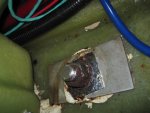
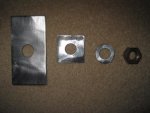
So I have now removed the nut and backing plates and cleaned up as best as I can. The backing plates and washers are now quite clean and shiny, having been a little stained / tarnished. One of them still has some black staining on it that cant be removed with the sanding disk. I can't really tell what they are made of (Stainless or mild steel?) Given that I cant tell, I'm tempted just to leave them clean rather than paint them. That way at least I can keep my eye on their condition once back in the water. As you can see from the enclosed pictures, the rust isn't really too bad and so at this point I'm not going to remove the keel. The bolt is a very snug fit in the through-hull hole and I doubt I would ever get any more sealant between the bolt and the hull (There is no countersinking on the inside of the hull). I will probably clean the bolt with a rust killer and then cover in Captain T's creeping crack stuff before putting lots of sikaflex around the bolt and putting the backing plate and washers on and tightening as tight as I can get it (not easy as access is very poor).

Thoughts? Comments? Suggestions on my proposed method? Has anyone done similar and is able to comment on the results? Oh and before you say it, YES, I do know that I should really be removing the keel and doing it properly but for various reasons that's not possible right now :-)

Thanks
 

Attachments

  • IMG_0109.jpg
    IMG_0109.jpg
    37.4 KB · Views: 1
  • IMG_1978.jpg
    IMG_1978.jpg
    82.9 KB · Views: 1
  • IMG_0113.jpg
    IMG_0113.jpg
    36.1 KB · Views: 1
300 series stainless steel., by far the most likely type for this job, will not be attracted by a magnet, whereas mild steel will. It appears from your photo that there is plenty of space to remove the stud. You need a second nut, tighten the two together, then unscrew the stud from the keel. I would use one of the hybrid sealants, such as CT1 or Sticks like s**t simply because they will set when wet.
 
Thanks Vyv - The picture was taken on an Iphone through a small access hole so its quite deceptive. I could only get a 1/4 turn each time before running out of room. The magnet test has shown the round and square washers to be magnetic as is the nut but the rectangular backing plate isn't. It's relatively heavy compared to the steel parts though so I don't think it can be aluminium. The manufacturer informs me that the studs are fitted after drilling and tapping the keels so in theory I should be able to remove it like you say, although I have been told this is unlikely to be possible (again by the manufacturer)
 
I can see the problem with getting sealant around the stud if you prefer not to drop the keel. I would drill a small hole, big enough to get the nozzle of the sealant into, at a shallow angle to the bolt to emerge near its junction with the keel. Injecting sealant into that will put it where you need it and it will be driven around the threads and upwards into the bilge. It's still a bit of a bodge but a perfectly acceptable one. A company called Furmanite have made lots of money sealing leaks in this way in the hydrocarbons industry. The effect on strength of the hull will be negligible and it can be epoxied when you have the opportunity.
 
Top