
We have a leak

webcraft

Well-Known Member
Joined
8 Jul 2001
Messages
40,411
Location
Cyberspace
www.bluemoment.com
A weep round the speed transducer is letting in an appreciable amount of water. (a couple of inches a day)

I don't want to cut our cruise short. Will it get worse? Can I seal it with epoxy putty?

Why has it suddenly started leaking? It's been fine for 18 years,. Boat has been on the hard nearly 2 years before launch.
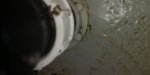
_IMG_000000_000000.jpg

- W
 
Last edited:
If the plastic has cracked then it could very well get worse. At least have a soft wood plug or other device to ram into the hole if fails further.

Underwater curing epoxy might work but the issue is applying sufficient pressure to allow the epoxy to seal while holding the water back i.e. not allowing the water pressure to undermine the epoxy. If going the epoxy rout, clean the plastic and gap well to remove slime, grease paint to allow the epoxy to make its bond.
 
If the plastic has cracked then it could very well get worse. At least have a soft wood plug or other device to ram into the hole if fails further.

Underwater curing epoxy might work but the issue is applying sufficient pressure to allow the epoxy to seal while holding the water back i.e. not allowing the water pressure to undermine the epoxy. If going the epoxy rout, clean the plastic and gap well to remove slime, grease paint to allow the epoxy to make its bond.

Are you suggesting the plastic tube could just snap off? It looks more like a failure of the sikaflex, but I guess no way to tell. All I did to it before launch was gently scrape the inside of the tube around the paddle wheel to remove barnacles.

Will have a bung handy.

I guess ultimately we are going to have to get lifted out and have a new transducer assembly installed. We have just arrived in Tiree, we're planning a few days here then across the Minch. Hard to assess how urgent the situation is, am hoping the underwater epoxy putty will fix it at least temporarily.

- W
 
Regardless of leak/no leak, you should encapsulate the housing in GRP as recommended by NASA. Sand back the surrounding area to a 5cm radius, clean it all up and cover the whole lot in GRP resin so that the plastic nut is encapsulated. Cover a few threads above it too but obviously not right to the top.

If you're somewhere you can beach the boat somehow then you also re-seal the fitting, but you'd need to be confident it wouldn't fail on disassembly; 18 year old plastic may be quite brittle.
 
Are you suggesting the plastic tube could just snap off? ...

If it is a radial crack, caused by aged hardening of the plastic and working the fitting over the years, then it could crack further if wiggled, squeezed, torqued. I would not consider it a high probability but it depends on its history.

Instead of a lift out, you could do this at low tide, leaning against a wall, save some cash.
 
The paddle assembly hasn't been cross threaded on installation?

That means putty would be unlikely to stop the flow.

Ink
 
The paddle assembly hasn't been cross threaded on installation?

That means putty would be unlikely to stop the flow.

Ink

The unit has been undisturbed and trouble free since I bought the boat in 2003

All I did was scrape out the barnacles in the tube round the paddle wheel, hard to believe this could have caused the issue.

It seems it is leaking at the base, as if it is a sealant failure rather than plastic failure. If so a fillet of epoxy putty might fix it in the way NASA recommend.

Only worry is, the epoxy putty will make it hard to remove the old fitting.

I had considered trying to torque up the plastic nut but Blowing Old Boots' comments on wiggling age - hardened plastic have definitely put me off that idea.

- W
 
I'm afraid this isn't very positive but I had this problem a few years ago, and the entire tube did snap off. I still remember looking out through a large hole from the bilges and seeing the tide coming over the sandbank on which I'd left the boat, and wondering where on earth I'd put the stopper. (The blanking cap was tied on but was useless in the circumstances)

Further research revealed that there are certain sealants that shouldn't come into contact with the log tube or it'll become brittle. A quick google just now didn't reveal what type of sealant, and unless you know what was used in the past you'd be none the wiser, but complete failure is a real possibility.
 
I'm afraid this isn't very positive but I had this problem a few years ago, and the entire tube did snap off. I still remember looking out through a large hole from the bilges and seeing the tide coming over the sandbank on which I'd left the boat, and wondering where on earth I'd put the stopper. (The blanking cap was tied on but was useless in the circumstances)

Further research revealed that there are certain sealants that shouldn't come into contact with the log tube or it'll become brittle. A quick google just now didn't reveal what type of sealant, and unless you know what was used in the past you'd be none the wiser, but complete failure is a real possibility.

And that's one of the reasons that Nasa specify that the tube and nut should be glassed over to make it stronger! The OP's transducer obviously wasn't installed that way.
 
I'm afraid this isn't very positive but I had this problem a few years ago, and the entire tube did snap off. I still remember looking out through a large hole from the bilges and seeing the tide coming over the sandbank on which I'd left the boat, and wondering where on earth I'd put the stopper. (The blanking cap was tied on but was useless in the circumstances)

Further research revealed that there are certain sealants that shouldn't come into contact with the log tube or it'll become brittle. A quick google just now didn't reveal what type of sealant, and unless you know what was used in the past you'd be none the wiser, but complete failure is a real possibility.

Why did the tube snap off, was there an impact? Spontaneous snapping seems unlikely, and I have no intention of trying to remove or tighten anything while we are afloat.

To put things in perspective, we are 50nm from anywhere we could lift out.

The leak is from under the bottom screw, the one that tightens the fitting down onto the sealant. There is no reason to think the actual tube is damaged, and it looked fine from the outside before we launched.

I am optimistic that with the right sealant pushed into the gap and around the white plastic screw this can be fixed. Water Weld or something similar. Not sure how I will get that on Tiree though.

- W
 
Been there, tried to epoxy it from the inside - including taping over it to apply some pressure ... two attemts in total.

Didn't work. .....

Haul out and re-seal the through hull fitting was the solution in the end. (It was Raymarine). Mine started leaking after being hauled out for annual maintenance - could have been flexing of the hull or position of the lifting straps combined with aging of the sealant - don't know for sure.

PS:Try and avoid any undue force that may make the situation worse .......
 
Why did the tube snap off, was there an impact? Spontaneous snapping seems unlikely, and I have no intention of trying to remove or tighten anything while we are afloat.

To put things in perspective, we are 50nm from anywhere we could lift out.

The leak is from under the bottom screw, the one that tightens the fitting down onto the sealant. There is no reason to think the actual tube is damaged, and it looked fine from the outside before we launched.

I am optimistic that with the right sealant pushed into the gap and around the white plastic screw this can be fixed. Water Weld or something similar. Not sure how I will get that on Tiree though.

- W
No impact, just an attempt to push in sealant, by hand, because water was weeping slightly past the grp 'poultice' around the tube. I think I was using butyl tape and the pressure caused the tube to snap completely. I possibly tried to torque the back nut against the tape, but it would have been by hand with little pressure. There was little strength in the tube.

I was able to seal it with a disc of plywood outside the hull, a nut and bolt to a cross piece inside the hull, and more butyl tape.
 
No impact, just an attempt to push in sealant, by hand, because water was weeping slightly past the grp 'poultice' around the tube. I think I was using butyl tape and the pressure caused the tube to snap completely. I possibly tried to torque the back nut against the tape, but it would have been by hand with little pressure. There was little strength in the tube.

I was able to seal it with a disc of plywood outside the hull, a nut and bolt to a cross piece inside the hull, and more butyl tape.

So would you recommend leaving the leak alone? I thought pushing sealant gently round the base would not put any pressure on the tube.

- W
 
There is nothing to be lost from trying to bodge something up. I once sealed a friend’s leaking fuel filter with gasket-sealing compound while fuel was gushing out and the mend lasted the season. I don’t know how the stuff reacts with water but I would try something quick-setting and keep pumping.
 
There is nothing to be lost from trying to bodge something up. I once sealed a friend’s leaking fuel filter with gasket-sealing compound while fuel was gushing out and the mend lasted the season. I don’t know how the stuff reacts with water but I would try something quick-setting and keep pumping.

It's just a question of not making it worse by snapping the tube off and creating a giant hole, as per Corribee Boy's scenario.

If I apply very little force while pressing the gunge in I can't see that happening.

Agree completely re bodging, I bodged up a leaking raw water pipe in 2013 and have only just replaced the pipe.

- W
 
I think there's a lot to be lost - a slight weep was a lot less worrying, in retrospect, than a 40mm hole in the hull! If I'd known the fragility of the tube I would have left well alone.

I did have some concern about the possibility of making the leak worse - hence the sandbank - but without that option I'd say keep yer mitts off it, but find your plywood disc just in case!
 
My memory of these things is from removing the fitting to replace it with a blank, in order to avoid damage when lifting.

I’d guess it was a Raymarine fitting, and screwed in, perhaps with a big “O” ring/gasket, rather than being sealed with sealant.

The first time I did it, I was worried about the boat getting flooded. However, with the blank and a bung handy, the water didn’t come in too fast, and it was easy to screw the blank on, or in, (can’t remember over a decade ago).

So I am wondering if there is a way of removing it and fitting a blank, or a bung, thus stopping the leak in the short term.
 
Top