Wago bits

Superglue may not perform well in damp environments. There are better glues for this. But that does look very neat. Is it covered with a protective panel?

You could use wago boxes. They also have cable restraint built in.

Do wago do rail mount connectors? I see rail mount mentioned earlier in this thread.
 
No need for boxes. The boat is bone dry. The glue seems to work OK. The first panels I made are now nearly 4 years old and no sign of failure. Using the glue is easy. Just a dab on the back of the Wago and press it down for 30 seconds and it is done.
 
Superglue may not perform well in damp environments. There are better glues for this. But that does look very neat. Is it covered with a protective panel?

You could use wago boxes. They also have cable restraint built in.

Do wago do rail mount connectors? I see rail mount mentioned earlier in this thread.
See post #12
 
This is the small panel I made up for connecting the cables from the mast. Wagos stuck onto the board with superglue. I have use similar in a variety of places in rewiring the boat.
That's a neat way of doing a small number of connections, i've used that method a few times. I would add some better cable support though, the white "clip" still allows movement. A cable tie saddle roughly beneath each screw would be ideal.
 
This is the small panel I made up for connecting the cables from the mast. Wagos stuck onto the board with superglue. I have use similar in a variety of places in rewiring the boat.View attachment 204204
I'm possibly going to use something like this for all my mast wires. I do need to have a better look as to how many wires there are. The boat is new to me and the wiring needs some serious TLC.
https://www.screwfix.com/p/wago-32a-wiring-centre-junction-box-225-x-145-x-50mm-white/527pf
 
When I personally wired up the boat I built 1998 to 2009 I also used din rail and din terminal of various sizes mainly 1,5, 2,5 4 mm and bugger depending on the wire ; current capacity with pin crimps held on wire numbers.

Thin wiring for LED's I used ring connector with screw connector so mufti rings sonnectoree again with wire numbers

Vers large current cables use 8 mm ring/ screw connectors using 3/4 copper bars a connectors

Having an engineering work shop at home I can manufacturer bus bats of any size I with


Distribution panel
 
When I personally wired up the boat I built 1998 to 2009 I also used din rail and din terminal of various sizes mainly 1,5, 2,5 4 mm and bugger depending on the wire ; current capacity with pin crimps held on wire numbers.

Thin wiring for LED's I used ring connector with screw connector so mufti rings sonnectoree again with wire numbers

Vers large current cables use 8 mm ring/ screw connectors using 3/4 copper bars a connectors

Having an engineering work shop at home I can manufacturer bus bats of any size I with


Distribution panel
I wouldn't call that a bodge as it looks excellent. Using the perforated trunking allows you to keep the wiring neat and add or remove wires easily.
I have built many large panels like this and it is the only way to go for a complicated system. DIN rail terminals come in many varieties for different sized cables including fused, switchable, LEDs, relays and can be commoned together with screw or plug in bus bars. Sprung contacts are reliable and top entry terminals make it easy to insert the wires.
There is a huge choice from Phoenix Contact, Wago or Entrelec and even a 15mm DIN rail range if you are short of space. Using different coloured terminals allows you to differentiate different circuits.
It is a bit like Lego for grown ups and quite satisfying to clip it all together.
 
When I personally wired up the boat I built 1998 to 2009 I also used din rail and din terminal of various sizes mainly 1,5, 2,5 4 mm and bugger depending on the wire ; current capacity with pin crimps held on wire numbers.

Thin wiring for LED's I used ring connector with screw connector so mufti rings sonnectoree again with wire numbers

Vers large current cables use 8 mm ring/ screw connectors using 3/4 copper bars a connectors

Having an engineering work shop at home I can manufacturer bus bats of any size I with


Distribution panel
Impressive!
 
No need for boxes. The boat is bone dry. The glue seems to work OK. The first panels I made are now nearly 4 years old and no sign of failure. Using the glue is easy. Just a dab on the back of the Wago and press it down for 30 seconds and it is done.
Careful with that. Moisture is not the only reason for boxes, as your house wiring demonstrates. Wago 221 fittings do NOT meet the pull out load requirements of ABYC or USCG. Even wire nuts have better pull-out strength (tested). They are quite weak at the low end of sizing (instruments). Secure the wire. You also want to make certain when you skip boxes that there is no way for anything to fall against the wiring. In other words, the location must be in important ways equivalent to a box. Not the same as a crimped and heat shrinked splice. You may know this, but I fear some may not.

Wagos are neat, but they have their limitations.
 
Careful with that. Moisture is not the only reason for boxes, as your house wiring demonstrates. Wago 221 fittings do NOT meet the pull out load requirements of ABYC or USCG. Even wire nuts have better pull-out strength (tested). They are quite weak at the low end of sizing (instruments). Secure the wire. You also want to make certain when you skip boxes that there is no way for anything to fall against the wiring. In other words, the location must be in important ways equivalent to a box. Not the same as a crimped and heat shrinked splice. You may know this, but I fear some may not.

Wagos are neat, but they have their limitations.
This is Europe/UK and we have different standards. But that said they are ABYC compliant. link
 
This is Europe/UK and we have different standards. But that said they are ABYC compliant. link
Yes (ABTC complaint) and at the same time no. It is not a simple yes/no thing. They are compliant if used in a box or similar situation with strain relief (pressure connections) because the pull-out requirement is lower. They are not compliant as in-line splices (crimp connections). Read the standards below.

They do not meet the pull-out requirements for crimps or terminal blocks. They are compliant in boxes because there is a special carve out for that use (pressure connections).

connector%20pull%20out.jpg


I like them and use them. But they have limitations. I'm just stating this for new DIYs that may not be aware of these limitations.
 
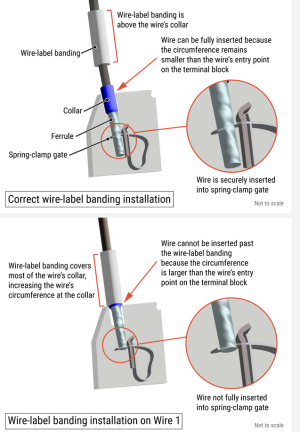
I don't know if you folks saw this from the NTSB report about the container ship Dali that struck and demolished a major bridge in Baltimore, MD. A single bad connection caused a cascading failure resulting loss of power and a ship-wide blackout at a critical time.

While not an indictment of pressure connectors, it shows that:
  • They can be connected insecurely if the work is done carelessly or even just inexpertly.
  • The defect may not be visible during inspection. In this case a tug would not have revealed the fault; it required vibration over time to develop.
And this is just one failure mode. You have to strip the wire properly and insert properly. If ferrules are used that must be done properly. They look so fast and easy, perfect for DIY, but take the time to do them perfectly. Failures are not that rare when work is rushed.

1767301096763.png
 
Careful with that. Moisture is not the only reason for boxes, as your house wiring demonstrates. Wago 221 fittings do NOT meet the pull out load requirements of ABYC or USCG. Even wire nuts have better pull-out strength (tested). They are quite weak at the low end of sizing (instruments). Secure the wire. You also want to make certain when you skip boxes that there is no way for anything to fall against the wiring. In other words, the location must be in important ways equivalent to a box. Not the same as a crimped and heat shrinked splice. You may know this, but I fear some may not.

Wagos are neat, but they have their limitations.
That panel is in the loo compartment just below the deckhead. The compartment is bone dry and just a pump toilet and cold water at the sink, no shower. Very spartan. The cables are under no stress and well supported. The old house type wiring has been there for nearly 50 years and is still sound. The new cabling to the mast is best tinned cable. Very happy with my decision to use them here and in other places on the boat
 
That panel is in the loo compartment just below the deckhead. The compartment is bone dry and just a pump toilet and cold water at the sink, no shower. Very spartan. The cables are under no stress and well supported. The old house type wiring has been there for nearly 50 years and is still sound. The new cabling to the mast is best tinned cable. Very happy with my decision to use them here and in other places on the boat
Sorry, but in the picture you posted, the wiring is far from well supported.
 
Sorry, but in the picture you posted, the wiring is far from well supported.
I can assure you that it is. How is it going to move? There is no load or stress on it - it just sits there. I agree it could be more elegant but the clip works. The mast cables have a P clip just out of sight to the right.
 
I can assure you that it is. How is it going to move? There is no load or stress on it - it just sits there. I agree it could be more elegant but the clip works. The mast cables have a P clip just out of sight to the right.

Until someone accidentally grabs it when the boat rocks.
 
Top