Volvo TAMD41D Overheating Question

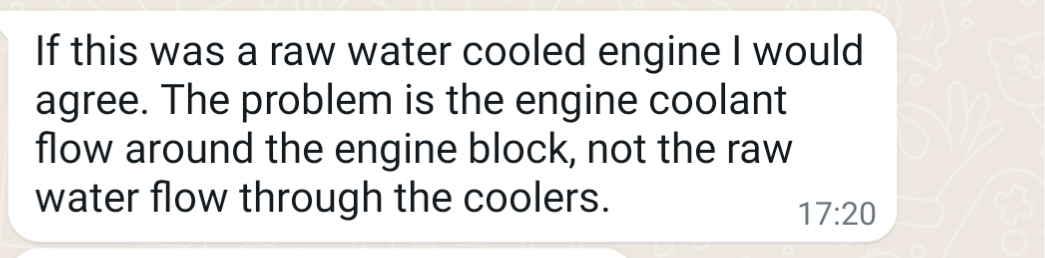
This is what the owner sent me from his mechanic.im very confused. Am I right the mechanic perhaps doesn't know what he is at? That was in response to my asked Ng if then elbow could be the issue and if it was replaced yet.
Screenshot_20230615-172238.png
 
This is what the owner sent me from his mechanic.im very confused. Am I right the mechanic perhaps doesn't know what he is at? That was in response to my asked Ng if then elbow could be the issue and if it was replaced yet.

View attachment 158238
I suggest you established what the problem is. From all your posts there appears to be two problems. (1) Overheating (as defined in your title). What is the evidence that it is overheating?. (2) coolant is pumped out of the filler when the cap is off: what happens if the engine is run with the cap on?

It would be good to know the answers to the above 2 questions before suggesting and more actions.

Www.solocoastalsailing.co.uk
 
Last edited:
An IR gun on both engines T stat house would be a good diagnostic indicator. Following the main coolers just to check there Health .£10 of eBay .

What about the closed cooling circuit ?
Reading post #1 the raw water side been the object of a parts throwing fest .Assuming the riser has been inspected for spray hole patentcy , so eliminating the raw water side ?? It’s not clear thus far wether the risers have been looked at and passed fit enough.

But if the closed side is inefficient……spinning impellers, broken vanes , restrictions, slipping shaft , stuck the T stat ( already mentioned by VP )


Also this “ cap off “ business is a red herring , it needs to run with it on and carefully observe its overflow drain , you know the little pipe after the cap .They all find a level expansion tanks usually near 1/2 full to allow the very space for expansion.Over filling blows out of the little overflow pipe .When you mess with the closed coolant levels it takes a few runs for a overfill to blow off and the correct level to establish.This is not necessarily a overheat scenario .
The thing should be run with the cap always on .Again post #1 claims the coolants been teated for unwanted gasses of compression and further more the heads been off and fresh HG fitted .

We don’t know thus far if the coolant level is constant ( with the cap on ) ? Is it using coolant ?
Assume seeing as the heads been “ done “ and no exhaust gasses present in the coolant it’s not disappearing down a cylinder .
In fact we need more info running with the cap on which we haven’t got for some strange reason .

Sump volume .
- no info on this …..I mean is it rising = filling with coolant ,if so the closed cooling level will drop or equally as bad decreasing oils level leaking through ( assume oil cooler ?? ) into the coolant ,Is the oil raw water or closed circuit cooled ? No info on sump vol changing thus far .Need to know it isn’t

If there is calorifer this needs disconcerting temporally .

Blow by .
No info on this thus far .Put your hand over the open filler hole on the rocker box at idle and a few revs .Compare both sides .Is the effected far greater ? Nice if equal , best to know by now .
Where are you going with this Porto I hear you all ask ?
I am going with the bottom o rings on the cylinder(s) sleeves knackered with this , impacting on sump vol slightly as coolant enters the oil , ( poor localised coolant cylinder circulation = overheat tendency) rising the remaining air pressure down there and kicking out as a slight or different blow by pressure compared to the good one . + eventually rising sump vol if it’s run long enough. Some gas from the sump air vols returns through the knocked sleeve o ring(s) and it’s this forcing the coolant out with the cap off …..compared to the other which does not force out with the cap off .


This excess coolant in the sump might be evaporating off between the short cool-down runs .So difficult with short runs to see the sump level rising .As said the coolant cap off is masking the real coolant level , also the short runs .

Coolant history .
How Fq has it been changed ? What type in terms of compatibility I mean mix the wrong types and it could gel up and clog channels in the block .Has it been inadvertently topped up with the incompatible other stuff ?
 
Last edited:
Hi Folks
I have been offered a boat for sale due to overheating issues with one of the engines.
I'm not familiar with the exact engine model, or if this is an issues with this particular engine?
The owner is selling it as he has simply given up.
He has spent a fortune, and it still overheats. He has had the following work done
Oil & filter service
Raw water pump rebuilt
Turbo replaced Engine
Coolant pump rebuilt
Engine coolant hoses replaced
Heat exchangers stopped port - stbd
Cylinder head removed, pressure tested and skimmed
Injector sleeves replaced
Compressions checked
Coolant checked for exhaust gases.
HAs anyone any ideas where to go from that?
Its a really beautiful boat, and exactly what we would be looking for. If we knew we could resolve the problem.
Ok guys let’s just for a minute assume the engines actually fine , nothing wrong .Never was anything.Been chasing shadows all along .

The overheat is from excessive EGT s and overloading caused by excessive friction in the stern gear apparatus ( inc the g box ) .So we need to check the P bracket cut less bearing , gen alignment, etc and somehow the g box friction.

Thinking tiny engines relatively to the boat .You know barely enough torque to knock the skin off cold custard .
 
They are a consumable item for sure! Not that expensive and easy job
aftermarket at around £160.00 not that sure that the genuine VP items @ £280.00 are that much better quality. ?

Just out of interest and stand to be corrected but...............
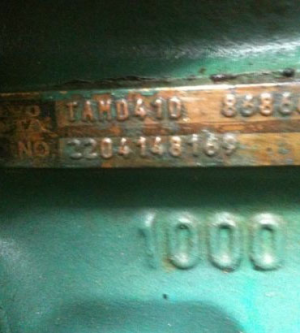
The Fairline Corniche 31 usually came with a pair of either 200HP or 165 Hp Volvo Penta 41 A/B the "D" was a derated commercial engine ????.
1686901360961.png
....and just to confuse things on both my VP 40 and 41 engines if the plastic overflow/expansion bottle had anything more than a inch or so of coolant in the bottom when when cold, it simply dumped anything over that into the bilge when the engine warmed up.
Did top up the bottle a couple of times assuming it should be full when cold only to find it all ejected .
On my latest boat with pair of Yanmars, when hot the bottle is virtually full when warm and virtually empty when cold.
If that expansion chamber has been brimmed when cold perhaps its just been over filled ?
 
Last edited:
Ok guys let’s just for a minute assume the engines actually fine , nothing wrong .Never was anything.Been chasing shadows all along .

The overheat is from excessive EGT s and overloading caused by excessive friction in the stern gear apparatus ( inc the g box ) .So we need to check the P bracket cut less bearing , gen alignment, etc and somehow the g box friction.

Thinking tiny engines relatively to the boat .You know barely enough torque to knock the skin off cold custard .
Why in your eyes is every overheat post on here caused by excessive EGT , the photo shows the boat not under load , as I’ve said it will blow water without the cap on . The 41 is a very simple engine and I’d bet the fault is a very simple one .
 
Why in your eyes is every overheat post on here caused by excessive EGT , the photo shows the boat not under load , as I’ve said it will blow water without the cap on . The 41 is a very simple engine and I’d bet the fault is a very simple one .
Not true .
” just for a minute “ .By the time you read post #25 that min was up .= back to “ basic 40/41 “ …..but he’s or his engineer(s) have gone round the houses with this “ simple “ engine .It ain’t clear if it’s at the dock or out under load either .He’s not said .

If it was that simple there would not be a post .Without being there standing over folks shoulders you can’t always assume incompetence, granted its looming up the mix somewhere by now .
I am working on an engineer competent enough to remove the head and do the injectors , rebuild the raw water pumps “ etc etc would have done the basic T stat check(s) and or replaced, although I it’s not actually been mentioned by the OP ……like a lot of other stuff btw .


With the cap
From what I understand reading what’s been said it the fact that the overheat motor blows out with the cap off shortly after start up, straight away .
While the good one doesn’t.Obviously with the good one when it’s warmed up without the cap on it can’t get pressure and will overflow . Nobodies suggested run it with the cap off .This is a observation early in the diagnosis.Useful comparing both .
 
Last edited:
Top