Volvo 2020MD Riser Exhaust

LittlestHobo

New Member
Joined
31 Oct 2022
Messages
11
Visit site
Hi All,

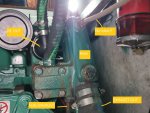
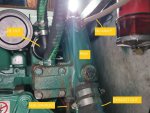
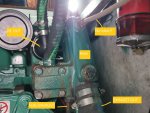
After some careful consideration and fantastic advice from you guys (here: Testing for block combustion leak) I've concluded I probably need to replace my exhaust elbow. All good and seems like a job I can do but... On closer inspection I have a riser exhaust elbow which costs 3 times more than the standard part to replace!

See picture showing the riser.
early-exhaust-smallest.jpg

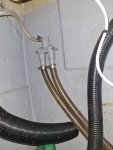
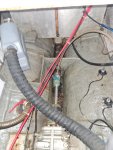
There is an anti siphon loop between the water pump and the HE inlet (see pic attached). And the rest of the exhaust is layed out in Picture 3 (attached)(Muffler etc).

So my question is can I replace the riser elbow with a standard one at a third of the price without causing issues)? And does anyone know what the beige pipe from the top of the riser is for?!

Many thanks for any thought ideas or advice!

Simon
 

Attachments

  • early-exhaust-small.jpg
    early-exhaust-small.jpg
    343.2 KB · Views: 26
  • anti-siphon.jpg
    anti-siphon.jpg
    340.5 KB · Views: 26
  • layout.jpg
    layout.jpg
    316.4 KB · Views: 26
  • early-exhaust.jpg
    early-exhaust.jpg
    343.2 KB · Views: 24
The simple answer is that when the original installation was done it was required so has anything changed?

But get the drawings and brochures and see if there is an aftermarket option available

Or bite the bullet
 
I had a water feed to the stern gland on Tiller Girl. Very effective. The feed teed of the water feed on it's way to the syphon breaker. Where is the feed to the stern gland? If that connects to the riser it wouldn't work very well. The water feed to the gland is to be pumped from the raw water (i.e. after the pump) rather than sucking (would it?) from the gland to the riser.

I agree with Scottie's point. Presumably the installation needed a high riser and it will still needs one. I had a 2030 but I regret I still don't have the installation drawings.
 
On your original posting you didnt say you had the high rise elbow and comments were based on the standard one which 90% of engines are fitted with,although the standard is prone to blocking no idea if this one is.I would just dismantle and check the exhaust and water passages are clear.
 
The simple answer is that when the original installation was done it was required so has anything changed?

But get the drawings and brochures and see if there is an aftermarket option available

Or bite the bullet

The original engine (not a penta but probably a Volvo MD2B as per the original 1978 model spec - Southerly 28) was replaced in 2002 or 2003 with the MD2020 D so.. I don't know if it was from necessity or just what they decided to buy or was available. To my rather naïve eye the engine doesn't look much lower than other boats. I did some measuring last night and the bottom end of the outlet HE pipe is on the water line.

I think the feed to the sterngland goes comes from the riser (there seems to be a pipe between them anyway). I'll take a closer look at the weekend.
 
On your original posting you didnt say you had the high rise elbow and comments were based on the standard one which 90% of engines are fitted with,although the standard is prone to blocking no idea if this one is.I would just dismantle and check the exhaust and water passages are clear.
[/QUOTE

I didn't know! - first boat, first problems.. I looked at a new standard elbow exhaust online and after about an hour of staring at my engine realised it was the riser version that was fitted.

She's being lifted out on Tuesday so I'll have a good rummage around next week and take the elbow off to check for blockages/ issues

Anyone have any tips for creating a rig to run the engine out of the water? I was thinking just a water source for the seawater inlet and then something to catch the exhaust out the back?

Thanks everyone for your help and suggestions.
 
I expect the high rise was fitted because there is limited fall from the injection point to the water trap which should be 30cm vertically - difficult to achieve in shallow draft boats. The water feed to the stern gland is also probably related to the shallow draft to ensure the tube and therefore bearings do not get starved of water. You can probably inspect the actual riser by removing the exhaust hose and possibly the plug just above it. However don't think this end would be prone to blockage as the exhaust and water will be quite cool and well mixed by then. In the standard elbow the coking up occurs close to the exit from the manifold where the hot water and gases mix. The equivalent location on yours is the square "box" where the water is injected.

To run out of the water you need a head of water feeding the raw water pump. If you have an above the waterline strainer, take the lid off close the seawater inlet and feed a hose from a bucket or from a tap, but with an extra tap at the end. That way you can control the amount of water to match what the pump requires. Do not feed water up the seawater inlet direct from the tap as this will quickly fill your engine!
 
Last edited:
I did some measuring last night and the bottom end of the outlet HE pipe is on the water line.

That is why the high rise exhaust was fitted and it would be unwise to replace it with other than a high rise exhaust. There may be stainless aftermarket versions available at less than the Volvo price.
 
Never seen an aftermarket high rise. Low volume and complicated construction probably puts the Chinese off!
 
Top