Viking's Odin anchor vs Ultra and the original Viking anchor

Greenland was an extreme challenge, uncharted water, steeply sloping bottom, rocks, no shelter. I was lucky to get through that summer unscathed.

But where is anchoring actually easy, at least in any kind of weather? Not around the UK coasts. Not in the Baltic. Not in the Adriatic, or the Aegean. Not if you're are venturing at all far. Maybe in the Caribbean it's easy sometimes, with all that sand. But that's pretty far from here. Around the UK, I can count challenge-free anchorages on one hand, probably -- Osborne Bay, St. Aubin's Bay on Jersey, Falmouth Harbour, Salcombe.

I guess there are weekend sailors who always get to pick their weather, and never anchor out of necessity. Who never anchor in the winter, or in an unfamiliar place, or in bad weather. Such sailors might have little need for extra holding power. I don't think that describes anyone in this thread, however.

Quote:

'I don't think that describes anyone in this thread, however.'

end quote

This thread has 7 contributors - I hardly think it representative of the membership of YBW, one of the 7 contributors anchors in all that sand in the Caribbean and when the chips were down (or the forecast questionable) wisely forsook the Scillies for a better anchorage. Many who sail in the Med secure their yachts to the marina hard for winter (and spend Xmas and New Year with family) - I'm not dismissive of their choices.

Sailing is meant to be a pleasure not. part of an entry requirement to the SAS. I'm unimpressed with the bravado of sitting out a forecast Storm when secure anchorage is only a half day sail away. If you seek, other, shelter you are then not subject to the random choices of your neighbours with their ground tackle.

So far I count two members, of YBW, who profess to have sailed high latitudes.

The rest of us are just (extended) weekend sailors. :). Your recommendations have, some, validity - but most of us sail for pleasure not thrills.

Jonathan
 
Hi Jonathan,

Forgive me I am confused. In the video, Panope (Steve) pretty much bags the Odin in all areas apart from the beginning test of a series of tests in his video using Odin and the other anchors.

This is interesting because I have purchased an Odin 50 at a not inconsiderable cost (though way less than the Ultra of course) - before Steve's video came out - (I am yet to use it as my boat is going through a major refit), and frankly - after watching the video I am strongly inclined to change from the Odin as my proposed main bower, to relegate it to the rank of a spare anchor only. Steve's video is not kind to the Odin at all.

So when you say something diametrically opposite as in "To me Odin is a revelation" - then I am rather interested how you and Steve can come to such different conclusions.

I am interested in your thoughts.
Cheers.

I'm not ignoring your post - I still have not seen the video, or seen only upto 'cobblestones'

In the introduction Steve pans the extension of the flange, welded to the shank. and its extension to the toe. This extension to the toe has no impact on setting ability, it effectively sits in a 'hole' or 'void' excavated by the fluke, (and does reinforce the toe).

Jonathan
 
I have refrained from contributing to this thread because it is impossible to persuade anyone with an entrenched view that the opposite might be the case. I (when I still had my boat) carry the recommended size Rocna for my boat, 15 kg. Over the many years that we have owned this anchor we have sat out many storms, up to 50 knots of wind as a maximum and a good few of around 40 knots. The anchor has always behaved as it should, admittedly mostly in relatively good holding seabeds.

My article on the subject can be read here Oversize anchors – necessary?
 

JRCO26


I thought to detail some of my tests. None of this new - its on Viking's Facebook page and somewhere in Sailing Anarchy

This is enough detail, but redacted - fancy word for edited, to introduce a different aspect and should provide meat for sceptics to put through the grinder.

I have an Odin 40, Viking 10, Spade S80, Mantus M1 15kg, I've extensively tested previously the Spade S80 and A80, Excel No 4 both steel and aluminium and a FX16 and Fx 23. I've been testing anchors now for well over 2 decades.

I used the Excels and Spades as primary anchors and in my fetish for low weight reduction retired the steel Excel and Spade and used the aluminium versions. I also downsized the rode from 8mm to 6mm.

All of the anchors except the Viking's are 15kg, approx, The Viking's are around 8kg in HT steel similar weight to the aluminium versions of the steel anchors..

Our yacht was a 38' Lightwave catamaran weight around 7t in full cruising mode, full tanks, enough food for 3 months (an equivalent mono is a 45'/50' AWB - I've measures them). On a beam reach we can average 10knts over 10 hours. Our cruising ground was SW Tasmania (we found the Whitsundays and The Reef too, too popular).

I test using a load cell and all the anchors can develop hold of around 2,000kg in good clean sand, except Mantus which struggles to break through 1,000kgs (its a design issue). I exclude the FX - they will achieve more than 2,000kg - are then enough for our cat- but I'm nurturing my load cell, which has a 2t limit though I do test the bulk of the anchors and none consistently breaks through 2,200kg.

I have other anchors, but much smaller, so a poor comparison, Rocna, Supreme, SARCA. I have a Knox - but it lacks market in Oz and I'm time short.

The fact that the anchors achieved 2,000kg hold is twice that of a 15kg Delta (or CQR) and puts the anchors, Viking and Odin (except) M1 in the Superhigh Holding Power (SHHP) category.

! don't rate the M1 but include it - as I've got it.

Roll bar anchors did not fit on our bow roller - which for us excluded 'good' anchors..... Like Viking.

I whinged to the owner of Viking Anchors - hence Odin. Odin fits perfectly on our bow roller.

Don't query why two similarly sized, almost identical anchors are numbered a No 10 and a No 40 - I have no idea.

I tested for setting and hold on the beach in shallow water using a 4WD and the load cell. Being easily accessible I was able to test Odin in a variety of seabed positions.

Odin sets a dream from any orientation that I could devise. Tension the rode such that the toe faces the tension and it rolls to the setting position, on its side and toe just engaged, increase tension and it begins to dive and re-oreintates to the shank being fore and aft as it dives (and moves forward). When set, depends on shear strength of the seabed - the 2 fins are just visible, left and right of the tension direction.

The setting performance is not much different to the other anchors - except Odin needs no crutches. ballast and roll bar.

To me pretty magic.

I don't waste my time testing in soupy mud - I've done enough research that in soupy mud the only anchors that will offer any reliability is a Fortress (and in support of Dockhead) the data shows you need a oversized Fortress to have reliability (we had a FX35?).

I've been testing anchors and I think I know my anchors (many would disagree. :)) but the weakness I found of many, most if not all, was that in an oscillating strongly gusting wind (when you are getting williwaws from left and right) - anchors would. reorientate with every opposing gust, the shear strength of the sand would collapse, too much movement, and the anchor would eventually capsize. Our chosen remedy was to anchor in a fork or inverted 'V'. Setting a fork is really not difficult, especially with 8kg anchors, but age is wearisome - and I was looking for a more comfortable and less challenging answer.

Odin provides the answer - in gusting winds in a clean sand seabed with the anchors set to 500kg tension the fins on the heel of Odin act like vertical flukes and they offer significant resistant to sideways movement. The Excel and Spade, my previous favourites, (also set to 500kg) would be induced to drag, Odin sat unperturbed.

I'm amused by Steve's use of cobblestones as a seabed. On the whole length of Australia's east coast from SW Cape to almost Cape York I know of one stony anchorage.

Weed is an issue. In Australia we are discouraged from disturbing the seagrass and we have enough anchorages with sand seabeds, silica sand in the south, coral sand in the north. - we don't need to anchor in weed.

Viking, the company, had issues with preparing the anchors but have installed a machine to round off the cut edges (which can almost be sharp) and are better able to accept galvanising. Steve made no mention, that I am aware of only having been able to see to the end of cobblestones, that the Odin toe is welded, because the steel is too difficult/hard to bend. You should be able to detect the 2 slits, following the fold lines, on your Odin 50. The slitting technique may have changed, it is possible to bend the toe with a decent press but involves extra labour (you need to leave a flap to allow the steel to be in the press and then cut the flap off later).

Multiple sets on the shoreline in shallow water and multiple sets in 5m depth, approx, to test bering resistance.

That's a sufficient and brief summary as to why I am impressed.


You suggest you are disappointed with the Odin performance - I suggest you keep an open mind as I don't think you will be disappointed. I find Odin a better anchor than the original Viking. Odin sets as well as Viking, has a similar hold to Viking, is more stable in veering winds and fits on bow rollers on which roll bar anchors do not fit. It has half the weight of the equivalent steel anchor. Its more stable and reliable in veering winds. I think the Odin 40 good for yachts 40'-50' or multis 35'- 43' Depends on radar arches, helm stations, dinghy on the deck etc. The steel is 'almost' bullet proof (not quite armour plating grade). At 1450 MPa is stronger than the steel used for many anchors, like the flukes 400MPa)) or the shanks which might be 800MPa (if you are lucky).

I don't think Odin has reached the end of its development, it can be improved but so far its minor.


Finally - I have never been comfortable with Steve's test protocols (I don't think I'm alone). His complete absence of hold data (has that improved?) is very questionable.

Jonathan
 
Last edited:
Greenland was an extreme challenge, uncharted water, steeply sloping bottom, rocks, no shelter. I was lucky to get through that summer unscathed.

But where is anchoring actually easy, at least in any kind of weather? Not around the UK coasts. Not in the Baltic. Not in the Adriatic, or the Aegean. Not if you're are venturing at all far. Maybe in the Caribbean it's easy sometimes, with all that sand. But that's pretty far from here. Around the UK, I can count challenge-free anchorages on one hand, probably -- Osborne Bay, St. Aubin's Bay on Jersey, Falmouth Harbour, Salcombe.

I guess there are weekend sailors who always get to pick their weather, and never anchor out of necessity. Who never anchor in the winter, or in an unfamiliar place, or in bad weather. Such sailors might have little need for extra holding power. I don't think that describes anyone in this thread, however.
If anchoring in the Caribbean "with all that sand" was so easy, why do we see so many boats struggling to set their anchors?
In my experience, lots of anchorages in the Caribbean are not your lovely sand. Many are broken coral sand and sea grass mixed together and quite variable even in the same anchorage. There are spots in certain anchorages where we know setting an anchor is harder than just a 100 metres away.

Most of the charter boats seem to be equipped with Delta anchors. These are the most common anchors we see dragging. Charter boats these days are not equipped with Bruce or CQR anchors or we might see a few more boats struggling to set anchors and dragging.

We know from various anchor tests over the years that NG anchors set far better than the old generation anchors ( if you have any anchor size that can be power set with the engine). We also know that weight for weight NG anchors have approximately twice the holding power when set.
I am not from the oversize the anchor brigade. I know many good cruising friends who have sailed around the world to some far off places living at anchor who share my view that an appropriately sized NG anchor is all you need. There is a relationship between what you can power set with your own engine and too big so you can't power set.
We have dragged the anchor numerous times during the setting process by the use of our 86hp engine. We will drop the anchor with 4:1 scope, fit the snubber and slowly build the revs to at least 3/4 throttle. This is usually sufficient to give a good set with only the top of the shank visible in most seabeds. We couldn't do this with a far bigger anchor as we would have insufficient HP from the engine to do so. A well set anchor ensure we sleep well.
Once set, it doesn't drag. Our experience is quite the opposite. The anchor keeps digging. Many times when we have come to lift the anchor, it is so deeply set the only way to break it out is to motor forward with the chain vertical. The large 1700w windlass just stalls.
 
Last edited:
Our yacht was a 38' Lightwave catamaran weight around 7t in full cruising mode, full tanks, enough food for 3 months (an equivalent mono is a 45'/50' AWB - I've measures them).
I have a question, and it's got nothing to do with your experience ...

have I understood this right .... 7t ? .... either way if that's metric or imperial, that seems very light for a 45'/50' AWB ..... the unladen weight of my 44ft AWB ist 10,400kg and with all my crap on board, plus crew, it is closer to 12,500-13,000 kg in "floating holiday home with sea view mode" .... I could go with it being equivalent in windage at anchor ... but definately not on weight.

Is weight equivalent what you meant? and if so, how did you get 7t?
 
If you take the bigger is better approach, to the nth degree, you would have a massive anchor that would be deployed and sat on the bottom. If you have insufficient engine horsepower to set it, then it will be lying on the bottom, on its side not set. Remember we are talking nth degree. A ridiculously over sized anchor. In benign conditions, the boat will be held by this lump of metal resting on the seabed ......

I swore I would never get involved in an Anchor thread, but here I am :ROFLMAO: :ROFLMAO: :ROFLMAO:

This entire post is absolutely spot on, and also reflects my experience since the 80s in numerous boats with numerous anchors in numerous parts of the world, also the experience of my sailing friends ... back in the late 70s/ early 80s (in Scotland) there was a tendency for my dad and his friends to go one size up .... but those were not NG anchors ... they were primarily Bruce, CQRs, Danforth, and the boats were all much smaller, so even one size up still wasn't that big, or that much of a difference .... the average family cruiser back then was 20-30ft, without powered windlasses or any of the cruising cr@p we cart around today.

That mindset has persisted, but I see no reason to second guess the manufacturers tables. They design the things, and it would not be in their interests to sell an undersized anchor for numerous (obvious) reasons. I only ever go next size up if my boat lies right at the top of the recommended size, or when the anchor size recommendations overlap and I'm well into the overlap. The important point IMO, as @geem says, is to be able to set the anchor properly - and the bigger the anchor, the more HP you need to sink it up to its shank. When I have set properly, I have never had my anchor "let go", but they have ploughed into the seabed in strong winds making them difficult to recover ... and if more holding power is needed, 2nd anchor with appropriate ground tackle is the answer IMO - also properly set.

... now you can roast me 😁
 
I have refrained from contributing to this thread because it is impossible to persuade anyone with an entrenched view that the opposite might be the case. I (when I still had my boat) carry the recommended size Rocna for my boat, 15 kg. Over the many years that we have owned this anchor we have sat out many storms, up to 50 knots of wind as a maximum and a good few of around 40 knots. The anchor has always behaved as it should, admittedly mostly in relatively good holding seabeds.

My article on the subject can be read here Oversize anchors – necessary?
I think no one disagrees that a modern anchor, well set in a good seabed, behind good shelter, will hold your boat in very bad weather.

The reason for many sailors not to settle for the minimum satisfactory anchor size -- which is what the makers' recommendations amount to -- is mathematical. You can see this in Fraysse's calculations (see: Tuning an Anchor Rode). Not only the forces, but the factors affecting holding, change in non-linear ways, which means an adequate holding force can become inadequate very quickly. For example, the holding coefficients between "poor" and "excellent" seabeds differ by 7x in Alain's calculations. Even between "poor" and "good" the difference in 4.5x.

Likewise, holding power disappears in a non-linear way as scope is reduced below about 5:1, falling off steeply. Catenary of chain, -- and the heavier the chain and deeper the water, the more this effect -- will offset this effect to some extent -- until it doesn't, when the forces reach what is required to pull the chain nearly straight.

The larger the anchor, the more room you have to maneuver within these parameters. A 50% larger anchor will give you roughly the same holding force at 3:1, which you would otherwise get only at 5:1. Or allow you to get the same holding force in a "good" bottom which you would otherwise get only in an "excellent" bottom. This can be EXTREMELY valuable, and not just for high latitude sailors. Simply put, a larger anchor INCREASES YOUR OPTIONS, and REDUCES THE RISK that you will find yourself in a position where your anchor doesn't hold. A larger anchor also gives you options to anchor in tighter spaces, by allowing you to use less scope.

HOW valuable this is, depends on your use case. If you're just a "extended weekend" kind of sailor, as Jonathan was saying, you might not need much of this. If you sail in predictable areas where you know you will always find good shelter and bottom conditions, you won't care so much. If you anchor only occasionally, so always have a choice where and whether to anchor, ditto. But for many other use cases, a larger anchor is extremely valuable.

Dashew wrote: "Anchor size . . . has a big effect on the tactics you use and just how tight of a space you can deal with.
The bigger your hook (relative to your boat) the quicker it will grab the bottom, and the better it will work in adverse condi
tions. Having an oversized anchor substantially reduces the chances of dragging. If you are sure the anchor is going to bite quickly, without drifting, you can anchor in much, much tighter quarters." https://setsail.com/PracticalSeamanship.pdf

Dashew's classic statement on anchor sizing is this:

"You should carry the largest possible anchor and use it for everyday anchorages. . . If you have to have to choose between heavy chain and a heavier anchor, always put the weight into the anchor. Since there are no good scientific rules for choosing anchor sizes, we suggest the following: Look at he average size of anchor in use for boats of your type, and double the size. After doing this, if you think you can swing it, add another 50%." Offshore Cruising Encylopedia, pp. 43 ff.

Another factor in this is that larger anchors work better, particularly what concerns setting, out of proportion to their size, even if their ultimate holding force is not out of proportion (according to tests). John Harries of MorgansCloud talks about this:

"Holding Is Not Linear. I’m not sure why, but out there in the real world it does seem that the force that an anchor will withstand before dragging does not scale in a linear fashion with size. So the bottom line is that bigger is not just better, it’s a lot better.

"Heavier Anchors Set Better. Of late there has been a lot of chatter stating that anchor weight does not matter. That’s true, but only once the anchor is set (when fluke area and shape govern ultimate holding). When we are actually trying to get the anchor to set, weight matters big time.

"The Hundred-Pound Factor. If your boat is big enough, and our anchor sizing rules above bring you close to 100 pounds, it is well worth considering buying a best bower over that threshold, since you will get an even bigger jump in setting effectiveness. We experienced voyagers have known about this for years without knowing why.

"And the final reason for having a really big anchor? Look around most any place where long distance voyagers hang out and you will see that anchor size is proportional to the number of offshore voyaging miles the skipper of the boat has done. That should convince you; never mind all the theory.

Specifying Primary Anchor Size

Even in benign conditions, the option of anchoring on short scope can be extremely useful. One of many reasons to sometimes anchor on short scope is to find flat bottom at the deepest part of a cove to put your anchor into. In the Baltic, where I cruised for 10 years, this is the only way to find a feasible anchorage in many areas. A tight cove can give you better shelter, too, but you may not have enough swinging room in deep water on normal scope, so you may not be able to put out enough chain to achieve a desirable scope. It can be a huge advantage to be able to lay your anchor into the middle of the cove at the deepest spot, where silt rolls downhill and gives your anchor something to dig into, in an otherwise rocky, steep bottom as is typical in the Northern Baltic, and a number of other places in the world.

Dashew FREQUENTLY anchors on very short scope even when he doesn't have to, because it gives him more control over the position of the boat, and reduces the risk of snagging something on the bottom with the chain as the boat swings. He CAN because he uses very large anchors, not two sizes oversized like I do, but double or triple.

He wrote: "The primary anchor on Wind Horse is a 240-lb. Rocna anchor . . . . The boat carries four anchors, and it seemed that the 240-lb. anchor is way more than the typical 100-lb. anchor found on a vessel with an 86,000-lb. displacement. I asked Steve how big is big enough. 'When people in the marina start laughing,' he said, 'You’re getting close.'” https://setsail.com/wp-content/uploads/2012/01/PassageMaker-NovDec05.pdf

Bigger anchors are a tradeoff, of course, not just cost, but handling, and different people on different boats have different use cases. So there's no one right answer for everyone. But it's not "second guessing" the maker, to oversize your anchor, when it's possible, and when your use case makes it desirable. The maker's size recommendations are intended to give a reasonable amount of holding power for reasonable conditions in reasonable bottoms and with reasonable scope, and should be considered a MINIMUM. There are very, very good reasons to go up from there, for many sailors, probably most.
 
I think no one disagrees that a modern anchor, well set in a good seabed, behind good shelter, will hold your boat in very bad weather.

The reason for many sailors not to settle for the minimum satisfactory anchor size -- which is what the makers' recommendations amount to -- is mathematical. You can see this in Fraysse's calculations (see: Tuning an Anchor Rode). Not only the forces, but the factors affecting holding, change in non-linear ways, which means an adequate holding force can become inadequate very quickly. For example, the holding coefficients between "poor" and "excellent" seabeds differ by 7x in Alain's calculations. Even between "poor" and "good" the difference in 4.5x.

Likewise, holding power disappears in a non-linear way as scope is reduced below about 5:1, falling off steeply. Catenary of chain, -- and the heavier the chain and deeper the water, the more this effect -- will offset this effect to some extent -- until it doesn't, when the forces reach what is required to pull the chain nearly straight.

The larger the anchor, the more room you have to maneuver within these parameters. A 50% larger anchor will give you roughly the same holding force at 3:1, which you would otherwise get only at 5:1. Or allow you to get the same holding force in a "good" bottom which you would otherwise get only in an "excellent" bottom. This can be EXTREMELY valuable, and not just for high latitude sailors. Simply put, a larger anchor INCREASES YOUR OPTIONS, and REDUCES THE RISK that you will find yourself in a position where your anchor doesn't hold. A larger anchor also gives you options to anchor in tighter spaces, by allowing you to use less scope.

HOW valuable this is, depends on your use case. If you're just a "extended weekend" kind of sailor, as Jonathan was saying, you might not need much of this. If you sail in predictable areas where you know you will always find good shelter and bottom conditions, you won't care so much. If you anchor only occasionally, so always have a choice where and whether to anchor, ditto. But for many other use cases, a larger anchor is extremely valuable.

Dashew wrote: "Anchor size . . . has a big effect on the tactics you use and just how tight of a space you can deal with.
The bigger your hook (relative to your boat) the quicker it will grab the bottom, and the better it will work in adverse condi
tions. Having an oversized anchor substantially reduces the chances of dragging. If you are sure the anchor is going to bite quickly, without drifting, you can anchor in much, much tighter quarters." https://setsail.com/PracticalSeamanship.pdf

Dashew's classic statement on anchor sizing is this:

"You should carry the largest possible anchor and use it for everyday anchorages. . . If you have to have to choose between heavy chain and a heavier anchor, always put the weight into the anchor. Since there are no good scientific rules for choosing anchor sizes, we suggest the following: Look at he average size of anchor in use for boats of your type, and double the size. After doing this, if you think you can swing it, add another 50%." Offshore Cruising Encylopedia, pp. 43 ff.

Another factor in this is that larger anchors work better, particularly what concerns setting, out of proportion to their size, even if their ultimate holding force is not out of proportion (according to tests). John Harries of MorgansCloud talks about this:

"Holding Is Not Linear. I’m not sure why, but out there in the real world it does seem that the force that an anchor will withstand before dragging does not scale in a linear fashion with size. So the bottom line is that bigger is not just better, it’s a lot better.

"Heavier Anchors Set Better. Of late there has been a lot of chatter stating that anchor weight does not matter. That’s true, but only once the anchor is set (when fluke area and shape govern ultimate holding). When we are actually trying to get the anchor to set, weight matters big time.

"The Hundred-Pound Factor. If your boat is big enough, and our anchor sizing rules above bring you close to 100 pounds, it is well worth considering buying a best bower over that threshold, since you will get an even bigger jump in setting effectiveness. We experienced voyagers have known about this for years without knowing why.

"And the final reason for having a really big anchor? Look around most any place where long distance voyagers hang out and you will see that anchor size is proportional to the number of offshore voyaging miles the skipper of the boat has done. That should convince you; never mind all the theory.

Specifying Primary Anchor Size

Even in benign conditions, the option of anchoring on short scope can be extremely useful. One of many reasons to sometimes anchor on short scope is to find flat bottom at the deepest part of a cove to put your anchor into. In the Baltic, where I cruised for 10 years, this is the only way to find a feasible anchorage in many areas. A tight cove can give you better shelter, too, but you may not have enough swinging room in deep water on normal scope, so you may not be able to put out enough chain to achieve a desirable scope. It can be a huge advantage to be able to lay your anchor into the middle of the cove at the deepest spot, where silt rolls downhill and gives your anchor something to dig into, in an otherwise rocky, steep bottom as is typical in the Northern Baltic, and a number of other places in the world.

Dashew FREQUENTLY anchors on very short scope even when he doesn't have to, because it gives him more control over the position of the boat, and reduces the risk of snagging something on the bottom with the chain as the boat swings. He CAN because he uses very large anchors, not two sizes oversized like I do, but double or triple.

He wrote: "The primary anchor on Wind Horse is a 240-lb. Rocna anchor . . . . The boat carries four anchors, and it seemed that the 240-lb. anchor is way more than the typical 100-lb. anchor found on a vessel with an 86,000-lb. displacement. I asked Steve how big is big enough. 'When people in the marina start laughing,' he said, 'You’re getting close.'” https://setsail.com/wp-content/uploads/2012/01/PassageMaker-NovDec05.pdf

Bigger anchors are a tradeoff, of course, not just cost, but handling, and different people on different boats have different use cases. So there's no one right answer for everyone. But it's not "second guessing" the maker, to oversize your anchor, when it's possible, and when your use case makes it desirable. The maker's size recommendations are intended to give a reasonable amount of holding power for reasonable conditions in reasonable bottoms and with reasonable scope, and should be considered a MINIMUM. There are very, very good reasons to go up from there, for many sailors, probably most.
We routinely anchor on 3:1 in crowded anchorages.
We end to ended our chain on one occasion as it was rusting at the anchor end. We set what we thought was sufficient scope in an anchorage where it blew well over 30kts for several days. When we then moved to the boatyard to lift out for the summer, we realised that we had only had 2.5:1 scope out.
It didn't drag.
Suggesting that manufacturers selection tables are the minimum is unfounded. They are what they believe is necessary for a given size/weight of boat.
I am sure they would love to sell far bigger and more expensive anchors but they don't suggest that
 
I think no one disagrees that a modern anchor, well set in a good seabed, behind good shelter, will hold your boat in very bad weather.

The reason for many sailors not to settle for the minimum satisfactory anchor size -- which is what the makers' recommendations amount to -- is mathematical. You can see this in Fraysse's calculations (see: Tuning an Anchor Rode). Not only the forces, but the factors affecting holding, change in non-linear ways, which means an adequate holding force can become inadequate very quickly. For example, the holding coefficients between "poor" and "excellent" seabeds differ by 7x in Alain's calculations. Even between "poor" and "good" the difference in 4.5x.

Likewise, holding power disappears in a non-linear way as scope is reduced below about 5:1, falling off steeply. Catenary of chain, -- and the heavier the chain and deeper the water, the more this effect -- will offset this effect to some extent -- until it doesn't, when the forces reach what is required to pull the chain nearly straight.

The larger the anchor, the more room you have to maneuver within these parameters. A 50% larger anchor will give you roughly the same holding force at 3:1, which you would otherwise get only at 5:1. Or allow you to get the same holding force in a "good" bottom which you would otherwise get only in an "excellent" bottom. This can be EXTREMELY valuable, and not just for high latitude sailors. Simply put, a larger anchor INCREASES YOUR OPTIONS, and REDUCES THE RISK that you will find yourself in a position where your anchor doesn't hold. A larger anchor also gives you options to anchor in tighter spaces, by allowing you to use less scope.

HOW valuable this is, depends on your use case. If you're just a "extended weekend" kind of sailor, as Jonathan was saying, you might not need much of this. If you sail in predictable areas where you know you will always find good shelter and bottom conditions, you won't care so much. If you anchor only occasionally, so always have a choice where and whether to anchor, ditto. But for many other use cases, a larger anchor is extremely valuable.

Dashew wrote: "Anchor size . . . has a big effect on the tactics you use and just how tight of a space you can deal with.
The bigger your hook (relative to your boat) the quicker it will grab the bottom, and the better it will work in adverse condi
tions. Having an oversized anchor substantially reduces the chances of dragging. If you are sure the anchor is going to bite quickly, without drifting, you can anchor in much, much tighter quarters." https://setsail.com/PracticalSeamanship.pdf

Dashew's classic statement on anchor sizing is this:

"You should carry the largest possible anchor and use it for everyday anchorages. . . If you have to have to choose between heavy chain and a heavier anchor, always put the weight into the anchor. Since there are no good scientific rules for choosing anchor sizes, we suggest the following: Look at he average size of anchor in use for boats of your type, and double the size. After doing this, if you think you can swing it, add another 50%." Offshore Cruising Encylopedia, pp. 43 ff.

Another factor in this is that larger anchors work better, particularly what concerns setting, out of proportion to their size, even if their ultimate holding force is not out of proportion (according to tests). John Harries of MorgansCloud talks about this:

"Holding Is Not Linear. I’m not sure why, but out there in the real world it does seem that the force that an anchor will withstand before dragging does not scale in a linear fashion with size. So the bottom line is that bigger is not just better, it’s a lot better.

"Heavier Anchors Set Better. Of late there has been a lot of chatter stating that anchor weight does not matter. That’s true, but only once the anchor is set (when fluke area and shape govern ultimate holding). When we are actually trying to get the anchor to set, weight matters big time.

"The Hundred-Pound Factor. If your boat is big enough, and our anchor sizing rules above bring you close to 100 pounds, it is well worth considering buying a best bower over that threshold, since you will get an even bigger jump in setting effectiveness. We experienced voyagers have known about this for years without knowing why.

"And the final reason for having a really big anchor? Look around most any place where long distance voyagers hang out and you will see that anchor size is proportional to the number of offshore voyaging miles the skipper of the boat has done. That should convince you; never mind all the theory.

Specifying Primary Anchor Size

Even in benign conditions, the option of anchoring on short scope can be extremely useful. One of many reasons to sometimes anchor on short scope is to find flat bottom at the deepest part of a cove to put your anchor into. In the Baltic, where I cruised for 10 years, this is the only way to find a feasible anchorage in many areas. A tight cove can give you better shelter, too, but you may not have enough swinging room in deep water on normal scope, so you may not be able to put out enough chain to achieve a desirable scope. It can be a huge advantage to be able to lay your anchor into the middle of the cove at the deepest spot, where silt rolls downhill and gives your anchor something to dig into, in an otherwise rocky, steep bottom as is typical in the Northern Baltic, and a number of other places in the world.

Dashew FREQUENTLY anchors on very short scope even when he doesn't have to, because it gives him more control over the position of the boat, and reduces the risk of snagging something on the bottom with the chain as the boat swings. He CAN because he uses very large anchors, not two sizes oversized like I do, but double or triple.

He wrote: "The primary anchor on Wind Horse is a 240-lb. Rocna anchor . . . . The boat carries four anchors, and it seemed that the 240-lb. anchor is way more than the typical 100-lb. anchor found on a vessel with an 86,000-lb. displacement. I asked Steve how big is big enough. 'When people in the marina start laughing,' he said, 'You’re getting close.'” https://setsail.com/wp-content/uploads/2012/01/PassageMaker-NovDec05.pdf

Bigger anchors are a tradeoff, of course, not just cost, but handling, and different people on different boats have different use cases. So there's no one right answer for everyone. But it's not "second guessing" the maker, to oversize your anchor, when it's possible, and when your use case makes it desirable. The maker's size recommendations are intended to give a reasonable amount of holding power for reasonable conditions in reasonable bottoms and with reasonable scope, and should be considered a MINIMUM. There are very, very good reasons to go up from there, for many sailors, probably most.
Rocna say that their sizing is based on wind speed of 50 knots. My experience, based upon the information shown in my website page, is that the force generated at about that wind speed does not appreciably set my anchor more deeply. In the event that the wind speed was even greater there is plenty of evidence that the anchor would penetrate further.

Having all the disadvantages of a heavier anchor simply does not pay off - the cross section of the boat is not enough to generate enough force, at least in any wind speed that I am likely to see.

Dashew's advice is only his opinion. Many others do not agree.
 
I think no one disagrees that a modern anchor, well set in a good seabed, behind good shelter, will hold your boat in very bad weather.

The reason for many sailors not to settle for the minimum satisfactory anchor size -- which is what the makers' recommendations amount to -- is mathematical. You can see this in Fraysse's calculations (see: Tuning an Anchor Rode). Not only the forces, but the factors affecting holding, change in non-linear ways, which means an adequate holding force can become inadequate very quickly. For example, the holding coefficients between "poor" and "excellent" seabeds differ by 7x in Alain's calculations. Even between "poor" and "good" the difference in 4.5x.

Likewise, holding power disappears in a non-linear way as scope is reduced below about 5:1, falling off steeply. Catenary of chain, -- and the heavier the chain and deeper the water, the more this effect -- will offset this effect to some extent -- until it doesn't, when the forces reach what is required to pull the chain nearly straight.

The larger the anchor, the more room you have to maneuver within these parameters. A 50% larger anchor will give you roughly the same holding force at 3:1, which you would otherwise get only at 5:1. Or allow you to get the same holding force in a "good" bottom which you would otherwise get only in an "excellent" bottom. This can be EXTREMELY valuable, and not just for high latitude sailors. Simply put, a larger anchor INCREASES YOUR OPTIONS, and REDUCES THE RISK that you will find yourself in a position where your anchor doesn't hold. A larger anchor also gives you options to anchor in tighter spaces, by allowing you to use less scope.

HOW valuable this is, depends on your use case. If you're just a "extended weekend" kind of sailor, as Jonathan was saying, you might not need much of this. If you sail in predictable areas where you know you will always find good shelter and bottom conditions, you won't care so much. If you anchor only occasionally, so always have a choice where and whether to anchor, ditto. But for many other use cases, a larger anchor is extremely valuable.

Dashew wrote: "Anchor size . . . has a big effect on the tactics you use and just how tight of a space you can deal with.
The bigger your hook (relative to your boat) the quicker it will grab the bottom, and the better it will work in adverse condi
tions. Having an oversized anchor substantially reduces the chances of dragging. If you are sure the anchor is going to bite quickly, without drifting, you can anchor in much, much tighter quarters." https://setsail.com/PracticalSeamanship.pdf

Dashew's classic statement on anchor sizing is this:

"You should carry the largest possible anchor and use it for everyday anchorages. . . If you have to have to choose between heavy chain and a heavier anchor, always put the weight into the anchor. Since there are no good scientific rules for choosing anchor sizes, we suggest the following: Look at he average size of anchor in use for boats of your type, and double the size. After doing this, if you think you can swing it, add another 50%." Offshore Cruising Encylopedia, pp. 43 ff.

Another factor in this is that larger anchors work better, particularly what concerns setting, out of proportion to their size, even if their ultimate holding force is not out of proportion (according to tests). John Harries of MorgansCloud talks about this:

"Holding Is Not Linear. I’m not sure why, but out there in the real world it does seem that the force that an anchor will withstand before dragging does not scale in a linear fashion with size. So the bottom line is that bigger is not just better, it’s a lot better.

"Heavier Anchors Set Better. Of late there has been a lot of chatter stating that anchor weight does not matter. That’s true, but only once the anchor is set (when fluke area and shape govern ultimate holding). When we are actually trying to get the anchor to set, weight matters big time.

"The Hundred-Pound Factor. If your boat is big enough, and our anchor sizing rules above bring you close to 100 pounds, it is well worth considering buying a best bower over that threshold, since you will get an even bigger jump in setting effectiveness. We experienced voyagers have known about this for years without knowing why.

"And the final reason for having a really big anchor? Look around most any place where long distance voyagers hang out and you will see that anchor size is proportional to the number of offshore voyaging miles the skipper of the boat has done. That should convince you; never mind all the theory.

Specifying Primary Anchor Size

Even in benign conditions, the option of anchoring on short scope can be extremely useful. One of many reasons to sometimes anchor on short scope is to find flat bottom at the deepest part of a cove to put your anchor into. In the Baltic, where I cruised for 10 years, this is the only way to find a feasible anchorage in many areas. A tight cove can give you better shelter, too, but you may not have enough swinging room in deep water on normal scope, so you may not be able to put out enough chain to achieve a desirable scope. It can be a huge advantage to be able to lay your anchor into the middle of the cove at the deepest spot, where silt rolls downhill and gives your anchor something to dig into, in an otherwise rocky, steep bottom as is typical in the Northern Baltic, and a number of other places in the world.

Dashew FREQUENTLY anchors on very short scope even when he doesn't have to, because it gives him more control over the position of the boat, and reduces the risk of snagging something on the bottom with the chain as the boat swings. He CAN because he uses very large anchors, not two sizes oversized like I do, but double or triple.

He wrote: "The primary anchor on Wind Horse is a 240-lb. Rocna anchor . . . . The boat carries four anchors, and it seemed that the 240-lb. anchor is way more than the typical 100-lb. anchor found on a vessel with an 86,000-lb. displacement. I asked Steve how big is big enough. 'When people in the marina start laughing,' he said, 'You’re getting close.'” https://setsail.com/wp-content/uploads/2012/01/PassageMaker-NovDec05.pdf

Bigger anchors are a tradeoff, of course, not just cost, but handling, and different people on different boats have different use cases. So there's no one right answer for everyone. But it's not "second guessing" the maker, to oversize your anchor, when it's possible, and when your use case makes it desirable. The maker's size recommendations are intended to give a reasonable amount of holding power for reasonable conditions in reasonable bottoms and with reasonable scope, and should be considered a MINIMUM. There are very, very good reasons to go up from there, for many sailors, probably most.
Dashew had a total of 300hp of twins engines on that boat. I suspect he can power set a pretty large anchor.

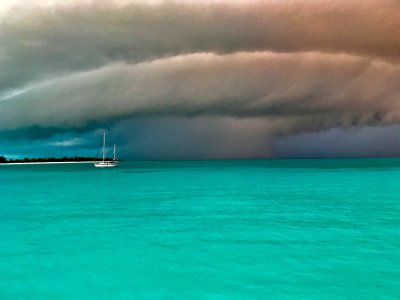
Here is a photo of a super cell that hit us in the Bahamas 7 years ago. We had threaded our way into a reef infested anchorage in company with friends who knew the area well. What we didn't expect in the benign conditions, was a howling wind, heavy rain and a 2m swell to developed very quickly. Our bow was being plunged under the waves and the force on our snubber was extreme. Our 18.5 tonne boat didn't drag all though we were anchored on a measly 30kg Spade.
The photo was taken just before dark by our friends anchored a short distance away. Just before all hell broke looseIMG_6488.JPEG
 
Dashew had a total of 300hp of twins engines on that boat. I suspect he can power set a pretty large anchor.

Here is a photo of a super cell that hit us in the Bahamas 7 years ago. We had threaded our way into a reef infested anchorage in company with friends who knew the area well. What we didn't expect in the benign conditions, was a howling wind, heavy rain and a 2m swell to developed very quickly. Our bow was being plunged under the waves and the force on our snubber was extreme. Our 18.5 tonne boat didn't drag all though we were anchored on a measly 30kg Spade.
The photo was taken just before dark by our friends anchored a short distance away. Just before all hell broke looseView attachment 205020
Fantastic photo!
 
I think I'm probably correct in saying that the size recommendations for anchors are based on a maximum of 50 knots. I know it is for Rocna, others may be different. We have in the past been subjected to prolonged (days) when the wind seldom dropped below 60 knots. We've only had one occasion where it stayed above 70 knots for any length of time. These winds were in the Outer Hebrides, where it does tend to be windy.
If we take the 50 knot recommendations as gospel, how many sizes up should I go to be/feel safe in these stronger wind speeds? There are lots of good anchorages where there is complete shelter from any sea, but it's not so easy to escape from the force of the wind.
 
Rocna say that their sizing is based on wind speed of 50 knots. My experience, based upon the information shown in my website page, is that the force generated at about that wind speed does not appreciably set my anchor more deeply. In the event that the wind speed was even greater there is plenty of evidence that the anchor would penetrate further.

Having all the disadvantages of a heavier anchor simply does not pay off - the cross section of the boat is not enough to generate enough force, at least in any wind speed that I am likely to see.

Dashew's advice is only his opinion. Many others do not agree.
Wind speed is not the only parameter you need to consider, to determine whether your anchor will hold you or not.

You also have to consider scope, and bottom quality. The holding with the same anchor and same wind speed will vary dramatically with different scope and different bottom types. I gave the math above, which comes from Fraysse's work. An anchor which is good at 50 knots in one spot, may be woefully inadequate in another.

I have a few years experience with a Rocna anchor and I believe that what you say about 50 knots winds is correct -- but this assumes you've got good scope, and a good holding bottom. What happens if you need to anchor in those conditions with less scope? And/or less than ideal holding bottom?

The purpose of a larger anchor is to give you more options in such cases. If you don't need those options, then of course there is little reason for you to have a bigger anchor. But many of us do need those options.

Larger anchor also gives you greater margin of error. You can't always be sure of the quality of the bottom if you haven't dived on it, or anchored in it before. The larger reserve of holding power you have, the less risk of an unpleasant surprise when the wind blows up in the middle of the night.

You also can't always be sure about the wind forecast. No forecast, for example, will tell you about one of those katabatic squalls which happen in some places, which can produce 70-80 knots of wind for short periods. I've had my own horrible experience with these. Again, the larger reserve of holding power you have, the better insurance you have that something unexpected is not going to disanchor you. I'm sure you've seen the photos of Moitessier's boat driven onto the shore at Cabo San Lucas and wrecked, because his anchor didn't hold.

There's simply no such thing as too much holding power. There is, of course, such a thing as an anchor too bulky or heavy to handle or fit, so naturally there are limits, and naturally it's a tradeoff. Every sailor will have to decide for himself and for his own boat. Naturally.
 
Dashew had a total of 300hp of twins engines on that boat. I suspect he can power set a pretty large anchor.

Here is a photo of a super cell that hit us in the Bahamas 7 years ago. We had threaded our way into a reef infested anchorage in company with friends who knew the area well. What we didn't expect in the benign conditions, was a howling wind, heavy rain and a 2m swell to developed very quickly. Our bow was being plunged under the waves and the force on our snubber was extreme. Our 18.5 tonne boat didn't drag all though we were anchored on a measly 30kg Spade.
The photo was taken just before dark by our friends anchored a short distance away. Just before all hell broke loose
As Vyv said, that is an amazing photograph. I would have a big print of that on my wall, if I were you.

The Bahamas is mostly fine white sand with fantastic holding. I think you could anchor with a fishhook there. I have happy memories sailing there with my father back in the last century. One reason was it was the only place we could sleep soundly with the awful CQR we had back then! The lingering trauma of 10 years with a CQR is one reason why I'm a little obsessive about anchoring :D

What concerns power setting large anchors -- it's an interesting question at what point an anchor becomes too large to set properly. I don't know the answer to it, but can say that I've never come close to such a problem in my own experience. Within the range of anchor sizes I have experience with (up to 200 pounds on a 67 foot boat) larger anchors were always easier to set. But there must be a limit somewhere.

I've used up to 75kg on my boat and had no problem setting it. At that size, however, it was awkward to handle with my gear, so I subsequently reduced.
 
As Vyv said, that is an amazing photograph. I would have a big print of that on my wall, if I were you.

The Bahamas is mostly fine white sand with fantastic holding. I think you could anchor with a fishhook there. I have happy memories sailing there with my father back in the last century. One reason was it was the only place we could sleep soundly with the awful CQR we had back then! The lingering trauma of 10 years with a CQR is one reason why I'm a little obsessive about anchoring :D

What concerns power setting large anchors -- it's an interesting question at what point an anchor becomes too large to set properly. I don't know the answer to it, but can say that I've never come close to such a problem in my own experience. Within the range of anchor sizes I have experience with (up to 200 pounds on a 67 foot boat) larger anchors were always easier to set. But there must be a limit somewhere.

I've used up to 75kg on my boat and had no problem setting it. At that size, however, it was awkward to handle with my gear, so I subsequently reduced.
I think in thin mud, a larger fluke anchor is always going to be better. Its not weight that really matters in these conditions, it's just area of fluke. A great example is the Fortress anchors in such conditions.
When the seabed is hard packed sand mixed with small rocks and dead coral pieces, it can be a totally different story. The only way to penetrate such a rock hard seabed is with something thin and pointy. Otherwise the force needed is massive. This is where a large anchor would be a hindrance not a benefit.
There is no question that a large anchor, well set will have higher holding power than a smaller one of the same design. The issue is achieving that set reliably in difficult seabeds.
I doubt upsizing by one size would cause much of an issue. I think most people will look at a selection chart and if they feel they are are the limit of the size or weight criteria, will likely choose the larger anchor. That's where we sit with the Spade selection for our boat. We are well in on the length but on the limit of weight for the smaller size anchor. Being a ketch as well, we have higher windage so we naturally migrate to the larger anchor on the chart. It still only suggests 30kg.
I think in the future I would like to test a Viking 20kg in my boat. I suspect the very large fluke area and thin HT steel plate would hit the sweet spot between fluke size and ease of pentration in hard substrates. All at very moderate weight
 
My attitude on testing anchors is that if the anchor does not meet the SHHP criteria, so a hold of about 2,000kg for a 15kg steel anchor (or similar size, fluke size, to a 15kg steel anchor) - then don't expect anyone to buy the anchor. Every anchor test in the last 40 years has been based on HOLD. Without hold data you could have a lemon. Steve Godwin did not measure hold - so I'm sceptical of his a conclusions. But the buying public worships his spread sheets, encouraged by me :( as I regularly post them. Add SHHP to Steve's spreadsheets, weighting hold highly. and you have a much better summary.

Once you have reached SHHP then the conclusion I draw is that a long list of anchors meet SHHP and at the end of the day they are all 'good' anchors. Some anchors stand out for some characteristic or other and some might have some negative aspects (like a roll bar causing clogging) - but experience shows any downsides do not deter people from buying and using, think Rocna and Supreme. The reality seems to be - clogging was overemphasised.

Jonathan
 
I have a question, and it's got nothing to do with your experience ...

have I understood this right .... 7t ? .... either way if that's metric or imperial, that seems very light for a 45'/50' AWB ..... the unladen weight of my 44ft AWB ist 10,400kg and with all my crap on board, plus crew, it is closer to 12,500-13,000 kg in "floating holiday home with sea view mode" .... I could go with it being equivalent in windage at anchor ... but definately not on weight.

Is weight equivalent what you meant? and if so, how did you get 7t?
We are, were, a 7t multihull which had the windage of a 45'/50' AWB.

7t is quite heavy for a 38' multihull, you can have lighter - but you sacrifice, water, fuel, desal unit a deep freeze, crayfish pot.......

Jonathan
 
So what is the disadvantage of a bigger anchor? If you anchor in mild conditions will it hold less well than a small anchor? I don’t beloeve it will. It may not fully bury, but so what. It can hold with just the tip buried. Clearly in extreme conditions or in an inferior soft substrate it will hold better, no-one surely disputes that? If there is no disadvantage and only a potential advantage then why not choose the bigger one? Is it one might be worried about an extra 25kg or 30kg on the bow? If so, don’t worry. It’s nothing compared to the 300kg of anchor and chain already there.
 
I think in thin mud, a larger fluke anchor is always going to be better. Its not weight that really matters in these conditions, it's just area of fluke. A great example is the Fortress anchors in such conditions.
When the seabed is hard packed sand mixed with small rocks and dead coral pieces, it can be a totally different story. The only way to penetrate such a rock hard seabed is with something thin and pointy. Otherwise the force needed is massive. This is where a large anchor would be a hindrance not a benefit.
There is no question that a large anchor, well set will have higher holding power than a smaller one of the same design. The issue is achieving that set reliably in difficult seabeds.
I doubt upsizing by one size would cause much of an issue. I think most people will look at a selection chart and if they feel they are are the limit of the size or weight criteria, will likely choose the larger anchor. That's where we sit with the Spade selection for our boat. We are well in on the length but on the limit of weight for the smaller size anchor. Being a ketch as well, we have higher windage so we naturally migrate to the larger anchor on the chart. It still only suggests 30kg.
I think in the future I would like to test a Viking 20kg in my boat. I suspect the very large fluke area and thin HT steel plate would hit the sweet spot between fluke size and ease of pentration in hard substrates. All at very moderate weight
I think the science says that holding power is closely related to fluke area. Weight affects other aspects of anchoring, but not so much holding power.

And "achieving the set", as you say, is the key thing, and that's the "other aspect". Weight of the anchor, and density of it, plays a role there. I have not experienced a situation, ever, where a larger anchor was a hindrance in getting a set. On the contrary, larger anchors exert greater pressure per unit of fluke area, so bite in more easily. ESPECIALLY in hard seabeds. Also, in weed.

Anchors with sharp flukes and clever geometry may be extremely good in that respect. I've used first Danforths, then Fortresses, as kedges for 40 years. In the right conditions the Fortress is amazing, biting in instantly. The Fortress, thrown off the stern, is God's gift to Baltic mooring. I have no experience of the Viking, but Steve's testing seems to indicate it also works like that. The problem with the Fortress, and the reason why no one uses it as a bower, is that it can skip across the bottom, and can pop out in a change of wind direction, and fail to reset. These situations are where a heavier, denser anchor -- imparting a downward vector of force which can engage the flukes in the seabed to get them started going in -- can be a great advantage.

Let us know how you get on with the Viking if you end up trying one.

A ketch rig as you have is a great advantage in anchoring -- raise the mizzen to keep you head to the wind as you settle to the anchor. Do you do that? I have always envied ketch sailors for this. A sloop or cutter will tend to fall off the wind after the anchor is down, which is really annoying.
 
Top