View from Ships Bridge and more info .....

  • Thread starter Thread starter Guest
  • Start date Start date
Re: Under the bow .... 2

[ QUOTE ]


.... but that is only relative ... to you they are big - to the ships bridge they are small white handkerchiefs amongst the white wave crests etc.

[/ QUOTE ]

March 1974.
Looking down from the deck of the ship that was towing our catamaran.
Not a small boat at that time: "Ratanga" 36ft x 17ft IIRC (Prout prototype).
Not a big ship either, "Polar IV" around 21,000 tons.
The white deck of that cat at the end of the tow-rope seemed rather like a little match-book on the floor in the far corner of the room.
Imagine the head of someone in the water.
Since that day, I am surprised when people are found and not when they are missed.
 
Re: Under the bow .... correction ...

Too late to edit the post .... please accept correction >

3. The ship has no idea what it can do (best IMHO is to keep on course etc. hoping that YOU do the right thing).

The IMHO is what SHIP should do ... not what a yacht should .... the ship now not able to see the yacht would hope and pray that yacht does thr ight thing. Ship trying to stop or turn is "Which way, how long...... etc."
 
Re: Cameras ??

There is a recent requirement for ships to carry searchlights capable of illuminating the length of the flat side - this is an ISPS (international ship and port security code) requirement - but not cameras. Nobody looks under the bow.
 
Re: Turning circles ...

The modern shape of hull, whilst fuel efficient, tends to move the pivot point in a turn further forwards.

This causes the ship to slide sideways more in the turn and lose more speed as she does so.

At the extreme, I had to do with a class of OBOs that were unsteerable as built - the pivot point was between no 1 and no 2 hatches, and when they went into a turn they went on turning, regardless of the helm, until they had done a 180 degree turn and had wiped off so much speed that they had lost steerage way. (The solution was to fit a Becker rudder.)
 
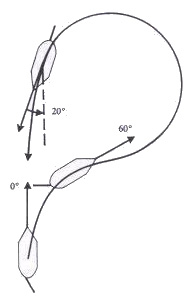
Williamson Turn ....

Get's it's name from the US Navy guy who devised a way to turn a ship onto a reciprocal course literally on same track.

If you just about turn a ship - you cannot regain the old track without going past 180 and then turning back at an estimated position. In the days of the N'Atlantic Convoys that this was devised for - GPS etc. was not around.

So the idea is "fictional scenario" ... Man Overboard ... helm is put hard over to turn stern away from MOB ... (he falls port side - helm to port). Watch compass till 60 deg of course ... helm hard over other way until you reach reciprocal course ... now you can adjust speed / stop etc. as you are near enough on old track but in opp. direction.

The amazing thing is on near all Merchant Ships I was on - it actually works even though different size etc.

There is one drawback with it .... it is imperative that a lookout keeps an eye on the location of the MOB ... with the WT the vessel turns one way then next ... making it hard for Lookout to keep constant eye on casualty.

Many people have concocted various alternatives ... but at end of day WT will usually work.

There is also another advantage with it ... the turfn, then turn other way kills ships speed while still having prop force on rudder ... once turn complete speed is reduced and engine can be brought to stop etc.
 
Re: Turning circles ...

[ QUOTE ]
Canyou please carify what a Williamson turn is, I can guess but i prefer to know the right answer.

Thanks

[/ QUOTE ]

A bit like this:

mob_williamson_turn.jpg
 
Arrrrr but you missed out the bit at the start !

About turn stern away from MOB ......

and the last bit where speed has been killed !!

/forums/images/graemlins/grin.gif /forums/images/graemlins/grin.gif /forums/images/graemlins/grin.gif /forums/images/graemlins/grin.gif
 
Nigel,

Excellent post. I do wish the data was clearer to see. I am surprised in a crash stop (full astern, rudder amidship) that the ship's heading doesn't veer - at least that's what it seems to indicate in the picture. With a single fixed screw, I would think it would stop facing 90 degrees right of where it started. Also the turning data only shows a turn to stbd - I would think the data should be different to port with a single-screw.

It might be pointed out that the Williamson turn does take a long time (relatively) and sets you up on your reciprocal quite a distance from the MOB. In some circumstances, an Anderson turn (just a circle) or a Scharnow turn might be advised. The Scharnow is a reverse Williamson - start with 240 degree turn and reverse rudder back onto reciprocal. I think the RN teaches a plethora of recovery turns, based on wind direction relative to ship's heading.
 
The main thing about the data is that it's the "advance" of ship from start point ... in a crash stop the final heading is not really the point - the distance to stop is the main thing. What is not shown is the crash stop using hard over helm side to side which significantly reduces advance distance.

As to Williamson vs others ... this is where I revert to KISS .... teaching one system keeps all in order ... and the Williamson is an easy one to remember and carry out. I can remember a Danish Captain when I was 2nd Mate ... he had us all up on Bridge for MOB drill ..... C/off, Me, and both 3/offs ..... He demo'd HIS version of the turn ... which I have to say I voiced my concern about - he wasn't too pleased ! So anyway ... bosun and another threw a painted drum over and C/off had to follow Masters turn and get back to the drum .... failed. So over went another drum and it was my turn ... I did a bog standard Williamson and got staright back to my drum and blow me down shortly after to C/offs as well .... then 3/offs had their goes with moderate success using Masters version ... I got in real sh*t with that Capt. for that ... but I spoke privately with him after that OK - he had a reason for HIS version - he was the standing Master for that vessel ... but in event of MOB - I don't want to have to remember fancy other commands ... Williamson showed it worked - good enough for me ... We never did agree or hit it off after that ....

KISS ...... it works !! I do actually disagree about it taking significantly longer ... any delay is outweighed by the act of gaining reciprocal course ....
 
Nigel,

I didn't say it takes "significantly longer"; I said "longer relatively" - I agree about the advantage of coming back on the recip. which is ideal for night/bad sea-state/crummy vis situations. It doesn't necessarily set you up advantageously to provide a lee on the desired side. I realize that may not be a concern on a small boat, but where you are launching a rescue boat on a particular side or you're using a recovery davit on a particular side, it's easier and faster (by a minute or a few) to do a single turn. We always used a "wind ahead turn to red, wind abaft the beam turn to green" memory aid, which was predicated on the rescue boat being on the stbd side. Standard for us was 6 minutes from sound of alarm to MOB being in the rescue boat, receiving 1st aid. That's daytime, good vis - with a night mobex, we always did a Williamson and ten minutes seemed about average. Mind you that involved more time just looking for oscar.
 
no prob ....

in 2 MOB's at sea ... one lost never found .... we reckon he committed suicide during the night ..... second recovered ....within the hour .... that includes boat launch and on-board ....
 
Have done hundreds (if not thousands) of exercises - as OOW, extra eyes on bridge, and even rescue swimmer - but have only witnessed one real MOB. Attempted suicide in the Straits of Juan de Fuca on a night blacker than the proverbial... The cold water made him scream and the aft lookout heard it. Took 45 minutes to recover him on board. Of course he wasn't dressed in the day-glo orange PFD with retro-reflective stripes that the mobex dummy wears, and we had to do a verification muster of all 200 on board to ensure we weren't looking for a seal.
 
Top