Video of a collision between a float plane and powerboat in Vancouver Harbour.

The boat only needed (and seemingly failed) to take avoiding action because the stand-on seaplane had failed to meet its obligations to give way, or not create a conflicting situation in the first place, under the
BS. An aircraft on the point of take-off, as this one was, can do nothing at all to alter its direction.
 
Sea planes usually have variable pitch propeller(s). They can slow down and stop very very quickly with no danger by reversing the pitch on the propeller.
I have seen it done and it is impressive how fast they can stop.
A VP prop (variable pitch) on a small single engine plane does not have pitch reversing (the closest is ground fine pitch on turbine driven props, the flat blades providing the drag after touchdown).

The prop on this aircraft would normally be in full fine (not ground fine as described above) for take off & landing.

Decelerating a single engine plane rapidly, whether it has wheels or floats) carries a huge risk of it going ar£e over tit (aviation equivalent of pitch poling).
 
I think the CTSB report will make interesting reading. Clearly there is some element of fault from both skipper and pilot. But as with many accidents there’s a stack of things that may have contributed:
- unclear guidance “keep clear” is not the same as “prohibited to enter”, does it equate not approach? Or does it mean move out the way of?
- where the rules normally enforced or had complacency crept in
- ATC - quality of the warning about the vessel westbound; not repeating the warning when it was not explicitly acknowledged
- aircraft movements being managed but (small?) boat movements not
- the pilot commencing take off when not safe to do so
- the pilot having restricted visibility during some parts of take off - does that class of aircraft actually need an escort of guard vessel to be safe in busy areas?
- why the boat was there (whilst there are possible legit reasons I wouldn’t be surprised if he was hoping for Instagram gold by capturing the plan take off over him!)
- whether the skipper of the boat understood the developing situation and how he could reduce the risk

Probably would not have made any difference but some form of VTS VHF message could have been useful. We get bombarded with navigation warning on Ch 16 with a follow up on Ch 12 from ferries which at least gives those listening a clue as to what is happening.
Indeed - and the seaplane can operate in Oban bay and is supposed to tell the HM who will broadcast intentions to all vessels.
 
- ATC - quality of the warning about the vessel westbound; not repeating the warning when it was not explicitly acknowledged
- aircraft movements being managed but (small?) boat movements not
There is no air traffic control as such. It's an exchange of information, there are no clearances to be acknowledged at a CTAF airfield. It's how it works in a large part of VFR general aviation. In the UK there are plenty of places you can take off and land without having to use the radio at all, especially farm strips.

Vancouver Coal Harbour seaport is only one step up from a farmers field and "see and avoid" is the MO.
 
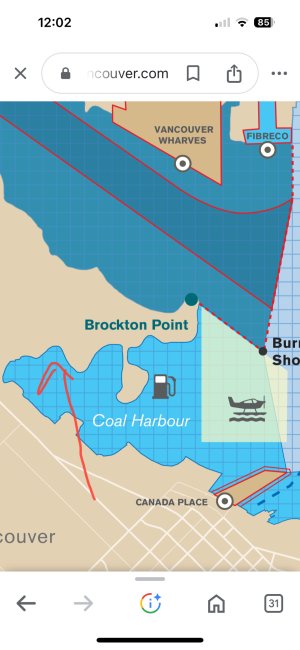
The Vancouver Port Information Guide says aircraft are subject to colregs and recreational boats "are required to keep clear" of the designated area.
I think it is pretty clear that the aircraft cannot have seen the boat at all or the take off would never have started/been abandoned. No pilot continues a take-off with a vehicle threatening to intrude onto the runway. That boat would have been very small indeed to the pilot at the start of the takeoff run - Beavers use a lot of water to get airborne. As said above, pilot on left side, nose high, big cowling between him and the boat, spray all over the screen. Poor beggar didn't have much of a chance though he surely should have been more curious about the traffic warning from the Tower which is on top of a very tall building and thus has a superb view of the water and much better perspective.

KeelsonGraham said:
BS. An aircraft on the point of take-off, as this one was, can do nothing at all to alter its direction.
Correct. Read the wording..."at the point of take-off". That's not the same as half way through the take-off run. Seaplanes practice what are called 'step turns' which are wide, sweeping turn manoeuvres while on the plane (on the step of the floats) but they are in no way a last minute swerve and certainly not carried out at the point of leaving the water when little if any directional change can be made.
In any case a last moment sighting of a boat under the nose would result in an instinctive pull on the yoke to try to hop over the obstructiuon, no way would any pilot try to turn in that situation. That alone indicates that the pilot never had time to react - and almost certainly never even saw the boat.
 
Last edited:
The Vancouver Port Information Guide says aircraft are subject to colregs and recreational boats "are required to keep clear" of the designated area.
I think it is pretty clear that the aircraft cannot have seen the boat at all or the take off would never have started/been abandoned. No pilot continues a take-off with a vehicle threatening to intrude onto the runway. That boat would have been very small indeed to the pilot at the start of the takeoff run - Beavers use a lot of water to get airborne. As said above, pilot on left side, nose high, big cowling between him and the boat, spray all over the screen. Poor beggar didn't have much of a chance though he surely should have been more curious about the traffic warning from the Tower which is on top of a very tall building and thus has a superb view of the water and much better perspective.
A mate of mine (retired Heathrow ATC) was always boasting that air traffic's job was more important than a pilot. I had to explain that if the pilot made a mistake, the pilot dies but if air traffic makes a mistake, the pilot still dies.
 
A mate of mine (retired Heathrow ATC) was always boasting that air traffic's job was more important than a pilot. I had to explain that if the pilot made a mistake, the pilot dies but if air traffic makes a mistake, the pilot still dies.
I had a similar conversation in Swanwick on a number of occasions when discussing safety. I was one of only two people who'd read the ATC manual (although many people referred to the document while quoting imaginary passages) which stated quite clearly that ATC was level 3 while on aircraft was level 5 safety critical. This essentially says that ATC can be down and it's likely nobody will come to harm.
 
The Vancouver Port Information Guide says aircraft are subject to colregs and recreational boats "are required to keep clear" of the designated area.
“The aircraft operations zones marked on the chart are areas of high activity and
operators of recreational vessels or pleasure craft are required to keep clear.”


In italics I’ve put the full quote from the Guide.

I don’t have a definitive chart for this area, I’m afraid, and would like to see one in order to understand the exact scope of the relevant aircraft operations zone.
 
There is no air traffic control as such. It's an exchange of information, there are no clearances to be acknowledged at a CTAF airfield. It's how it works in a large part of VFR general aviation. In the UK there are plenty of places you can take off and land without having to use the radio at all, especially farm strips.

Vancouver Coal Harbour seaport is only one step up from a farmers field and "see and avoid" is the MO.
Presumably the fact there IS a radio exchange though means its required, expected or at the very least customary. There is a human factors issue, not necessarily specific to this event or location, where people have routine conversations but critical information (or the criticality of that information) is not fully understood. Pilots are usually much more disciplined at their radio comms than boats - not simply acknowledging receipt but repeating back the content. I'm not sure if that applies in these settings - if not, perhaps it should, at least with safety critical info. However it seems obvious that if all that communication is only with the aircraft and never to marine traffic there's a missing step. Its surely quite forseeable that a boat may:
- intentionally enter the restricted area to get a closer look at the aircraft
- accidentally enter the restricted area because they don't know it exists, or have misunderstood their location/its limits
- enter the restricted zone with the intention to cross but suffer mechanical or other problems
- enter the restricted zone, then spot an aircraft starting to take off and make a poor decision about how best to avoid it.
 
It looks as though the object is for pleasure craft aiming to get to and from the yacht club/marina (see arrow) to go south of the pale green area.
That was my understanding reading the info, but all of the locals in various clips and comments seem to think boats are allowed through but need to be careful. What's not clear on this, but is on Navionics, is that the north western tip of the green is actually touching the drying part (which I consider to be land!) so a very long way around. The 5kt speed limit is in force within the green, and the light on the north of the green has speed limit signs on all sides (there are many photos online).

Seems some odd decisions and rules in the harbour which may get a rethink and were probably mostly historical and built up over time.
 
That was my understanding reading the info, but all of the locals in various clips and comments seem to think boats are allowed through but need to be careful. What's not clear on this, but is on Navionics, is that the north western tip of the green is actually touching the drying part (which I consider to be land!) so a very long way around. The 5kt speed limit is in force within the green, and the light on the north of the green has speed limit signs on all sides (there are many photos online).

Seems some odd decisions and rules in the harbour which may get a rethink and were probably mostly historical and built up over time.
We used to have a house on the North Vancouver side. We still visit regularly and these days we stay in Coal Harbour. My impression - from quite a bit of casual observation - has always been that pleasure boats generally cut across the float plane area rather than going around it to the south. I may be wrong but that’s the picture that’s in my mind.
 
It is clear that the meaning of 'Keep Clear' in the rule for the designated area is, er, obscure.

Interpretations might include -

1) Boats and ships should keep clear of this area altogether. (Though I think if that were intended, the rule would just say they are prohibitied.)

2) Keep the area generally clear - i.e. no anchoring, fishing, racing, dawdling about in the area, etc., but you may pass through.

3) Keep clear not of the area but of seaplanes within it and their manoeuvres.
 
Top